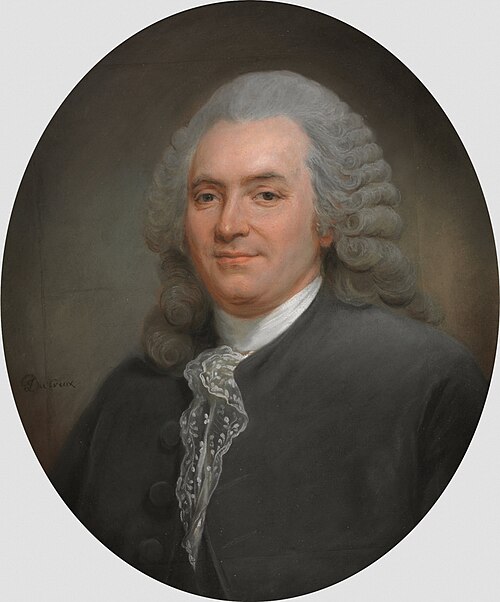
1727–1781 · French
Anne-Robert-Jacques Turgot
Diminishing returns, a theory of capital and interest a century early - and twenty months as finance minister spent trying to reform France before it broke.
The idea in one paragraph
Most economists on this site only wrote about policy. Turgot got to run the experiment - on France, with the clock ticking. His economics said wealth comes from saving and investment, that piling more effort onto the same field eventually yields less and less, and that markets clogged with privilege - guilds, tolls, forced labor, tax exemptions for the rich - make everyone poorer. As Louis XVI's finance minister he acted on all of it at once: freed the grain trade, abolished the guilds, ended forced peasant labor. Twenty months later he was fired, the reforms were rolled back, and France kept its appointment with 1789. He is the man who tried to prevent the French Revolution with economics.
The world they lived in
The France Turgot served was rich in everything except money and fairness. The crown was staggering under war debts, yet the nobles and clergy who owned much of the land were largely exempt from the main taxes, and collection of what was owed was outsourced to profit-seeking tax farmers. Peasants owed the corvée - weeks of unpaid forced labor building royal roads. In the towns, guilds decided who could bake bread or make hats, at what price, under rules centuries old. Grain could barely move between provinces, so one region could starve while another sat on a surplus, and every bad harvest became a political crisis.
Turgot was born in Paris in 1727, a third son destined for the Church, and abandoned theology for administration and the company of the Enlightenment philosophes. He absorbed free-market ideas from Vincent de Gournay - the merchant-official whose circle popularized the phrase laissez-faire - and from Quesnay's physiocrats, though too independent to be anyone's disciple. As intendant (royal governor) of the poor Limoges region from 1761 to 1774, he tested his ideas in miniature: fairer tax rolls, roads built by paid labor, free movement of grain. Then, in 1774, a new twenty-year-old king reached for the most capable administrator in France.
What they argued
His Reflections on the Formation and Distribution of Riches (1766) - written up, the story goes, for two visiting Chinese students - packs a startling amount of modern economics into a hundred short sections. Its hero is capital: someone has to save before anyone can plow, build, or stock a workshop, so savings are the fuel of everything. A saver can buy land, lend at interest, or back a farm, a factory, or a trading voyage, and because money chases the best deal, returns across these uses get pulled toward one another. The interest rate, in Turgot's account, is simply the price of saved funds, set by supply and demand like the price of anything else - which is why he called usury laws capping interest as futile as decreeing the price of wheat - in an era when lending at interest was still officially sinful.
His most famous insight came in a 1767 commentary on a prize essay by Saint-Péravy. Add doses of investment to a plot of land - more seed, more manure, more labor - and output rises, at first faster and faster, then more and more slowly, until one last dose adds nothing at all. Any gardener knows it: the second bag of fertilizer helps less than the first. This is diminishing returns, stated with a precision economists wouldn't match until the marginal revolution a century later, and it became one of the load-bearing walls of the entire discipline.
Then came the experiment. Named Controller-General of Finances in August 1774, Turgot handed Louis XVI a program of almost reckless clarity - no bankruptcy, no new taxes, no new borrowing - and cut court expenses to make it arithmetic rather than rhetoric. Within weeks he freed the internal grain trade, betting that grain flowing to where prices were high would end the old cycle of local famine. The bet was immediately stress-tested: a bad harvest sent flour prices up, and in the spring of 1775 riots - the "Flour War" - broke out across northern France. Turgot held the line and kept the trade free.
In January 1776 he went further, submitting his Six Edicts. The two that mattered were dynamite: one abolished the corvée, replacing forced peasant labor with a money tax on landowners - including the privileged orders - and the other abolished the guilds, opening the trades to anyone willing to work. Together they attacked the principle that some Frenchmen were born exempt. The Parlement of Paris refused to register the edicts; the court, the financiers, and Marie-Antoinette's circle closed ranks; and Turgot, never one to sweeten a warning, reminded the king in writing that weakness had brought the head of Charles I of England to the block. Louis forced the edicts through, then lost his nerve. In May 1776 Turgot was dismissed. Nearly everything he had built was reversed within months.
Where it breaks down
Turgot never fully shed the physiocratic frame he worked within. Like Quesnay, he treated land as the ultimate source of society's net surplus and leaned toward loading taxation onto it - and Adam Smith's critique of that whole system in The Wealth of Nations lands on Turgot too: its "capital error" was calling manufacturers and merchants "barren and unproductive," when workshops plainly generate surpluses of their own. The irony: Turgot's own theory of capital, with returns arising in industry and commerce as surely as in farming, pointed past the doctrine he officially held. He was, in a sense, refuted by his best chapter.
The sharper attacks were practical. His rival and successor Jacques Necker argued, in a book published mid-crisis in 1775, that freeing the grain trade in a subsistence economy, with no reserves and no cushion for the poor, gambled with people's bread; the Flour War made his case in burning granaries. And historians echo the critique contemporaries made in real time: Turgot tried to do everything at once, on principle, without building allies, softening opponents, or compensating losers. Being right, it turns out, is not a political strategy.
Lasting influence
The ideas outlived the ministry. Diminishing returns became foundational - it underpins Malthus on population, Ricardo on rent, and the production functions in every modern growth model. His account of saving, capital, and interest ran so far ahead of its time that Joseph Schumpeter ranked his analytical achievement among the greatest in the field, and the Austrian school, down to Murray Rothbard, claims him as an ancestor for treating interest as a price rather than a moral failing. Smith, who met Turgot in Paris in 1766, carried more than a little of him into The Wealth of Nations.
The larger legacy is the counterfactual that history keeps turning over. Turgot's program - spread the tax burden to the privileged, free the internal market, stop borrowing - was a fair sketch of how France might have avoided bankruptcy, and it was the bankruptcy of 1788 that forced the calling of the Estates-General. Thirteen years after his dismissal, the Revolution abolished the corvée, the guilds, and noble tax privilege anyway - without asking nicely. Every reforming finance minister since has walked his tightrope between what the arithmetic demands and what the powerful will allow - and most have discovered which side usually wins.