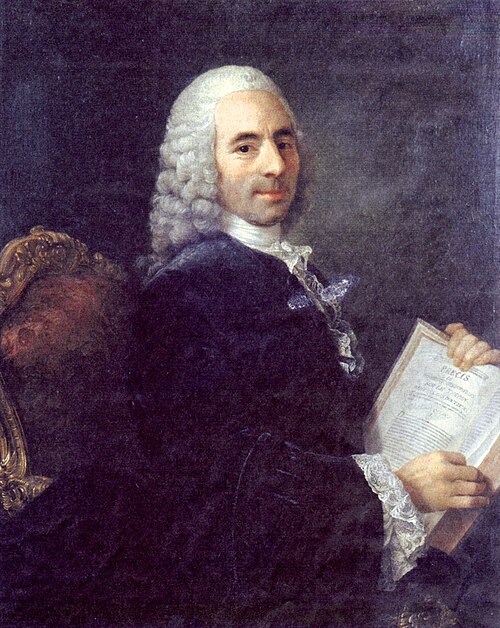
1694–1774 · French
François Quesnay
The Tableau Économique - the first picture of an economy as a circular flow - and the conviction that the whole machine runs best when left alone.
The idea in one paragraph
Quesnay spent his career as a royal physician, and he looked at the economy the way a doctor looks at a patient: what matters is circulation. Money and goods move in a loop - farmers grow food, landlords spend the rent, craftsmen turn wool into coats, and the spending flows back to the farms to start the cycle again. Wealth isn't a pile of gold; it's this flow, renewed every harvest. Quesnay believed only agriculture added new wealth to the loop, and that the kingdom's endless taxes and tolls were tourniquets on its own arteries. The prescription followed: take the pressure off, and let the blood move.
The world they lived in
Mid-1700s France was the largest, most populous kingdom in western Europe, and nearly all of it was farmland worked by peasants carrying burdens their great-grandfathers would have recognized. The crown, permanently short of cash, didn't even collect its own taxes: it sold the right to a private syndicate, the Ferme Générale, whose "tax farmers" paid the king up front and then squeezed the countryside for everything above that. Nobles and clergy were largely exempt, so the load fell on those least able to carry it. Grain moving from one French province to another paid tolls as if crossing into a foreign country, and the state's energy went into mercantilist projects - subsidized luxury manufactures, hoarded gold - while the farms that fed everyone decayed.
Quesnay watched all this from the strangest of vantage points: Versailles. Born in 1694 outside Paris to a farming family, largely self-taught, he rose from village surgeon to physician to Madame de Pompadour and then to Louis XV himself. He didn't publish a word of economics until he was past sixty - two articles on farming for the great Encyclopédie in 1756 and 1757 - but his rooms in the palace became a salon where a circle of devoted followers formed around him: Mirabeau the elder, Du Pont de Nemours, Mercier de la Rivière. They called themselves les économistes; history calls them the physiocrats - "the rule of nature" - and they were the first true school of economics: one master, one doctrine, actual disciples.
What they argued
The Tableau Économique (1758) was something genuinely new: a model of an entire economy on a single page. Drawing on Richard Cantillon's earlier sketch of income circulating between classes, Quesnay drew a zigzag of numbers tracing how money flows between three groups - the productive class (farmers), the proprietors (landlords), and what he bluntly called the sterile class (artisans and merchants). Rent arrives in the landlord's pocket; half goes to food, half to manufactured goods; craftsmen spend their earnings on food and raw materials; the money flows back to the farms, whose surplus pays next year's rent. The insight: an economy is a circuit - you can trace who pays whom, and predict what happens to everyone when one flow gets pinched.
The engine of the circuit was what Quesnay called the net product. Sow one sack of seed and harvest five: agriculture, he argued, is the only activity that returns more than it consumes, because nature works alongside the laborer for free. A weaver, by contrast, turns wool worth so much into cloth worth the wool plus his keep - useful, honorable, but "sterile" in Quesnay's technical sense: no surplus left over. Everything the kingdom does beyond feeding itself - the armies, the cathedrals, Versailles - is financed, in the end, out of that agricultural surplus.
If that's true, a striking conclusion about taxes follows. Tax anything you like - salt, cloth, doorways - and the burden trickles through the circuit until it lands on the net product anyway; the only difference is how many tax farmers take a cut along the way. So Quesnay proposed replacing the whole extortionate jungle with a single, transparent tax on land rent, paid by the landlords who collected the surplus. And since the surplus was the seed corn of national wealth, agriculture needed feeding, not bleeding: abolish internal tolls, allow free trade in grain (even for export), and let good prices draw capital - what Quesnay called "advances" - back into the soil.
The policy attitude got a slogan that outlived everything else: laissez faire, laissez passer - let it be done, let it pass. The physiocrats believed the economy had a natural order, knowable like the circulation of the blood, and that government's job was to protect property, keep order, and otherwise stand aside. His disciples were not restrained: Mirabeau ranked the Tableau with writing and money among humanity's three great inventions. Visitors were more measured, but they kept coming - including, in 1766, a Scottish tutor named Adam Smith.
Where it breaks down
Smith himself delivered the definitive critique, and he delivered it gently, since he thought the physiocratic system - "with all its imperfections" - was the closest thing to truth yet published in political economy. But its "capital error," he wrote in The Wealth of Nations, was treating artisans, manufacturers, and merchants as "altogether barren and unproductive." A workshop plainly can produce a surplus above what it consumes - Britain's factories were about a generation away from making that undeniable - and once manufacturing yields a surplus too, the case for taxing land alone collapses with it. The single tax was elegant arithmetic built on a false premise.
Modern historians of economics add a methodological complaint: Quesnay had his conclusion before he had his diagram. The Tableau wasn't derived from evidence that only farms yield surpluses; it was constructed to illustrate a doctrine he already held. And the school's sect-like devotion - one master, no dissent - struck contemporaries as more church than science; Smith noted it dryly, and even Turgot, the movement's greatest practical ally, kept careful distance from full membership.
Lasting influence
The doctrine died; the diagram conquered the world. The circular-flow picture in the first chapter of every economics textbook is the Tableau with the sterile-class doctrine removed, and the logic of tracing flows between sectors runs straight into modern GDP accounting, which measures a nation's wealth exactly as Quesnay insisted - as an annual flow, not a hoard. Wassily Leontief's input-output tables, which earned a 1973 Nobel Prize and still underpin how statistical agencies map economies, are the Tableau rebuilt with matrices and computers. Karl Marx, no friend of landlords, called the Tableau "an extremely brilliant conception" in Theories of Surplus-Value - his own models of how an economy reproduces itself descend from it.
The rest of the legacy scattered widely. Laissez-faire became the banner of a whole tradition that Quesnay would only partly recognize. Smith absorbed the physiocrats' respect for natural liberty and their focus on real production over gold; according to his first biographer, Dugald Stewart, Smith would have dedicated The Wealth of Nations to Quesnay had the doctor not died two years before it appeared. And the single tax on land refused to stay buried: a century later Henry George revived it and built a worldwide movement on the idea. Not bad for a physician who took up economics at sixty.