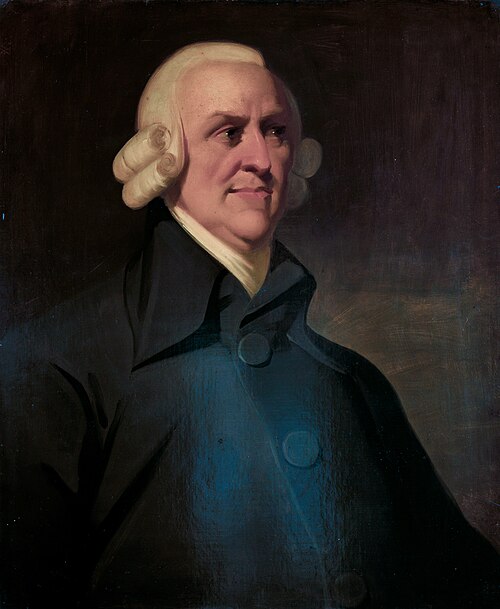
1723–1790 · Scottish
Adam Smith
The invisible hand - self-interested trade, steered by prices, can organize a society better than any planner.
The idea in one paragraph
Nobody woke up this morning planning to get you breakfast. Yet the coffee was roasted, the bread was baked, and the milk arrived on time - because thousands of strangers, each just making a living, were coordinated by nothing more than prices. That was Adam Smith's great claim: self-interest, channeled through voluntary exchange, produces cooperation on a scale no king could command. A nation's wealth isn't the gold in its vaults; it's the flow of things its people make, and that flow grows when work is divided, trade is free, and government sticks to the jobs markets can't do. The invisible hand isn't magic. It's what markets do when you let them.
The world they lived in
Smith was born in 1723 in Kirkcaldy, a small Scottish port town, and raised by his widowed mother. A customs officer's son growing up beside a harbor, he spent his childhood watching trade - and, just as instructively, watching the elaborate machinery built to obstruct it. He came of age during the Scottish Enlightenment, a remarkable burst of thinking that gave the world David Hume (Smith's closest friend), modern geology, and a general conviction that society could be studied as carefully as the stars. By his late twenties Smith was a professor of moral philosophy at Glasgow, lecturing on everything from ethics to law to what we'd now call economics.
The reigning economic doctrine of his day was mercantilism, and it held that a nation grew rich the way a miser does: sell much, buy little, hoard the gold. Governments acted accordingly. Imports were punished with duties, colonies existed to be milked, guilds decided who was allowed to make hats, and royal monopolies like the East India Company were handed entire continents of trade. Everywhere Smith looked, well-connected merchants had persuaded the state that what was good for them was good for the nation.
In the 1760s, a well-paid stint tutoring a young duke took Smith to France, where he met the Physiocrats - thinkers who already suspected that economies run best when left alone. He came home to Kirkcaldy and spent roughly a decade writing his answer to mercantilism. The Wealth of Nations appeared in 1776, the same year Britain's American colonies - chafing, in part, under exactly the trade restrictions Smith was attacking - declared independence.
What they argued
The pin factory
Smith opens his great book not with a theory but with a factory tour. One untrained worker making pins alone, he reckoned, might struggle to finish twenty in a day. But ten workers who split the job - one draws the wire, another straightens it, a third cuts it, a fourth points it - could turn out around 48,000 pins a day. That's not a 10x improvement; it's more like a 200x improvement per person. This is the division of labor, and Smith put it at the very foundation of prosperity: we get rich by specializing. And specialization is only worth doing if you can trade your pins for everything else you need - so the bigger the market, the finer the division of labor, and the richer everyone gets. It's the logic that runs from his pin factory straight to the global supply chain behind your phone.
Not from benevolence
"It is not from the benevolence of the butcher, the brewer, or the baker that we expect our dinner," Smith wrote, "but from their regard to their own interest." This is the most famous sentence in economics, and the most misread. Smith isn't celebrating selfishness - he spent his whole other career writing about sympathy and conscience. He's making a practical observation: in a big society you mostly deal with strangers, and you can't run a civilization on favors from strangers. Trade solves this. You appeal not to the baker's charity but to her incentive: give me bread, and I'll give you something you want more. Both sides walk away better off, and nobody had to be a saint.
The invisible hand
Put those two ideas together and something remarkable falls out. Each person, "intending only his own gain," is - in Smith's phrase - "led by an invisible hand" to promote ends that were no part of his intention. When bread gets scarce, its price rises; bakers bake more and shoppers waste less, and nobody needed to issue a decree. A price is a price signal - a compressed message about scarcity that travels further and faster than any official report. Smith actually used the famous phrase only once in The Wealth of Nations, but it names the book's deepest idea: markets convert millions of private choices into public order, without anyone being in charge.
Wealth is what you can buy, not gold
Against the mercantilists, Smith argued that a nation's wealth is its annual produce - the stream of goods and services its people can actually consume - not the pile of treasure in the royal vault. From this everything else follows. A tariff that "protects" domestic candle-makers doesn't enrich the nation; it forces everyone to overpay for candles to benefit a lobby. It's "the interest of the great body of the people to buy whatever they want of those who sell it cheapest" - a rule Smith noted would seem too obvious to state if merchants hadn't spent so much money making it sound controversial. Free trade, in Smith's telling, isn't a favor to foreigners; it's ordinary shopping sense scaled up to nations.
What government is for
Smith is often shelved as the patron saint of laissez-faire, but he gave government real work: defend the country, run honest courts, and build the roads, bridges, and schools that are worth having but that no merchant can profit from building. He supported publicly funded education partly because he worried repetitive factory work would dull people's minds - hardly a man who thought markets fix everything. He also laid down four famous maxims of taxation - taxes should be proportionate to ability to pay, predictable rather than arbitrary, convenient to pay, and cheap to collect - which still read like a checklist your tax code fails. And he never trusted businessmen with power: "people of the same trade seldom meet together," he warned, without the conversation ending in "a conspiracy against the public." Smith favored markets because he distrusted the powerful, merchants included.
The other book
Seventeen years before The Wealth of Nations, Smith published The Theory of Moral Sentiments, and he revised it until the year he died. It asks how self-interested creatures manage to be decent, and answers: sympathy. We constantly imagine how our conduct looks to an "impartial spectator" - an internalized fair-minded observer, something like a conscience with good manners. For Smith the two books were one project: markets don't float free of morality; they work because they're embedded in a society of people who want, as he put it, not only to be loved but to be lovely.
Where it breaks down
Smith never quite nailed down what makes things valuable. In places he suggested value comes from the labor embodied in a good - the labor theory of value - a loose thread his successors pulled in opposite directions. Karl Marx ran it to the conclusion that profit is extracted from workers; the marginal revolution of the 1870s (Jevons, Menger, Walras) dropped it entirely, arguing value is subjective and set at the margin. On this point, later economists - Marxist and mainstream alike - agree Smith was muddled.
The invisible hand also has well-documented tremors. When my factory's pollution lands in your lungs, the price system carries no signal about it - the problem economists after Arthur Pigou call an externality. Modern critics like Joseph Stiglitz add that when one side of a deal knows much more than the other (think used cars, or health insurance), markets can misfire in ways Smith's framework didn't anticipate. And John Maynard Keynes argued that whole economies can get stuck - that the self-correcting machinery Smith's heirs took for granted can jam for years, as it did in the 1930s.
Two further critiques are more contested. Nineteenth-century German scholars alleged a "Das Adam Smith Problem": the sympathy-driven Smith of Moral Sentiments supposedly contradicts the self-interest-driven Smith of The Wealth of Nations. Most modern Smith scholars consider this resolved - the books address different spheres of life - but the debate resurfaces regularly. And historian Emma Rothschild has argued (contested) that Smith meant "invisible hand" half-ironically, and would be startled by the theological weight the phrase now carries. What's not contested: Smith was a far more cautious, government-friendly, merchant-suspicious thinker than the bumper-sticker version of him.
Lasting influence
Economics as a discipline essentially starts with Smith; for a century, being an economist meant annotating him. His free-trade case won its great political victory when Britain repealed its protectionist Corn Laws in 1846, and it lives on in every trade agreement and in institutions like the WTO. His four tax maxims still show up, lightly reworded, in treasury design documents. The phrase "invisible hand" long ago escaped economics entirely - and Smith himself spent over a decade as the face of the British £20 note, an honor he'd have appreciated: careful about money, made of paper, valuable only because everyone agrees it is.
His descendants quarrel over the estate. Free-marketeers from Friedrich Hayek to Milton Friedman claim him as their founder - there's a think tank named after him - while center-left economists point to his support for public schools, his suspicion of monopolists, and his sympathy for workers. Both claims hold up, which tells you something. Two and a half centuries later, when your barista, your landlord, and a container ship from Shanghai coordinate your morning without a coordinator, you're living inside Smith's argument.