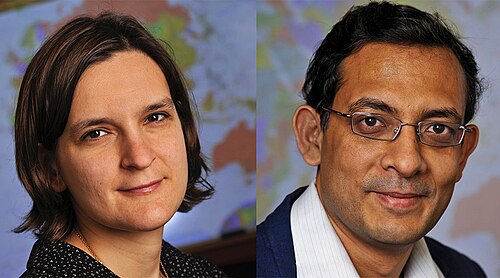
1961–present · Indian-American & French-American
Esther Duflo & Abhijit Banerjee
The randomista revolution - testing anti-poverty ideas with randomized trials, one concrete question at a time.
The idea in one paragraph
For decades, the fight against global poverty ran on grand theories and gut feelings: more aid or none, big dams or free markets. Esther Duflo and Abhijit Banerjee asked a smaller, sharper question: does this particular thing work? Borrowing the randomized trial from medicine, they split villages into treatment and comparison groups and measured what actually changed. Their answer, built experiment by experiment: the poor are sophisticated decision-makers navigating brutal constraints, and small, well-tested fixes can move mountains. The approach won them the 2019 Nobel Prize - making Duflo, at 46, the youngest economics laureate ever.
The world they lived in
They reached the same idea from opposite ends of the world. Banerjee was born in Mumbai in 1961 and raised in Kolkata, the son of two economics professors, in a home bordering a slum whose children he played with - an early lesson that the poor were neighbors, not abstractions. He studied in Kolkata and Delhi, took a Harvard PhD in 1988, and became a star theorist at MIT. Duflo, born in Paris in 1972 to a pediatrician mother who treated child victims of war, began as a historian until a year in 1990s Moscow convinced her that economics offered a historian's questions with a lever attached. She came to MIT, where Banerjee co-supervised her 1999 PhD; they married in 2015.
The field they entered was exhausted by its big debates. Rich countries had spent hundreds of billions on aid while the loudest voices argued about all of it at once: Jeffrey Sachs claimed a "big push" could end poverty; William Easterly countered that aid bred dependency and corruption. Both sides had theories, anecdotes, and no way to settle anything. Medicine had solved the same problem in the 1940s with the randomized controlled trial; nobody had seriously tried running policy that way. In 2003, Banerjee, Duflo, and their colleague Sendhil Mullainathan founded the Abdul Latif Jameel Poverty Action Lab (J-PAL) at MIT to do exactly that.
What they argued
Start in Udaipur district, Rajasthan, where fewer than one child in twenty was fully immunized - despite free vaccines. Why? Grand theories offered answers (fatalism! ignorance!), but Banerjee and Duflo ran a test with the NGO Seva Mandir instead. Some randomly chosen villages got a reliable monthly vaccination camp; others got the camp plus a small incentive - about a kilo of lentils per shot. Reliable camps alone tripled full immunization, from 6% to 18%. Adding the lentils - worth less than a dollar - pushed it to 39%. Parents weren't against vaccines; they were busy, stretched, prone to putting things off - like everyone. A bag of lentils made today the easy day. That is the method in miniature: don't debate human nature - randomize, measure, and be surprised.
The experiments kept puncturing confident beliefs. Take mosquito nets, subject of a famous fight: aid skeptics insisted people don't value what's free - sell nets cheaply and they'll actually be used. Jessica Cohen and Pascaline Dupas, economists in the J-PAL orbit, tested it in Kenya: charging pregnant women even 75 cents cut take-up by about three-quarters, and women who got free nets used them just as much as those who paid. Or take village schools in India, gutted by teacher absenteeism: Duflo and coauthors gave schools tamper-proof cameras and tied pay to showing up. Absence fell from 42% to 21%, and test scores rose - no sermon about vocation, just demand and supply of effort plus a cheap camera.
Poor Economics (2011) assembled fifteen years of such findings into a portrait of how poor people actually live - and its central claim is the opposite of condescending. A family on 99 cents a day makes more financial decisions, under more pressure, than most hedge fund managers: which child's schooling to bet on, whether fertilizer now beats a funeral debt due next month. If they sometimes buy a television before more calories, it's because life without one is crushingly boring. The poor lack money, not judgment - but they also lack the invisible scaffolding the rich take for granted: piped water, automatic savings, pensions, vaccines that arrive without effort. The rich don't have to decide to be healthy; the poor decide daily.
The deeper argument was about how economics should be done. Rather than cathedral-sized questions - why are nations poor? what makes GDP grow? - they asked plumber-sized ones with checkable answers, in the spirit of Amartya Sen's insistence that development means expanding what real people can do. Duflo embraced the modest job description: economists should be less like physicists and more like plumbers - installing things in the real world, watching what leaks, fixing it.
Where it breaks down
The sharpest critique came from fellow Nobel laureate Angus Deaton: randomized trials answer a narrower question than advertised. A result proves a program worked there, then, with that NGO - not that it will work when a government scales it nationwide with less devoted staff. The "external validity" problem is real, and Duflo and Banerjee partly accept it; their reply - replicate across contexts, study mechanisms - helps, critics say, but quietly reintroduces the theorizing the method claimed to escape. Whether RCT results generalize remains contested.
Second, ethics. Experimenting on poor people - lentils for some villages, bednets charged to some mothers while neighbors get them free - strikes some critics as using the world's most vulnerable as a laboratory, with looser consent standards than medicine would tolerate. Defenders reply that rolling out untested programs on everyone is just an experiment without a control group; the debate continues.
Finally, the "small questions" objection, pressed by the development economist Lant Pritchett: nothing in history has reduced poverty like broad economic growth - China moved hundreds of millions with no randomized trials at all - and the randomista movement, he argues, diverts talent from the growth, trade, and migration questions that matter most, precisely because they can't be randomized. Banerjee and Duflo's answer, in Good Economics for Hard Times, is candid: economists don't actually know how to switch on growth, so improving lives directly and measurably is not a consolation prize. Contested - vigorously.
Lasting influence
The 2019 Nobel, shared with their collaborator Michael Kremer, certified a revolution in method: the randomized trial went from curiosity to the default tool of development economics. Duflo was the youngest laureate in the prize's history and only its second woman - after Elinor Ostrom, another economist who insisted on looking closely at how poor communities actually work. J-PAL grew into a global network; programs it evaluated and helped scale - remedial tutoring, deworming, free bednets - have reached hundreds of millions of people, and governments from Indonesia to Peru now run policy pilots the way drug companies run trials.
The quieter legacy is a change in posture. Aid debates once sounded like theology; at their best they now sound like engineering, and the poor appear in economics not as victims but as decision-makers whose choices, closely observed, make sense. Banerjee and Duflo turned "does it work?" from a rhetorical question into a research program; it is hard to imagine the field going back.