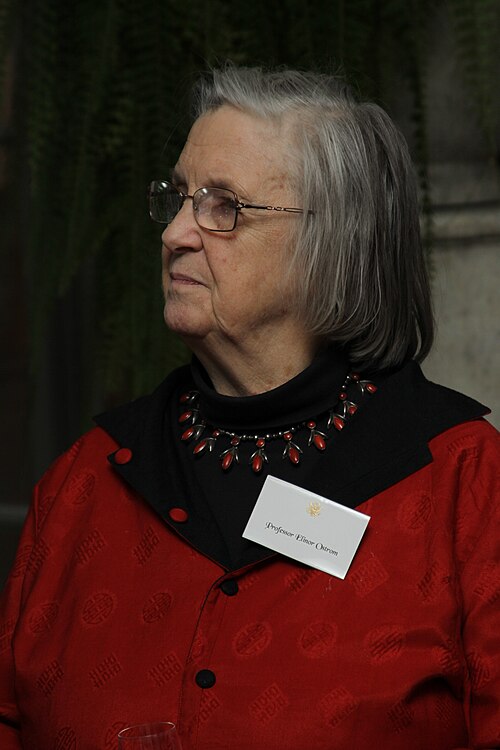
1933–2012 · American
Elinor Ostrom
Governing the commons - real communities manage shared resources for centuries without privatizing them or calling in the state.
The idea in one paragraph
Economics textbooks long taught that a shared resource - a pasture, a fishery, a water supply - is doomed: everyone grabs, nobody protects, the resource collapses. That's the "tragedy of the commons," and the standard prescriptions were to privatize it or put the government in charge. Elinor Ostrom did something radical: she went and looked. Around the world she found communities managing shared pastures, forests, and irrigation systems successfully for centuries - with rules they wrote themselves, and neither private owners nor state regulators in sight. For showing there is a third way between market and state, she became, in 2009, the first woman ever to win the Nobel Prize in economics.
The world they lived in
Elinor Ostrom was born in Los Angeles in 1933, a Depression-era kid. When she applied to UCLA's economics PhD program, she was turned down - as a girl she'd been steered away from the math courses the department required. She did her doctorate in political science instead; the discipline's first female Nobel laureate never held an economics degree. Her dissertation studied how water users around Los Angeles stopped saltwater from ruining their shared groundwater basin - her first commons. With her husband Vincent Ostrom she moved to Indiana University, founding in 1973 the Workshop that grew into the "Bloomington school," a close cousin of James Buchanan's public choice tradition.
The intellectual weather was set by a single essay, the biologist Garrett Hardin's "The Tragedy of the Commons" (1968). Hardin imagined herders on a shared pasture, each adding one more cow because the gain is theirs and the overgrazing is everyone's, until the pasture dies. The moral seemed obvious, and it fit the Cold War's tidy menu: either give the pasture a private owner with an incentive to protect it, or hand it to the state. Governments acted on it, sometimes seizing village forests and fisheries to save them. Ostrom's question was simple and devastating: is that actually what happens?
What they argued
Look closely at Hardin's doomed herders, Ostrom said, and you'll notice something odd: they never talk. They can't make agreements, monitor neighbors, or punish cheats - strangers trapped in a game. Real herders are neighbors who know exactly whose cows are on the meadow. Ostrom's crucial distinction was between an open-access resource, which truly is up for grabs, and a commons, which has a defined community of users who can organize. Confuse the two and you'll predict tragedy where people have quietly been preventing it for centuries.
Her evidence was gloriously concrete. In the Swiss Alpine village of Törbel, farmers have shared summer pastures under written rules dating back to 1483 - including the elegant "wintering rule": you may graze no more cows on the common meadow than you can feed from your own land over the winter. Self-limiting, self-enforcing, and still working after five centuries. In Valencia, Spain, farmers of the irrigated huerta have settled water disputes through an elected tribunal of fellow irrigators that has met outside the cathedral for about a thousand years; gossip does half the enforcement. Off Maine, lobster crews studied by the anthropologist James Acheson divided fishing grounds through informal "harbor gangs" that kept the stock healthy while open-access fisheries nearby crashed. None of this is romantic anarchism: these are institutions, with boundaries, rules, and teeth.
From dozens of such cases - successes and failures - Ostrom distilled what makes self-governance last. Durable commons have clear boundaries: everyone knows who's in and what's shared. Their rules fit local conditions rather than a distant blueprint, and the people who must follow the rules get a real say in changing them. Monitors accountable to the users watch for cheating, and punishment starts small - a warning, a token fine - escalating only for repeat offenders. Disputes get settled quickly and cheaply, close to home; crucially, outside governments let all this stand. Larger systems, like a river basin serving many villages, work as nested layers of small units cooperating upward. She called this polycentric governance: many centers of decision-making rather than one grand controller. Readers of Friedrich Hayek will hear an echo - knowledge lives locally - though her answer was collective rule-making, not only prices.
Just as distinctive was the method. While much of economics reasoned from blackboard models, Ostrom went fieldwork first: count the cows, read the bylaws, interview the fishermen - then build theory and test it in laboratory games. Her conclusion was aimed at intellectual tidiness itself: there are no panaceas. Public goods and externalities don't automatically require a government fix, and shared resources don't automatically require an owner. The interesting question is always which institutions fit this resource, these people, this place. It depends - and she made "it depends" rigorous.
Where it breaks down
The honest caveats start with scale. Ostrom's star cases are small, stable communities where everyone knows everyone - face-to-face monitoring, lifelong reputations. The gravest modern commons problem, the global climate, has none of that: billions of strangers, no shared cathedral steps. Ostrom acknowledged this and urged a polycentric response - cities, nations, and firms acting in overlapping layers rather than waiting for one global treaty - but whether that can substitute for a binding global agreement remains contested.
Second, a selection problem, raised within the commons literature itself: communities that governed their resources well survived to be studied, while the failures left behind ruined pastures and no bylaws to read. Counting mostly survivors risks overstating how often self-governance works - a critique Ostrom took seriously, though critics argue the balance sheet is still incomplete.
Finally, mainstream economists note that her framework is better at explaining than predicting. The design principles describe long-lived commons but don't tell a policymaker in advance when a community will self-organize and when property rights or state regulation are the better tools. Tradable fishing quotas - a market fix - have rescued fish stocks where informal norms failed. Ostrom would have happily agreed that markets sometimes win; her point was that they don't win by default.
Lasting influence
The 2009 Nobel - shared with Oliver Williamson, a student of transaction costs in the tradition of Ronald Coase - made Ostrom the first woman laureate, and one of the few winners whose evidence smelled of hay and seawater. The committee's citation was almost a manifesto: economic governance happens beyond markets and states.
Her fingerprints are now everywhere resources are shared. Community forestry in Nepal and Mexico, fisheries co-management from Chile to Japan, and irrigation reform across Asia all draw on her design principles - as does the study of newer commons she helped pioneer late in life: open-source software, Wikipedia, shared scientific knowledge. Development agencies that once defaulted to nationalize-or-privatize now ask her question first: what are the local users already doing? She died in June 2012, working almost to the last day, months after Time named her among the world's hundred most influential people. In this site's long argument between market and state, Ostrom stands calmly in the middle holding a clipboard, pointing out that ordinary people, allowed to write their own rules, keep solving the problem the theorists called unsolvable.