Development & experimental economics
1990–todayTest what actually reduces poverty, one randomized trial at a time.
The big idea
How do poor countries become rich, and how do poor people become less poor? For decades, economists answered with grand theories argued from armchairs. The modern answer is humbler: often, we don't know until we test. Borrowing the randomized controlled trial from medicine, experimental development economists split villages, schools, or families into a group that gets a program and a group that doesn't, then measure what actually changes. Do textbooks raise test scores? Do free bed nets get used, or do people only value what they pay for? Instead of debating incentives in theory, run the experiment. The ambition shrank from "solve poverty" to "find out what works" - and that turned out to be a kind of power.
When and why it rose
Postwar development economics thought big. "Big push" theorists argued poor countries were stuck in a trap only a massive coordinated investment could spring; decades later the Washington Consensus prescribed the opposite medicine - privatize, liberalize, balance the budget. Both were sweeping, confident, and hard to test, and by the 1990s the record was sobering: some star pupils stagnated while rule-breakers like China boomed.
Amartya Sen reframed the question itself. Development, he argued, isn't a GDP number - it's the expansion of people's real capabilities: to be healthy, educated, and free to shape their own lives. A country can grow while its citizens can't read; famines, his research showed, happen in places with food but without democracy. His capabilities approach won the Nobel in 1998 and built the UN's Human Development Index.
Then came the randomistas. Esther Duflo and Abhijit Banerjee co-founded J-PAL at MIT in 2003 and, with Michael Kremer, ran hundreds of randomized trials across the developing world - on deworming, microcredit, teacher absenteeism, chlorine dispensers. The trio's Nobel came in 2019, for transforming how the field asks questions.
What it got right
Evidence over ideology - that's the revolution's honest core. Trials punctured comfortable stories on every side: microcredit, once hailed as a miracle, turned out to modestly help some businesses but not lift households from poverty; free bed nets, which skeptics said would be wasted, got used just fine. Governments and NGOs now scale programs - like "teaching at the right level" in Indian schools - because trials showed they work, not because they sounded good. And Sen's reframing means nobody serious now measures development by GDP alone.
Where it fell short
The sharpest critic is a fellow Nobelist. Angus Deaton argues that a trial's result travels badly: what worked in Kenyan villages may fail in Indonesian cities, because the experiment tells you that something worked there, not why - the external validity problem. Others add the "small questions" charge: you can randomize textbook distribution, but not central banks, trade policy, or the institutions that actually made nations rich - so the method quietly steers the field toward what's testable rather than what's biggest. There are ethical prickles too (who consents to being the control group?). Duflo and Banerjee's reply is characteristically modest: grand theories had their century, and small answers that are true beat big answers that aren't.
Its fingerprints today
The Human Development Index on every country comparison is Sen's. J-PAL-tested programs have reached hundreds of millions of people, and "what does the RCT evidence say?" is now a standard question at aid agencies, education ministries, and charities - the effective altruism movement runs largely on this fuel. The randomistas' deepest legacy may be a habit of mind: in a field once ruled by confident grand theory, "let's test it" became a respectable, even prestigious, answer.
Key figures

Amartya Sen
1933– · Indian
Famines are about entitlements, not food shortages - and development means expanding what people can do and be.
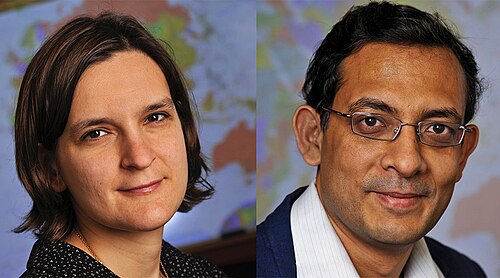
Esther Duflo & Abhijit Banerjee
1961– · Indian-American & French-American
The randomista revolution - testing anti-poverty ideas with randomized trials, one concrete question at a time.