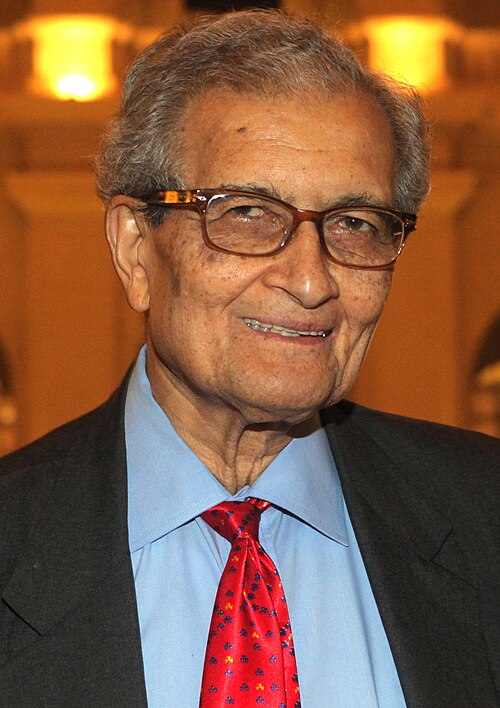
1933–present · Indian
Amartya Sen
Famines are about entitlements, not food shortages - and development means expanding what people can do and be.
The idea in one paragraph
In 1943, a nine-year-old boy in Bengal watched a famine kill between two and three million people - and noticed that nobody he knew went hungry. Amartya Sen spent a career unpacking that observation. Famines, he showed, are usually not caused by a collapse in the food supply; they happen when some group's entitlement to food - wages, jobs, prices, rights - collapses, which is why free societies with elections and newspapers don't have them. The same logic scales up: poverty isn't just low income, and development isn't just growth. What matters is what people are actually able to do and be. That idea rebuilt development economics and won him the 1998 Nobel Prize.
The world they lived in
Sen was born in 1933 in Santiniketan, Bengal, on the campus of the poet Rabindranath Tagore's school, into a family of academics. The famine arrived when he was nine: starving rural laborers streamed past his school toward Calcutta, yet the disaster was so ruthlessly class-selective that, as he later wrote, no one among his family or friends was touched at all. A few years later, during the run-up to Partition, a Muslim day-laborer named Kader Mia was knifed by Hindu rioters after coming into a hostile neighborhood looking for work - and died telling Sen's father that poverty had left him no choice but to take the risk. Economic unfreedom, Sen concluded early, can cost people everything.
He studied in Calcutta and then Cambridge, finishing his PhD in 1959, and taught in Calcutta, Delhi, London, Oxford, and Harvard - as much a philosopher as an economist. The field he entered treated development as a race to raise GDP, and its theoretical wing had just been stunned by Kenneth Arrow's impossibility theorem, which seemed to prove that no fair voting rule could turn individual preferences into a coherent "social choice." Sen took on both problems: what should we actually be maximizing, and how can a society decide anything at all?
What they argued
Poverty and Famines (1981) opens with a sentence that does most of the work: starvation is "the characteristic of some people not having enough food to eat. It is not the characteristic of there being not enough food to eat." In Bengal in 1943, food availability was not unusually low - comparable to years with no famine. What changed was purchasing power: a wartime boom in Calcutta and rapid inflation drove rice prices up while rural wages stood still, so landless laborers' entitlements collapsed. They starved amid food. Sen found the same pattern elsewhere - Bangladesh's 1974 famine struck in a year of peak food output. The practical upshot inverted famine relief: don't just ship grain, restore people's ability to command food - cash, wages, employment.
If famines are entitlement failures, they are also cheap to prevent - modest public employment schemes usually suffice. So why do they happen? Because unaccountable rulers can afford them. A free press gets the news out early; opposition parties turn hunger into a political emergency; elections give governments a life-or-death incentive to act. Hence Sen's famous claim in Development as Freedom (1999): "no famine has ever taken place in the history of the world in a functioning democracy." Compare China's Great Leap famine of 1958–61, which killed tens of millions while officials reported bumper harvests, with democratic India, which has suffered crop failures but no famine since independence.
The larger framework is the capabilities approach. Income, Sen argued, is only a means; what matters is what people can actually do and be - live long, read, work, move freely, take part in public life. He loved Adam Smith's example of the linen shirt: an eighteenth-century day-laborer needed one not for warmth but because appearing without it marked him with shame - poverty is relative in goods but absolute in capabilities. In that spirit (and drawing on John Stuart Mill's liberalism), development is freedom: the expansion of what people can choose, with growth as one instrument among several. When his friend Mahbub ul Haq wanted a single number "as vulgar as GDP" but less blind to human lives, Sen helped him build the Human Development Index - life expectancy, education, and income - over his own protests that no one number could carry the idea.
Beneath all this sat his technical home turf, social choice theory. Extending Arrow, Sen proved troubling results of his own - his "liberal paradox" shows that even minimal personal liberty can clash with unanimous preferences - but drew a constructive moral: impossibility strikes when we feed the machinery too little information. Let judgments use interpersonal comparisons (whose need is greater, who is worst off) and reasoned public debate, and social choice becomes possible. His essay "Rational Fools" pressed the same point against economists' all-purpose self-interested agent: real people also act from commitments - which is why they vote, keep promises, and tip in restaurants they'll never revisit.
Where it breaks down
The capabilities approach is easier to admire than to measure. Which capabilities count, and who decides their weights? Sen deliberately refused to publish a canonical list - the philosopher Martha Nussbaum wrote one partly out of frustration - and critics such as the economist Robert Sugden argue that without weights the approach can't be operationalized the way income can. The HDI, its most famous offspring, buys usability with crudeness; Sen himself has called it a deliberately rough summary.
The famine work is contested on the facts and on the framing. The agricultural economist Peter Bowbrick has argued that Sen's Bengal data understate a genuine supply shortfall - a charge Sen rejects, and historians such as Cormac Ó Gráda land between the camps; label it contested. Free-market and libertarian critics add a pointed reply: the famines Sen studied were saturated with state interference - wartime grain seizures, price controls, and bans on moving rice between districts - so the deeper lesson is markets blocked, not markets failing. Even the celebrated democracy claim has debated edge cases (critics cite near-famine conditions in democratic India in 1966–67 and Niger in 2005), though defenders note these were caught before mass mortality - which is roughly Sen's point.
Lasting influence
Every UN Human Development Report since 1990 ranks countries by Sen's yardstick rather than income alone, and "human development" is now the shared vocabulary of aid agencies and finance ministries. Famine relief was transformed: the modern preference for cash transfers and employment schemes over grain convoys is applied entitlement theory. The generation that remade development economics around health, education, and agency - including Esther Duflo and Abhijit Banerjee - works inside a question Sen posed: not "is the economy growing?" but "what can the poor actually do?"
Along the way the press dubbed him "the Mother Teresa of economics," a label he visibly dislikes - he points out that he has never claimed a life of self-sacrifice, and that his actual trade is arguing. Fair enough: few economists have argued to greater effect. Now in his nineties, he is still at it.