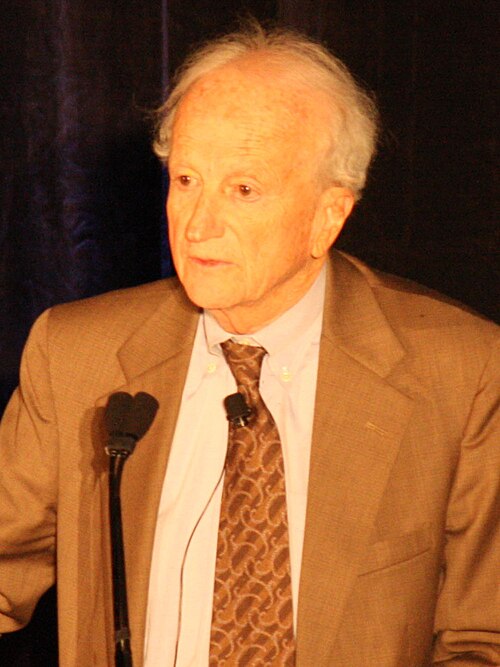
1930–2014 · American
Gary Becker
The economics of everyday life - crime, marriage, education, and prejudice, all run through Chicago price theory.
The idea in one paragraph
Most economists study markets for wheat or steel. Gary Becker pointed the economist's toolkit at everything else: who marries whom, why crime happens, whether college pays, and what prejudice costs. His bet was that people respond to incentives everywhere, not just when they're shopping. So education is an investment, a burglary is a gamble weighed against the odds of prison, and discrimination is a tax the bigot partly pays himself. Colleagues at first found this somewhere between eccentric and offensive; it won him the 1992 Nobel Prize "for having extended the domain of microeconomic analysis to a wide range of human behaviour." Half of modern applied economics works in territory he opened.
The world they lived in
Becker was born in 1930 in Pottsville, Pennsylvania, a coal town, and grew up in Brooklyn. His father, a small businessman losing his eyesight, had young Gary read him the stock quotes and business news aloud. He studied math at Princeton, then went to the University of Chicago for his PhD, where Milton Friedman's price theory course electrified him: economics wasn't a filing cabinet of models, it was a working tool for real questions. The Chicago habit of applying that tool aggressively - people optimize, prices matter, follow the margins - became his life's method.
The America of his career kept handing him material. The civil rights movement made discrimination the moral question of the age. Crime surged through the 1960s and 70s. Women poured into the workforce while divorce rose and family size fell. All of it was considered sociology's turf; economists stuck to money, trade, and business cycles. When Becker wrote his 1955 doctoral thesis on the economics of discrimination, much of the profession reacted with indifference or hostility - this simply wasn't economics. He taught at Columbia from 1957 to 1970, returned to Chicago, collected the Nobel in 1992 and the Presidential Medal of Freedom in 2007, and died in 2014.
What they argued
Start with discrimination, because that's where he started. Picture an employer facing two equally productive applicants who refuses to hire the Black one. Becker modeled this as a "taste for discrimination": the employer acts as if hiring from the disliked group carries an extra personal cost. The sting in the model is that indulging the taste is expensive for the discriminator - he passes up productive workers or pays more for the same output, while a less prejudiced competitor happily hires the people he rejected and undercuts him. Discrimination doesn't just harm its victims; it eats the discriminator's profits. Becker never claimed markets abolish racism - he claimed prejudice has a price, and that you can predict where it will persist: wherever competitive pressure is weak.
Next, education. Why do students give up years of wages to sit in lecture halls? Becker's answer: they are investing in themselves. Schooling and training build skills the way a factory builds machines - he called the skills human capital - and the investment has a cost (tuition plus the opportunity cost of forgone earnings) and a return (higher pay for decades). That framing explains why the young train more than the old (more years to collect the return), why firms pay for some training and not other kinds, and why earnings rise steeply early in a career. The phrase "human capital" struck 1960s ears as treating people like machinery; today finance ministers and HR departments use it without blinking.
Crime got the same treatment, and the origin story is pure Becker. Running late to examine a doctoral student, he weighed the cost of a parking garage against the odds of a ticket for parking illegally on the street - and parked on the street. (He then made the calculation the student's first exam question.) A criminal, he argued, is not a different species; he's a person comparing the expected gain from an offense against the probability of getting caught multiplied by the punishment if caught. Deterrence becomes arithmetic: you can fight crime by raising the odds of capture or the severity of sentences, and the model tells you the cheap margin to push on.
Then the family - presented, he knew perfectly well, in the least romantic vocabulary available. Marriage is a market: people search for partners and pair off when the expected gains from the match - companionship, shared households, the division of labor between home and market work - beat staying single. Children appear in the model as durable goods: costly up front, yielding a long stream of (mostly non-monetary) returns, with parents trading off quantity against "quality" - which is why fertility falls as incomes and mothers' wages rise. It sounds like satire; it generated testable predictions about divorce, family size, and women's work that held up remarkably often, and it was collected in A Treatise on the Family (1981).
Where it breaks down
The oldest complaint has a name: the imperialism of economics. Sociologists and philosophers charge that Becker's framework flattens love, duty, faith, and identity into "preferences," explaining everything and therefore, critics say, nothing - relabeling a mystery is not solving it. Becker cheerfully accepted the imperialist label, which did not settle the argument.
A second front opened from psychology. Daniel Kahneman and Amos Tversky showed experimentally that people misjudge small probabilities and discount the future erratically - precisely the calculations Becker's rational criminal is supposed to perform, given that arrest is a low-probability event. Empirical work on deterrence tends to find that swift and certain punishment matters far more than severity, which fits a psychologically boundedly rational offender better than a perfect calculator. How much of behavior the rational-choice model captures "well enough" remains contested.
The family model drew the sharpest fire. Feminist economists - most bluntly Barbara Bergmann, who titled an essay on it "preposterous conclusions" - objected that Becker's household is run by a benevolent "altruist" whose preferences stand in for everyone's, and that the model can dress up existing gender roles as efficient specialization rather than constrained choice. And on discrimination, the stubborn persistence of wage gaps after decades of competition suggests Becker's mechanism is incomplete; rival theories of statistical discrimination (Kenneth Arrow, Edmund Phelps) were built to fill the gap.
Lasting influence
Every time a politician says "invest in education," they are speaking Becker. Human capital is now the standard lens on schooling from the World Bank down to school-board meetings. The economics of crime became a pillar of law and economics and still frames debates about policing and sentencing - including the empirical case against long sentences, which uses his own cost-benefit logic. The audit studies that catch discrimination by sending out matched résumés descend from his insistence that prejudice is measurable and has a price. Family economics is now simply a field.
More broadly, Becker made "the economics of everything" a genre - Freakonomics is unimaginable without him - and gave behavioral economics its sparring partner: Richard Thaler honed his ideas at Chicago partly by cataloguing where Becker's rational actors misbehave. Not bad for a thesis topic his elders considered not really economics.