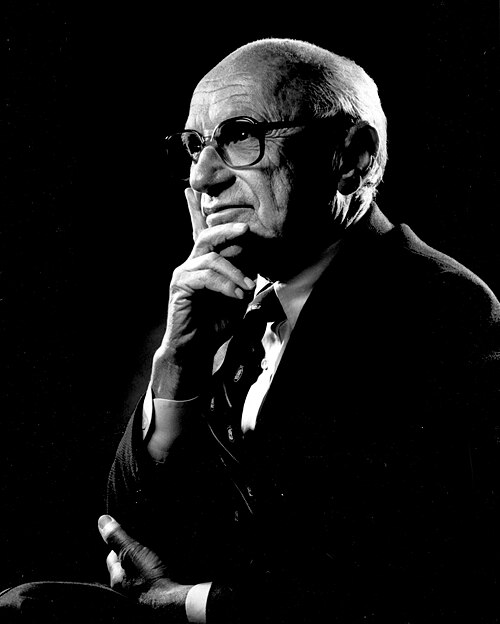
1912–2006 · American
Milton Friedman
Monetarism - "inflation is always and everywhere a monetary phenomenon"
The idea in one paragraph
You've felt it at the checkout: everything costs more this year, and everyone has a favorite villain - greedy firms, unions, oil sheikhs. Friedman's answer was simpler and ruder: look at the money. When the amount of money in an economy grows much faster than the amount of stuff, prices rise. Always. "Inflation is always and everywhere a monetary phenomenon" - which means it's not weather, it's policy, and the government printing the money is the one villain who can actually fix it. From that one thread Friedman unspooled a counter-revolution against Keynes: money matters most, governments fail too, and steady rules beat clever officials nearly every time.
The world they lived in
Friedman was born in Brooklyn in 1912, the son of poor Jewish immigrants from a corner of the Austro-Hungarian Empire. He was 17 when the Great Depression hit - the formative economic event of his life, as it was for the whole profession. The Depression seemed to prove that free-market capitalism was inherently unstable, and the economist with the cure was Keynes: when private spending collapses, government must fill the hole. By the time Friedman finished his training (Rutgers, Chicago, Columbia) and settled at the University of Chicago in 1946, the Keynesian view wasn't a school of thought; it was simply economics. Money, in that framework, barely mattered - fiscal policy (taxing and spending) was the steering wheel.
Friedman spent thirty years arguing, with cheerful relentlessness, that this consensus was wrong on the facts. He was an unlikely insurgent: barely five feet tall, grinning, devastating in debate, and armed with more data than anyone on the other side. From his post at Chicago he built the "Chicago school," found a kindred spirit in Friedrich Hayek (they were founding members of the Mont Pelerin Society in 1947), and wrote a newsmagazine column that made him the most famous economist alive.
Then the 1970s handed him his vindication: inflation and unemployment rising together - stagflation - something mainstream Keynesian models said shouldn't happen and Friedman had predicted in 1967. He won the Nobel Prize in 1976, and by 1980 his ideas were staffing governments in Washington and London. He died in 2006, at 94, having lived from the Model T to the iPod and changed his profession's mind about most of the things he cared about.
What they argued
Inflation is a money story
Friedman revived the old quantity theory of money - the idea that the price level tracks the money supply - and rebuilt it with modern evidence. The intuition fits in a sentence: if a helicopter dropped freshly printed cash equal to everyone's bank balance tonight, we'd all be twice as rich in dollars by morning and not one loaf of bread richer in reality - prices would simply double. Sustained inflation, he argued, never comes from unions or oil prices, which change relative prices, not all prices; it comes from money growing faster than output, year after year. The flip side: to stop inflation, stop printing. He also warned that monetary policy works with "long and variable lags" - squeeze the money supply today and prices respond a year or two later - which is why he distrusted fine-tuning and proposed a rule: grow the money supply by a fixed few percent a year, and otherwise leave the dials alone.
The permanent income hypothesis
Keynesian models assumed people spend a fixed slice of this month's income, so a temporary tax rebate should reliably jolt the economy. Friedman's A Theory of the Consumption Function (1957) said: watch actual humans. People smooth. A waiter with a big-tip weekend doesn't buy a car; a farmer doesn't starve in the off-season. Spending tracks what people think their normal, long-run income is - their permanent income - not this month's blip. A one-off rebate check mostly gets saved; only lasting changes in prospects change spending. This quietly kneecapped the simple Keynesian multiplier and still shapes how economists judge stimulus checks today. It was also the work his Nobel citation led with.
The Great Depression was a monetary failure
With economist Anna Schwartz, Friedman spent over a decade assembling A Monetary History of the United States (1963), a 93-year audit of American money - and its famous chapter renamed the Depression "the Great Contraction." Their finding: between 1929 and 1933, as thousands of banks failed and depositors' money simply vanished, the U.S. money supply shrank by roughly a third - and the Federal Reserve, created expressly to prevent such panics, stood by and let it happen. An ordinary recession became a catastrophe. The lesson lands hard, because it flips the standard story: the Depression wasn't capitalism failing on its own; it was a government agency failing at its one job. Contested at the time, the monetary account became close to orthodoxy. In 2002, Fed governor Ben Bernanke told Friedman and Schwartz to their faces: "You're right, we did it. We're very sorry. But thanks to you, we won't do it again."
The natural rate, and the prophecy that came true
In the 1960s, policymakers believed in a stable menu: accept a bit more inflation, get permanently lower unemployment (the Phillips curve). In his 1967 presidential address to the American Economic Association, Friedman said the menu was a mirage. Fool workers with surprise inflation and they'll take jobs at wages that look better than they are - but only until they notice prices rose too. Expectations catch up; unemployment drifts back to its "natural rate," set by real things like skills and job-matching; and you're left with the same joblessness plus entrenched inflation. Buying jobs with inflation requires ever-accelerating inflation. Edmund Phelps reached the same conclusion independently. Within a few years the 1970s delivered exactly the combination - high inflation and high unemployment - that the old models ruled out. It remains one of the most celebrated predictions in modern economics.
Ideas with consequences: vouchers, volunteers, and floating money
Friedman insisted on judging policies by results, not intentions, and his policy inventions got adopted at a remarkable rate. He argued for school vouchers - fund students, not school systems, and let families choose - planting the seed of today's school-choice movement. He was the intellectual force behind ending the military draft, serving on the 1969–70 Gates Commission; when a general suggested he'd rather not command an army of mercenaries, Friedman shot back that the alternative was an army of slaves (the all-volunteer force arrived in 1973, and he called it his proudest achievement). His negative income tax - replace welfare bureaucracy with straightforward cash - became, in mutated form, the Earned Income Tax Credit. And he championed floating exchange rates years before the Bretton Woods system collapsed in the early 1970s and made floating the global norm. His case for all of it was the same: concentrate decisions in individual hands, because incentives beat directives.
Where it breaks down
Monetarism won the war and lost the operating manual. Central banks tried literal money-supply targeting around 1979–82 - and the reliable money-to-prices link promptly dissolved. Financial deregulation and new kinds of accounts made "the money supply" a moving target, and the velocity of money, stable in Friedman's data, lurched unpredictably. British economist Charles Goodhart coined the law that fit: any measure adopted as a policy target stops being a reliable measure. Critics like Nicholas Kaldor had long argued the money supply wasn't really under the central bank's control at all. By the mid-1980s the Fed had quietly dropped money targets in favor of interest rates, and in 2003 Friedman himself conceded to the Financial Times that using the money supply as a target "has not been a success." His deeper claims - inflation is the central bank's responsibility; expectations matter - survived and now run the world's central banks. The specific dashboard he recommended did not.
Chile. In 1975 Friedman gave lectures in Chile and met General Pinochet, whose dictatorship - advised by Chicago-trained economists dubbed the "Chicago Boys" - was imposing market reforms alongside brutal repression. Protesters dogged Friedman for years, including at his Nobel ceremony, arguing he had lent legitimacy to a torturer's regime. Friedman's defense: he gave the same free-market advice to communist China; advising a bad government to inflate less is not an endorsement; and free markets, he argued, would corrode the dictatorship itself - pointing later to Chile's return to democracy in 1990 and its relative prosperity. Whether Chile's economic record vindicates the reforms, and what responsibility an adviser bears, are both hotly contested to this day; his critics' strongest point is that he was quicker to see how planning threatened freedom than how dictatorship did.
The natural rate turned out to be a moving target. The concept assumed policymakers could at least roughly know where the natural rate sits. In practice the estimate wobbles by whole percentage points. In the late 1990s, U.S. unemployment fell well below standard estimates of the natural rate - with inflation quiet, contrary to the theory's warning - and the 2010s repeated the trick. Economists such as James K. Galbraith argue the concept is too slippery to guide policy; defenders reply that the framework - expectations adjust, there's no permanent inflation-jobs trade-off - remains intact even if the number is fuzzy. Contested, and consequential: central banks still steer by versions of this unobservable star.
Lasting influence
It's hard to name a twentieth-century economist with more visible fingerprints on ordinary life. If your country's army is volunteer, your currency floats, your low-wage job comes with a tax credit rather than a caseworker, or your city has charter schools or vouchers - that's Friedman's paw print. If your central bank publishes an inflation target and treats inflation as its problem, that's the house Friedman built, even though the money-supply furniture was thrown out. The response to 2008 - flooding the banking system rather than repeating 1930 - was Friedman and Schwartz's lesson applied in real time, by a Fed chairman who had promised them exactly that.
He also changed how economics argues: after Friedman, grand theory had to answer to long runs of data. And through Free to Choose - the 1980 book and television series he wrote with his wife and lifelong collaborator Rose Friedman - he took the case for markets over the heads of the experts, straight to the public, becoming the most effective popularizer economics has ever produced. Adam Smith made the case that markets coordinate; Friedman made it on prime-time TV. Keynes once wrote that practical men are the slaves of some defunct economist. For the last several decades, much of the time, that economist has been Milton Friedman.