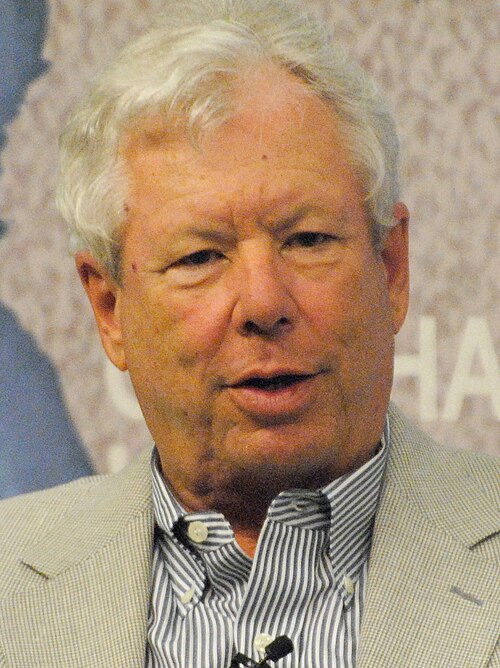
1945–present · American
Richard Thaler
Nudges and choice architecture - redesigning the default so Humans, not Econs, come out ahead.
The idea in one paragraph
Would you drive twenty minutes across town to save $10 on a $25 clock radio? Most people say yes. To save $10 on a $500 television? Most say no - same ten dollars, same drive. Standard economics has no room for that answer; Richard Thaler built a career collecting answers like it. Real people aren't the textbooks' cool calculators - "Econs," he calls them. We're Humans: we keep money in mental jars, overvalue whatever we already own, and postpone anything involving a form. So the way a choice is presented - the default box, the order of options - quietly steers what gets chosen. Design that presentation kindly, and you can nudge people toward their own goals without forcing anyone.
The world they lived in
Born in East Orange, New Jersey, in 1945, Thaler trained as a conventional economist at the University of Rochester. But he kept a list on his office blackboard - "the List" - of things real people did that his models said they wouldn't. Dinner guests devouring cashews, then thanking him for taking the bowl away. Friends skipping a basketball game in a snowstorm, admitting they'd have braved the roads if they had already paid for the tickets. In the mid-1970s he discovered the papers of Daniel Kahneman and Amos Tversky and realized the List wasn't a pile of jokes - it was a research program. He spent 1977–78 at Stanford, near both psychologists, absorbing it.
It was a terrible moment to be a heretic: the profession's rising stars were perfecting Robert Lucas-style models of flawless rationality, and Thaler's dinner-party evidence struck them as cute at best. He answered with mischief: from 1987, a regular "Anomalies" column in the Journal of Economic Perspectives, each installment a documented fact standard theory couldn't digest - stock markets overreacting, people tipping in restaurants they'd never revisit. In 1995 he joined the University of Chicago, the cathedral of rational-agent economics, and in 2017 he won the Nobel Prize for, in effect, being right all along. Asked what he'd do with the $1.1 million, he promised to "try to spend it as irrationally as possible."
What they argued
Start with mental accounting. In theory, money is fungible - every dollar is interchangeable with every other. In practice we label dollars. People maintain a sacred "vacation fund" earning 1 percent interest while carrying credit-card debt at 20, and, like the radio-and-TV shoppers, judge a saving by its share of the bill rather than by the dollars. The jars aren't stupid - for a creature with limited attention and willpower, they're a workable answer to bounded rationality. But they mean identical dollars follow different rules, which standard theory says never happens.
Then the coffee mugs. In a 1990 experiment with Kahneman and Jack Knetsch, Thaler handed university mugs to half a classroom at random and opened a market. Since the mugs landed at random, about half should have moved to classmates who valued them more. Almost nothing traded: owners demanded roughly twice what non-owners would pay, minutes after acquiring a mug they'd never wanted. That's the endowment effect - loss aversion applied to ownership: giving up what's mine registers as a loss. It's why houses sit unsold at prices no buyer will pay, and why free trials convert so reliably into paid subscriptions.
The point of the anomalies was that these quirks are systematic, not noise - which means somebody will design around them. Casinos and subscription services already do. In Nudge (2008), written with the legal scholar Cass Sunstein, Thaler flipped the design power to benevolent ends. There is no neutral way to present a choice: something is the default, something comes first on the form. Since the "choice architecture" will steer people regardless, they argued, build it to help - while keeping every option open and leaving economic incentives untouched. They called it libertarian paternalism: paternalist in the gentle push, libertarian in the freedom to shrug it off.
The showcase is retirement saving. When joining a pension plan meant filling out paperwork, huge numbers of workers who wanted to save never got around to it. Flip the default to automatic enrollment - in unless you opt out - and participation in the classic study jumped from about half to nearly nine in ten. Thaler and Shlomo Benartzi's Save More Tomorrow plan added a second nudge: workers commit today to raising their saving rate out of future pay raises, so the increase never shows up as a smaller paycheck - no loss to avert. At the first company to try it, saving rates more than tripled in under four years. Nobody was banned from anything, nobody was taxed; a form was redesigned.
Where it breaks down
The sharpest objection: who nudges the nudgers? The psychologist Gerd Gigerenzer argues that nudging treats citizens as incurably biased and their governments as bias-free - better, he says, to "boost" people by teaching risk literacy than to steer them like sheep. The economists Mario Rizzo and Glen Whitman push further: a choice architect cannot know your true preferences (maybe you "undersave" because you genuinely prize the present), so "helping people do what they really want" slides toward helping them do what officials want - and mild paternalism, they warn, rarely stays mild.
The effects may also be smaller than the headlines. A 2022 meta-analysis by Stephanie Mertens and colleagues found respectable average effects across hundreds of nudge trials - after which Maximilian Maier and co-authors reanalyzed the same data and concluded that, corrected for publication bias, the average effect is indistinguishable from zero. Stefano DellaVigna and Elizabeth Linos examined every trial run by two US government nudge units: nudges at scale still work, but at roughly one-sixth the effect sizes academic journals report. Where the truth lands is contested; defaults, at least, keep performing.
And markets teach. The economist John List found that the endowment effect largely evaporates among veteran sports-card traders. Defenders of standard theory read that as vindication: where stakes are high and feedback is fast, the anomalies fade. Thaler's reply is that the important choices are exactly the ones without practice rounds - you don't pick a pension, a mortgage, or a spouse fifty times with instant feedback.
Lasting influence
In 2010 the British government created the Behavioural Insights Team - instantly nicknamed the Nudge Unit - to redesign tax letters, organ-donation prompts, and pension defaults; by the OECD's count, some two hundred public bodies worldwide have since applied behavioral insights to policy. Automatic enrollment became law-backed practice in America (the Pension Protection Act of 2006) and Britain (auto-enrolment from 2012), turning tens of millions of non-savers into savers - probably behavioral economics' largest real-world payoff yet.
Thaler enjoys pointing out that the insight is older than the field: Adam Smith wrote about overconfidence and weak self-control in 1759. What Thaler added was cheerful persistence - four decades of anomalies that turned "behavioral" from an insult into a curriculum, plus a Nobel, a bestselling memoir (Misbehaving), and a cameo beside Selena Gomez in The Big Short, explaining why gamblers believe in hot hands. His advice to policymakers fits on an index card, which is the point: if you want people to do something, make it easy.