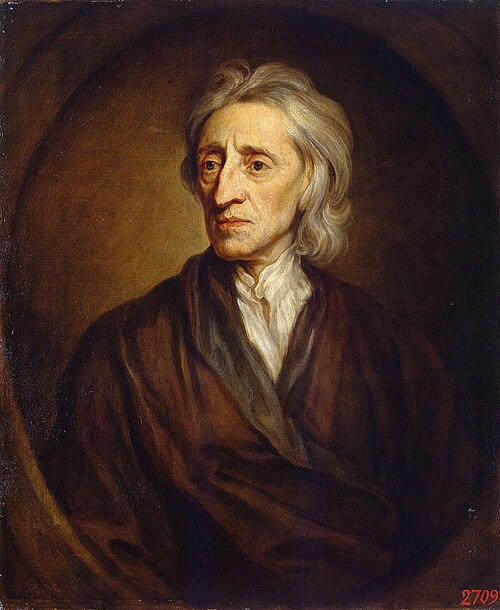
1632–1704 · English
John Locke
Property begins with labor - and money obeys the market's laws, not the government's wishes.
The idea in one paragraph
Pick a wild apple and eat it. At what moment did it become yours? Locke's answer built the modern idea of property: it became yours when you did the work - when you "mixed your labor" with what nature left unowned. Government doesn't grant property; it exists to protect property that labor already created. And money, Locke argued, is property too, with laws of its own: the price of borrowing it is set by supply and demand, its value depends on how much of it is circulating, and no act of Parliament can decree otherwise. Locke was a philosopher first - but his economics quietly laid the foundations the classical economists built on.
The world they lived in
Locke's England spent his lifetime arguing, often with weapons, about who had the right to rule. Born in Somerset in 1632, he was a boy during the Civil War (his father rode with the parliamentary cavalry), a student during Cromwell's republic, and an Oxford-trained physician when the monarchy returned. His life pivoted on one patient: Lord Ashley, later Earl of Shaftesbury, whose liver abscess Locke helped drain and whose political fortunes he then shared - including writing papers for him on trade, interest, and coinage. When Shaftesbury's opposition to the Crown turned dangerous, Locke fled to Holland; he sailed home in 1689, in the wake of the Glorious Revolution, and published in one extraordinary year the Essay Concerning Human Understanding and the Two Treatises of Government.
The 1690s handed him a monetary emergency to match his political one. England's silver coins were hand-struck and easy to "clip" - shave around the edges - and by mid-decade the average coin had lost nearly half its silver. Prices quoted in coin became guesswork; a war against France strained the treasury; something had to be done. The question that consumed Parliament, the Treasury, and Locke himself was brutally practical: when the state reminted the coinage, how much silver should a shilling contain?
What they argued
Start with the famous chapter five of the Second Treatise. God gave the world to humanity in common, Locke says - so how can anyone own anything? Through labor. The berries you gather, the field you clear and till, carry your effort in them, and that effort was always yours. Two provisos kept the story fair: take only what leaves "enough, and as good" for others, and only what you can use before it spoils. Then money enters the tale and quietly changes it. Gathered berries rot; gold doesn't. Once people consent to value durable metal, you can sell your surplus instead of wasting it - and accumulation without spoilage, and without obvious limit, becomes legitimate. In three moves Locke had derived property, markets, and inequality from a berry patch.
His monetary economics began as a rebuttal. Merchants led by Josiah Child wanted the legal maximum interest rate lowered to 4 percent - cheap money by decree, as Holland seemed to enjoy. Locke's Some Considerations replied that the "price of money" is set like the price of anything else, by the supply of funds people will lend and the demand of those who want to borrow. Cap it below the natural rate and lenders don't lend cheaper - they stop lending, or route loans through evasions that add cost, hurting exactly the widows and orphans who live on interest. It's the price-control argument you now hear about rent caps, made about credit in 1691.
Underneath lay an early version of the quantity theory of money: what money is worth depends on how much of it circulates relative to the trade it must carry - and, Locke added, on how quickly it changes hands. Double the coin chasing the same goods and prices rise; money has no fixed magic value. He never fully escaped his mercantilist era - he still worried that a nation losing coin would see trade wither - but he had grasped the core mechanism that David Hume would soon polish into a theorem.
Then came the recoinage, Locke's ideas facing a live test. Treasury secretary William Lowndes proposed reminting the clipped coins at a face value about 25 percent higher - accepting the devaluation that had already happened in practice. Locke was appalled. A shilling, he insisted, is a weight of silver; raising the denomination is just renaming, like decreeing an inch shall now be called a foot - and it would quietly rob every creditor and landlord owed payment in old shillings. Parliament sided with Locke in 1696, and the coins were restruck at full ancient weight, with Isaac Newton at the Mint to oversee the job.
Where it breaks down
The labor-mixing theory has a famous leak. The philosopher Robert Nozick asked: if I pour my can of tomato juice into the sea, do I own the sea - or have I just lost my juice? Why does mixing labor with a thing gain the thing rather than waste the labor? Locke's provisos leak too: once money justifies unlimited accumulation, "enough and as good for others" quietly disappears - the political theorist C. B. Macpherson argued Locke had licensed "possessive individualism" while seeming to constrain it. Later economists added that labor alone doesn't make value; things are valuable because people want them, however much sweat they contain.
His recoinage victory is judged even more harshly. Restoring the old silver standard meant, in effect, a sharp deflation: debts contracted in light coins now had to be paid in heavy ones, coin grew scarce just as war demanded spending, and the poor bore the squeeze. Many monetary historians - echoing Lowndes at the time - conclude that Locke won the argument and England lost by it. And Hume soon showed that Locke's residual fear of losing coin to foreigners was needless: money flows across borders self-correct, so a nation can no more run out of coin through trade than a valley can run out of air.
Lasting influence
Locke's political economy is stamped on the modern world twice over. Once through politics: "life, liberty, and property" became, lightly edited, the founding creed of the American republic, and the idea that government exists to protect what labor has earned remains the moral engine of property-rights arguments everywhere - from farmland titling programs to intellectual property debates. And once through economics: his supply-and-demand account of interest and his quantity-theory reasoning fed straight into Hume, then into the classical mainstream, and eventually into every central banker who takes it for granted that printing money moves prices rather than creating wealth.
His deepest legacy, though, is a fork in the road. Adam Smith inherited Locke's world of property-owning individuals trading freely under law and built classical economics on it. But the labor theory of property had a second life: sharpened into the labor theory of value, it became the premise from which Karl Marx argued that profit is unpaid labor - that the factory owner harvests berries other people picked. The philosopher of property supplied ammunition to property's defenders and its fiercest critic alike. Few thinkers have armed both sides of a 300-year argument quite so thoroughly.