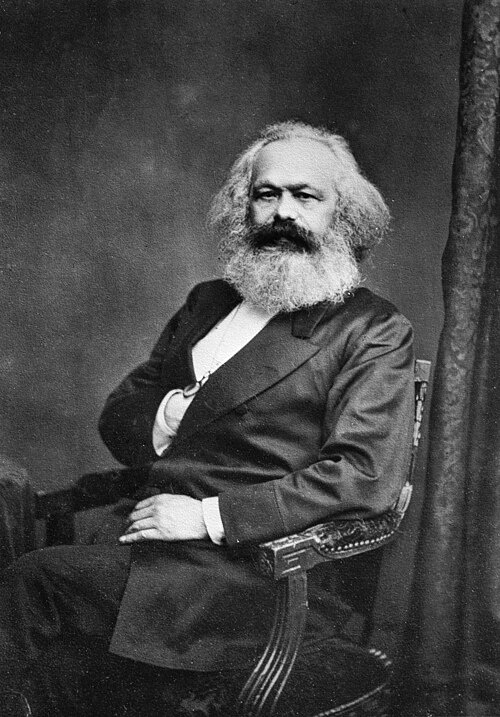
1818–1883 · German
Karl Marx
Profit, he argued, is unpaid labor - capitalism runs on extracting surplus value from workers, and its own contradictions would bring it down.
The idea in one paragraph
Every society in history, Marx argued, has been organized around one question: who does the work, and who keeps the surplus? Slaves and masters, serfs and lords - and now workers and owners. Capitalism just hides the arrangement inside a paycheck. Workers produce more value in a day than they're paid for; the difference - surplus value - becomes profit for whoever owns the means of production. Marx thought capitalism was the most productive system humanity had ever built, and also that it couldn't sit still: competition would drive endless upheaval, recurring crises, ever-bigger firms, and an ever-larger working class - until that class took the whole machine over and ran it for everyone.
The world they lived in
Marx was born in 1818 in Trier, a sleepy town in the Prussian Rhineland, to a lawyer father who had converted from Judaism to keep his job under Prussia's restrictions. Marx studied law, switched to philosophy, earned a doctorate, and found that no university in censorship-heavy Prussia would touch him. So he became a journalist - and was so good at infuriating the authorities that his newspaper was shut down and he was pushed into exile: Paris, then Brussels, and finally London, where he spent the rest of his life, much of it in genuine poverty, researching in the British Museum's reading room while his friend and collaborator Friedrich Engels paid the bills.
The world he was trying to explain was the industrial Britain of the 1840s - the "hungry forties." The factory system had produced wealth on a scale no one had ever seen, and misery to match: mill hands working twelve-hour days six days a week, children hauling coal underground, families packed into cellars in Manchester slums. Engels had documented it firsthand in The Condition of the Working Class in England. The economists of the day, heirs of Adam Smith, described this world as natural and self-adjusting. Marx wanted to know why a system this productive kept the people doing the producing so poor.
Then came 1848, when revolutions swept across Europe - Paris, Vienna, Berlin, Milan - just as Marx and Engels published a slim pamphlet called the Communist Manifesto. The uprisings failed, the old order clawed its way back, and Marx drew a conclusion that shaped everything after: indignation wasn't enough. What the movement needed, he decided, was a scientific account of how capitalism actually worked - and why it would dig its own grave. That project became Capital, whose first volume appeared in 1867. He died in London in 1883 with the rest unfinished; Engels assembled volumes two and three from his notes.
What they argued
History moves by class struggle
"The history of all hitherto existing society," the Manifesto begins, "is the history of class struggles." Marx's big framework - historical materialism - says that how a society makes its living shapes everything else about it: its laws, politics, religion, even its ideas of right and wrong. Change the technology of production and you eventually change the whole society. The hand-mill, he quipped, gives you feudal lords; the steam-mill gives you industrial capitalists. On this view, capitalism isn't the natural endpoint of history, as Smith's heirs implied. It's one stage among several - it had a birth, and it would have a death.
Capitalism, the revolutionary
Here's what surprises first-time readers: the Manifesto contains some of the most glowing praise of capitalism ever written. The bourgeoisie, Marx wrote, "has accomplished wonders far surpassing Egyptian pyramids, Roman aqueducts, and Gothic cathedrals" - it conquered nature, knitted the globe into one market, and dragged humanity out of what he bluntly called rural idiocy. But it did so by making permanent revolution the price of survival: "all that is solid melts into air." Every firm must innovate or die, every tradition and trade gets churned under. Marx admired the dynamism and believed nobody could switch it off - least of all the capitalists, who are as trapped on the treadmill as their workers.
Where profit comes from
Marx's economics starts from the labor theory of value he inherited from Smith and David Ricardo: a good's value reflects the labor it takes to produce. His twist was to ask - if everything trades at its value, where does profit come from? His answer: the one commodity that produces more value than it costs is human labor-power. Suppose it takes the equivalent of four hours of work to cover your wage - the cost of keeping you fed, housed, and able to show up tomorrow. But your contract says eight hours. Those extra four hours of value belong to your employer. That unpaid remainder is surplus value, and in Marx's system all profit, rent, and interest flow from it. The worker isn't cheated at the market - the wage is a fair price for labor-power - yet exploitation happens anyway, baked into the structure. That's why Marx aimed his fire at the system, not at greedy individuals: the factory owner, he said, is just capital wearing a human face, forced by competition to squeeze or be squeezed.
The contradictions
From that engine, Marx derived capitalism's fatal tendencies. Competition forces owners to replace workers with machines - but if surplus value comes only from labor, mechanization slowly strangles the source of profit (his famous, and famously disputed, "falling rate of profit"). A standing pool of the unemployed - the "reserve army of labor" - keeps wages down. Production for profit rather than need generates crises of overproduction: warehouses full, workers laid off, want amid plenty - a spectacle Marx noted would have seemed absurd in any earlier epoch, when crises meant too little. Each downturn kills off smaller firms, so capital concentrates into fewer, bigger hands, while the working class grows larger and more organized. Capitalism, in short, manufactures its own opposition and hands it the training.
What comes next
Marx was strikingly tight-lipped about the society he expected to follow - he sneered at rivals who wrote "recipes for the cook-shops of the future." The broad strokes: the working class takes political power, the means of production become common property, and production is planned for use rather than profit. His fullest sketch, in the Critique of the Gotha Programme, imagines two phases: an early stage of socialism where people are paid by their work, and a mature communism of abundance governed by the slogan "from each according to his ability, to each according to his needs." How, exactly, a planned economy would decide what to make and in what quantities - the question that would dominate the twentieth century - he never worked out. He didn't think he had to; history's job, not his.
Where it breaks down
The first crack runs through the foundation. In the 1870s - while Marx was still alive - Jevons, Menger, and Walras replaced the labor theory of value with subjective value: things are valuable because people want them, at the margin, not because of the labor sunk into them. That dissolved puzzles the labor theory struggled with and became the basis of modern economics. Then in 1896 the Austrian economist Eugen von Böhm-Bawerk pressed what's now called the transformation problem: volume one of Capital says goods exchange according to labor values, but volume three concedes that market prices systematically deviate from those values - and Böhm-Bawerk argued Marx's attempt to bridge the two contradicts itself. Marxian economists have proposed repairs ever since, and whether any of them succeeds is still contested; what's not contested is that mainstream economics moved on.
The second is the prediction record. Marx expected workers under capitalism to be progressively immiserated and the middle class to be ground out of existence. Instead, real wages in the capitalist world rose spectacularly - an ordinary worker today lives at a material standard Victorian factory owners couldn't buy - and the middle class ballooned. (Scholars still argue over whether Marx predicted absolute impoverishment or merely a relative, insecure one; the textual evidence is genuinely mixed, so label that one contested. Either way, the grave-digging never arrived on schedule.) The philosopher Karl Popper added a methodological jab: when predictions failed, Marx's followers adjusted the theory to fit, making it - in Popper's view - unfalsifiable pseudo-science. Marx's defenders reply that he offered tendencies, not timetables.
The third strike came at the part Marx left blank. In 1920 Ludwig von Mises argued that a planned economy faces an insoluble calculation problem: without market prices for machines, land, and raw materials, planners have no way to compare the value of alternatives - no way to know whether a project creates wealth or destroys it. Friedrich Hayek deepened the critique: prices carry dispersed, local knowledge that no central planning office could ever collect. Socialist economists like Oskar Lange proposed market-simulating answers, and the debate ran for decades - but the grinding shortages and gluts of the Soviet economy persuaded most economists that Mises and Hayek had won. (You can feel the problem yourself in the price-signals interactive - it's the other side of this conversation.) How much of that failure lands on Marx personally is contested - he designed no blueprint - though critics like Leszek Kołakowski argue the disaster was latent in the doctrine itself, while Marx's defenders note he'd likely have been appalled by the regimes that ruled in his name.
Lasting influence
Measured by earthly consequences, Marx is arguably the most influential economist who ever lived. By the mid-twentieth century roughly a third of humanity lived under governments claiming his authority - the Soviet Union, China, and their orbits - and the Cold War that organized world politics for two generations was, at bottom, an argument about his ideas. The collapse of most of those regimes after 1989 settled the planning question for nearly all economists, but it didn't end Marx's influence; it just returned it to its older channels.
Those channels run wide. The labor movements he championed helped win things now too ordinary to seem radical - the eight-hour day, the weekend, workplace safety law. Several planks of the Manifesto's ten-point program, wild-eyed in 1848, are now standard policy in every capitalist democracy: a progressive income tax, free public education for all children. The modern welfare state was partly built to prove him wrong - Bismarck pioneered social insurance in the 1880s expressly to blunt socialism's appeal - making Marx one of history's most effective critics: capitalism reformed itself in no small part because he said it couldn't. His vocabulary - capitalism, class conflict, exploitation, alienation - is how billions of people argue about economics whether they've read him or not. And whenever inequality surges back up the agenda, from Occupy to Thomas Piketty's bestselling charts, the ghost at the seminar table is the man buried in Highgate Cemetery. Keynes dismissed Capital as an obsolete textbook; a century on, it still outsells almost every economics book written since - including his.