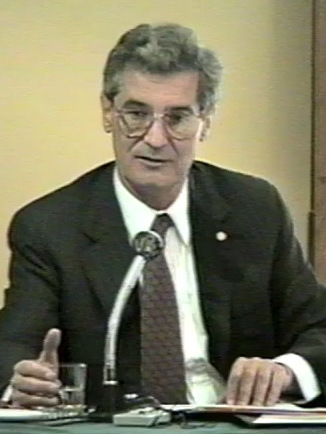
1937–2023 · American
Robert Lucas
Rational expectations - people adapt to policy, so the historical patterns policymakers lean on break the moment they lean on them.
The idea in one paragraph
Suppose the government discovers a trick: surprise bursts of inflation seem to lower unemployment. So it announces a plan to use the trick at every downturn. Congratulations - the trick is dead. Workers now demand raises up front, firms mark up prices in advance, and the inflation arrives with no jobs attached. That's Lucas's revolution in one move: people aren't lab rats running yesterday's maze; they learn the game and play against you. So any policy built on historical patterns destroys those very patterns - the "Lucas critique" - and macroeconomics can't be done by extrapolating the past. You have to model actual people making actual decisions, with their eyes open.
The world they lived in
Robert Lucas Jr. was born in Yakima, Washington, in 1937, weeks before his parents' small ice-creamery went under - a Depression baby from a New Deal household. He went to the University of Chicago as a history undergraduate, and drifted into economics after realizing, while reading about ancient Rome, that the questions gripping him were economic ones. Largely self-taught from Paul Samuelson's Foundations, he returned to Chicago for a PhD, absorbed Milton Friedman's price theory ("the most exciting intellectual experience of my life"), and taught at Carnegie Mellon before coming home to Chicago in 1975 for good.
The macroeconomics he inherited was riding high. Large Keynesian forecasting models - hundreds of equations fitted to postwar data - promised to fine-tune the economy, and the Phillips curve offered a menu: buy lower unemployment, pay with a bit more inflation. Friedman and Edmund Phelps warned in the late 1960s that the menu would vanish if governments ordered from it, because expectations would adjust. Then the 1970s delivered the verdict: inflation and unemployment rose together - stagflation, the thing the menu said couldn't happen. Lucas turned that prophecy into a method, and within a decade the ground rules of macroeconomics had been rewritten around his "new classical" school - monetarism's heir, with sharper mathematics and fewer apologies. The Nobel committee ratified the revolution in 1995.
What they argued
The engine of it all was rational expectations, an idea Lucas borrowed from John Muth and detonated under macroeconomics. It doesn't claim people are geniuses. It claims they don't make the same mistake forever - that you can't systematically fool millions of people with a strategy printed in the newspaper. Any model that assumed otherwise, Lucas argued, was a model of exploitable idiots - and would fail exactly when a government tried to exploit them.
His 1972 paper, "Expectations and the Neutrality of Money," showed what this does to monetary policy. Picture producers on scattered islands, each seeing only the price of their own goods. When your price rises, is that real demand - work more, hire, expand - or just inflation everywhere? You can't be sure, so you split the difference. That confusion is why money surprises move output: only unexpected money changes behavior, because only surprises get mistaken for real opportunity. The flip side, sharpened by Thomas Sargent and Neil Wallace into the "policy ineffectiveness proposition," was startling: fully anticipated monetary policy does nothing real. Announce the stimulus, and wages and prices leap ahead of it; the announced inflation loses its unemployment-reducing punch. What remained for a central bank wasn't fine-tuning but credibility - being predictable, and predictably boring.
Then came the methodological earthquake. "Econometric Policy Evaluation: A Critique" (1976) attacked the forecasting models at their root. Their equations - how consumption responds to income, how wages respond to unemployment - were snapshots of behavior under old policies. Change the policy and people re-optimize, so the equations themselves shift; steering by them is like a casino changing the rules and expecting gamblers to keep their old strategies. Simple, almost obvious - and it condemned an entire industry of thousand-equation models. The constructive demand became famous as microfoundations: build macro models from things policy can't change - preferences, technology, constraints - and let behavior emerge from people optimizing inside them. Within fifteen years, essentially all academic macroeconomics, Keynesian included, was built this way.
Late in his career Lucas turned to a bigger question: why are some countries rich and others poor? His 1988 paper "On the Mechanics of Economic Development" asked what, if anything, could make India grow like East Asia, and confessed that "the consequences for human welfare involved in questions like these are simply staggering: once one starts to think about them, it is hard to think about anything else." His answer centered on human capital - skills that make other people's skills more valuable, compounding across generations - and it took up the oldest question of Adam Smith's with modern tools.
Where it breaks down
Start where the evidence bites hardest: full rationality. Daniel Kahneman, Amos Tversky, and later Richard Thaler assembled decades of experiments showing people mispredict, procrastinate, anchor on irrelevant numbers, and stay confused in ways that don't wash out - bounded rationality, not rational expectations. Even sympathetic macroeconomists now build models with learning or "sticky" expectations. How badly this damages Lucas's framework - a useful approximation, or a foundation crack - is contested.
Policy ineffectiveness fared worse. New Keynesian economists showed that once prices and wages adjust sluggishly - as they visibly do - anticipated monetary policy has real effects even with rational expectations. The empirical consensus is that systematic policy matters; Lucas's own students helped build the models that say so.
The bruising came in 2008. Representative-agent models descended from Lucas's program largely lacked banks, debt, and the possibility of collapse, and in a 2003 address he had declared that the "central problem of depression-prevention has been solved." Paul Krugman's much-quoted 2009 essay "How Did Economists Get It So Wrong?" blamed the profession's Lucas-inflected romance with elegant models - "mistaking beauty for truth" - for missing the crisis. Defenders, including John Cochrane, reply that no framework predicts the timing of panics and that post-crisis models added financial frictions fast. Whether 2008 refuted the program or merely humbled it remains contested; that it embarrassed it is not.
Lasting influence
Lucas reset the rules of an entire discipline: after him, "where are the microfoundations?" became the first question at every macro seminar, and the DSGE models used today by the Fed, the ECB, and their peers are direct descendants of his islands. More practically, the modern craft of central banking - inflation targets, forward guidance, the obsession with credibility and "anchored expectations" - is applied Lucas. When a central banker frets about "unanchored expectations," that's his revolution speaking: policy works through what people expect, so manage expectations or manage nothing.
His growth work seeded the other half of modern macro. With Paul Romer's endogenous growth theory, Lucas's human-capital mechanics turned the profession's attention from smoothing rich countries' business cycles to the vastly larger stakes of why poor countries stay poor. He won the Nobel in 1995, an award with a famous footnote: his divorce settlement, signed years earlier, entitled his ex-wife Rita to half of any Nobel won before the end of October 1995. The committee called three weeks before the deadline. Rational expectations, it turned out, worked - hers.