Monetarism
1956–todayInflation is always and everywhere a monetary phenomenon - watch the money supply.
The big idea
Monetarism's core claim fits on a bumper sticker, because Milton Friedman put it there: "Inflation is always and everywhere a monetary phenomenon." When too much money chases too few goods, prices rise - not because of greedy corporations, pushy unions, or oil sheikhs, but because someone let the money supply grow faster than the economy. Control the money, and you control inflation. Everything else is commentary.
When and why it rose
Monetarism was a counter-revolution, and its target was the Keynesian consensus of the 1950s and 60s. Friedman's assault came in two waves. First, history: A Monetary History of the United States (1963, with Anna Schwartz) argued that the Great Depression wasn't capitalism failing on its own - the Federal Reserve let the money supply collapse by a third, turning a recession into a catastrophe. The Depression, in this telling, was a government failure wearing a market failure's clothes.
Second, prophecy. In 1967, Friedman predicted that trying to buy permanently low unemployment with a little extra inflation would fail: people would come to expect the inflation, demand higher wages, and leave unemployment right where it started - only now with rising prices. When stagflation arrived in the 1970s, exactly as forecast, the Keynesian machine had no dial for it, and monetarism's stock soared. He was revising the old quantity theory of money, but with modern statistics and a showman's timing.
What it got right
The big calls were right. The expectations argument (made independently by Edmund Phelps) is now bedrock - every central banker alive worries about "anchoring inflation expectations," which is Friedman's insight in institutional dress. The reinterpretation of the Depression persuaded the profession; Ben Bernanke, then a Fed governor, told Friedman at his ninetieth birthday: "You're right, we did it. We're very sorry." Monetarism also drew the modern division of labor in which monetary policy, run by independent central banks, owns the fight against inflation. When the Fed under Paul Volcker strangled America's double-digit inflation around 1980, it was monetarist medicine - brutal, and effective.
Where it fell short
The prescription outlived the diagnosis. Friedman's signature rule - grow the money supply at a fixed few percent a year and otherwise leave it alone - flopped in practice. When central banks tried strict money targeting around 1979–82, the once-stable link between measured money and spending broke down (financial deregulation kept redefining what counted as "money"), and targets were quietly abandoned. As the Bank of England's Charles Goodhart put it, any measure you target stops being a good measure. Critics also note the human cost of the cure: the Volcker disinflation put millions out of work, and whether it had to hurt that much is contested. Today no major central bank targets money growth - they target inflation directly, keeping Friedman's goal while discarding his dashboard.
Its fingerprints today
Independent, inflation-targeting central banks - the Fed, the ECB, and dozens more - are monetarism's institutional monument. The 2% inflation target, the obsession with expectations, the reflex that printing money causes inflation: all Friedman. When COVID-era stimulus met surging prices in 2022, the loudest "told you so" came from monetarists watching the money supply spike (how much money growth explains that episode is, yes, contested). Half a century on, every central banker is part-Keynesian in a crisis and part-monetarist the rest of the time.
Key figures
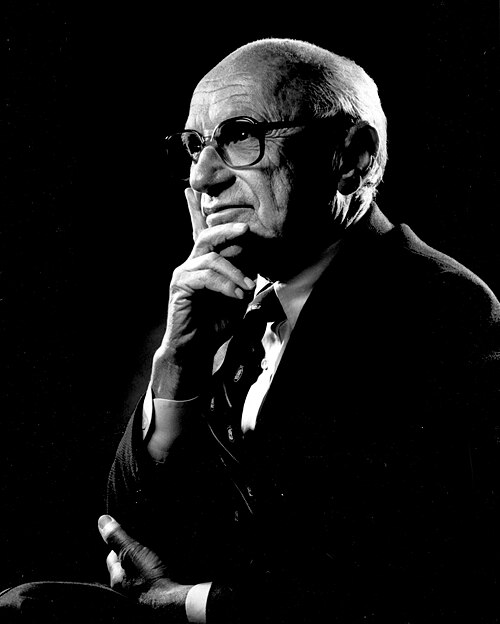
Milton Friedman★
1912–2006 · American
Monetarism - "inflation is always and everywhere a monetary phenomenon"
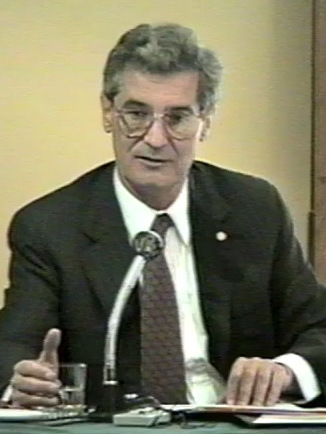
Robert Lucas
1937–2023 · American
Rational expectations - people adapt to policy, so the historical patterns policymakers lean on break the moment they lean on them.

Arthur Laffer
1940– · American
The Laffer curve - tax rates of 0% and 100% both raise nothing, so somewhere in between sits a revenue peak.