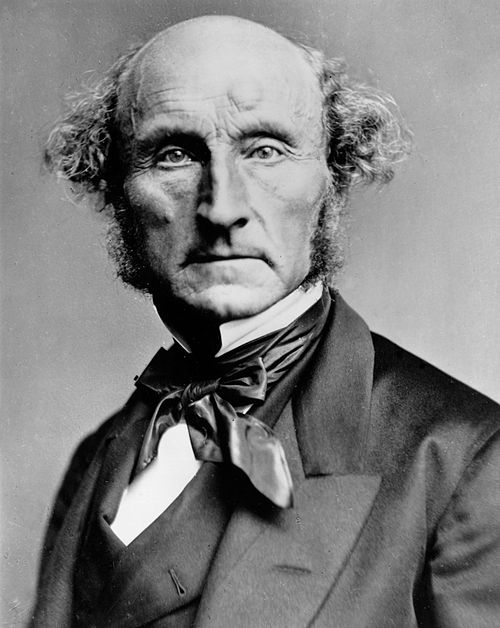
1806–1873 · British
John Stuart Mill
The classical synthesis - and the claim that production follows natural laws, but how we share the proceeds is society's choice.
The idea in one paragraph
Mill split economics down the middle. How much a society can produce is governed by hard facts - soil, machines, skill, scarcity - and no vote can repeal them. But how the output gets divided is not a law of nature at all: property rules, inheritance, taxes, and wages are human arrangements, and "the society that made them can alter them." With one distinction, the great synthesizer of classical economics opened a door his predecessors had kept shut: you can accept how markets create wealth and still argue, in daylight, about who should end up with it. Add his harm principle - your freedom ends only where injury to others begins - and you have the operating system of modern liberalism.
The world they lived in
John Stuart Mill never really had a childhood; he had a curriculum. His father, James Mill - Ricardo's closest ally and a devoted disciple of the philosopher Jeremy Bentham - set out to build the perfect utilitarian mind. Greek at three, Latin at eight, logic at twelve, and at thirteen a full course in political economy, delivered on daily walks and written up by the boy himself. It worked, at a price. At twenty, Mill fell into a deep depression, having realized that achieving all his father's reforms would bring him no joy. He crawled out through Wordsworth's poetry and a heresy he kept for life: a doctrine of human welfare that has no room for feeling isn't much of a doctrine.
The England around him was the Industrial Revolution at full steam - railways, factory smoke, spectacular fortunes, and slums that shocked Europe. Mill earned his living for thirty-five years at the East India Company, wrote at dawn, and watched the era's convulsions: Chartists demanding the vote, the Corn Laws repealed in 1846, revolutions sweeping the continent in 1848 - the same year his Principles of Political Economy appeared and became the economics textbook of the English-speaking world for forty years. Beside him through much of it was Harriet Taylor, whom he loved for two decades before their 1851 marriage and credited as co-author of his best ideas; historians still argue about how literally to take him.
What they argued
The Principles was the classical tradition brought to order - Adam Smith's vision, David Ricardo's machinery, Malthus's warnings, all cleaned, qualified, and furnished with examples. Mill sharpened the theory of free trade, worked out how supply and demand set the terms when two countries exchange, and added ideas - economies of scale, opportunity cost - that textbooks still teach. In an aside he came to regret, he suggested that on the theory of value, "happily," there was nothing left to clear up.
The book's beating heart, though, is the distinction in its opening pages. The laws of production are physical: you cannot legislate more wheat from an acre or repeal diminishing returns, and any policy pretending otherwise will fail. But the laws of distribution are "of human institution solely." Slavery, feudal dues, modern property, inheritance - each was a choice, enforced by law and custom, and each could be chosen differently. That distinction did quiet, enormous work: a good economist could defend markets as production machines while treating the resulting split of income as an open political question - taxable, reformable, improvable. The classical liberal had built a bridge, and social reformers have been walking across it ever since.
Then there is On Liberty (1859), the small book that outlived everything. Its harm principle says power may be exercised over a person against their will "only to prevent harm to others" - never merely for their own good. Around it Mill built the classic case for free speech: silencing an opinion robs humanity, because the opinion may be true, may hold part of the truth, or may be the whetstone that keeps true beliefs sharp instead of dead dogma. He feared Victorian conformity - the tyranny of the majority operating through raised eyebrows rather than laws - almost more than the state.
Mill kept revising himself in public, which contemporaries found unnerving and posterity finds honest. Later editions of the Principles praised worker cooperatives - firms owned and run by their laborers, in the spirit of Robert Owen's experiments - as the probable future of industry, letting workers become capitalists rather than abolishing capital itself. In his Autobiography he and Harriet even placed themselves "under the general designation of Socialists." Handle that label with care, as he did: Mill's socialism was decentralized, voluntary, and competitive - cooperatives contending in open markets - and his posthumous Chapters on Socialism is sharply skeptical of revolutionary schemes and central planning. And in The Subjection of Women (1869) he made the era's most scandalous argument: that women's "nature" was an artifact of their subordination and legal equality was owed on both justice and efficiency grounds; as an MP he had moved Parliament's first women's-suffrage amendment in 1867.
Where it breaks down
The fire came from both directions, which is the fate of bridges. Socialists found him timid. Karl Marx, in the afterword to Capital, dismissed Mill's attempt to reconcile classical economics with workers' claims as "shallow syncretism" - you cannot, on Marx's view, keep the production machine and politely rearrange its proceeds, because exploitation happens in production, not after it. Later socialists agreed: cooperatives and inheritance taxes were rounding errors against the wage system itself.
Classical liberals and later economists attacked the bridge's other pylon: the production/distribution split may not be coherent. Distribution is an incentive system - change who keeps the harvest and you change how much gets planted. Redistribute aggressively and people work, save, and invest differently, so the "natural" laws of production shift with every "social" choice about distribution. Critics in the tradition of Friedrich Hayek - and sympathetic readers like Schumpeter - have pressed this point: Mill's tidy separation licenses redistribution by assuming the pie won't notice how it's sliced.
His technical economics dated quickly, too. In 1869 he publicly recanted the wage-fund doctrine - the claim that a fixed pot of capital sets total wages - knocking a strut from his own system, and within a generation the marginal revolution had rebuilt value theory, retiring the framework the Principles had perfected.
Lasting influence
Mill's textbook trained every English-speaking economist until Alfred Marshall's Principles displaced it in 1890 - John Maynard Keynes belonged to the first Cambridge generation raised on Marshall, but the liberal habit of mind Keynes inherited, comfortable with markets and unembarrassed about correcting them, is Mill's. The modern mixed economy - private production, public redistribution - runs on Mill's distinction, whether its architects know it or not.
On Liberty became the common law of open societies: the harm principle surfaces wherever someone asks if the state may stop an adult from harming only themselves, and his defense of noxious opinions remains the strongest card in every free-speech debate. The Subjection of Women made him a founding text of liberal feminism. And his personal example - the prodigy who kept changing his mind in public, and who insisted on answering the strongest version of an opponent's argument - is, more or less, the ethic this site is attempting. He thought every creed, including his own, needed its critics kept alive.