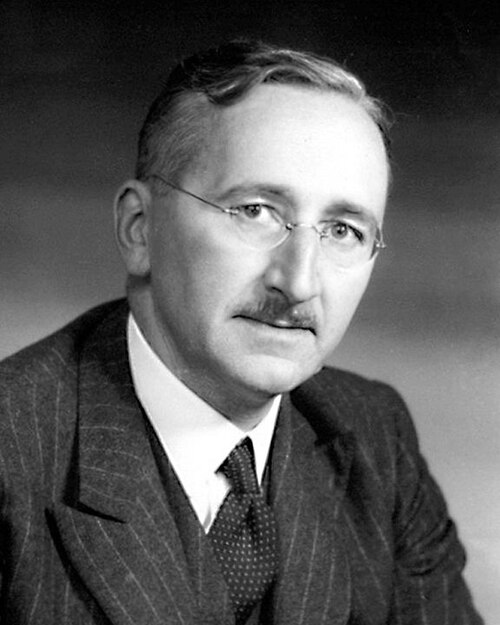
1899–1992 · Austrian-British
Friedrich Hayek
The knowledge problem - prices carry information that no central planner can gather
The idea in one paragraph
Nobody knows how to run an economy - and Hayek's point is that nobody has to. The knowledge that matters (which field flooded, which machine broke, which customers stopped buying) is scattered across millions of people in tiny, local fragments that no office could ever collect. What coordinates all those people is the price system. When something becomes scarcer, its price rises, and everyone who uses it quietly economizes - without knowing why, without being told. Prices are a kind of telecommunications network for knowledge. Try to replace that network with central planning, Hayek argued, and you don't just lose efficiency. You eventually lose freedom too.
The world they lived in
Hayek was born in Vienna in 1899, into the last golden years of the Austro-Hungarian Empire - and then watched it all collapse. He served in the First World War, came home to a defeated country, and lived through the hyperinflation that vaporized Austrian savings in the early 1920s. Meanwhile, next door, the Soviet Union was attempting the largest economic experiment in history: running a whole country without markets. Was that the future? A great many serious people in the 1920s and 30s thought so. Hayek's mentor Ludwig von Mises had already fired the first shot against that idea in 1920, and Hayek spent his career developing the argument.
In 1931 Hayek moved to the London School of Economics, arriving just as the Great Depression was making capitalism look broken. There he became the chief intellectual rival of John Maynard Keynes, whose case for government management of the economy was winning converts fast. Their debate - spend your way out of a slump, or let prices adjust? - was the economics fight of the decade, and by most accounts Keynes won it. Hayek spent the postwar decades out of fashion.
He didn't stay there. The Road to Serfdom (1944) became a surprise bestseller, he became a British citizen in 1938, and in 1974 - with inflation and unemployment rising together, exactly the mess Keynesian tools weren't fixing - he shared the Nobel Prize. By the time the Berlin Wall fell in 1989, the old Vienna argument looked prophetic.
What they argued
The knowledge problem
Start with a question that sounds silly: who knows how to make a pencil? Nobody, really. The logger doesn't know graphite chemistry; the graphite miner has never run a sawmill. Modern production works only because millions of specialists each contribute one sliver of know-how. Hayek's crucial observation is that most of this knowledge is local and fleeting - "knowledge of the particular circumstances of time and place," as he put it. The warehouse manager who knows a shipment is delayed, the farmer who senses this soil needs a different crop: none of that ever appears in a government statistic. A planning board can't collect it, because by the time it's collected, it's out of date. So the real economic problem isn't calculating the best plan from known facts. It's using knowledge that nobody possesses in full.
Prices as information
His famous example, from the 1945 essay "The Use of Knowledge in Society," is tin. Suppose tin becomes scarcer - maybe a mine collapsed, maybe a new use for tin appeared somewhere. Here's the magic: it doesn't matter which. The price of tin rises, and every user of tin, everywhere on Earth, gets the message that matters - economize on tin - without knowing anything about the cause. A canning factory switches to aluminum. An electronics firm redesigns a part. Each response frees up tin for whoever needs it most urgently. One number moved, and the whole world adjusted. That's what Hayek means by price signals: prices don't just tell you what things cost, they carry compressed news about scarcity from people you'll never meet. It is, he wrote, a marvel - and because nobody designed it, nobody appreciates it.
Spontaneous order
That word - designed - is the hinge of Hayek's whole worldview. Some order is made, like a factory floor. Other order grows, like a language. Nobody invented English grammar or sat down to design the common law; they emerged from millions of small interactions, and they encode more practical wisdom than any committee could write down. Hayek argued the market economy is this second kind of order - "the result of human action, but not of human design." Here he was updating Adam Smith's invisible hand with an information-age twist: the market isn't just a machine for satisfying wants, it's a discovery procedure - a running experiment that constantly finds out things no one knew, including what things are worth.
Booms, busts, and cheap credit
Before all this, Hayek made his name on the business cycle. His theory, built on Mises's work: when banks or central banks push the interest rate below its natural level, credit becomes artificially cheap, and businesses borrow to start long-term projects - housing developments, factories - that the economy's real savings can't actually support. The boom feels great, but it's a coordination error in slow motion: too many projects chasing too few real resources. Eventually the mismatch surfaces, and the bust is the painful discovery that some of those investments should never have been started. On this view the crash isn't the disease - it's the correction. Keynes thought this counsel of patience was disastrous in a depression, and that disagreement defined 1930s economics.
The Road to Serfdom
Written during the Second World War, when wartime planning was popular and many expected it to continue in peacetime, The Road to Serfdom makes a political argument, and it's more careful than its reputation suggests. Hayek did not say the welfare state leads to the Gulag - he explicitly endorsed a social safety net, and social insurance too. His target was full socialism: state ownership and central direction of production. His argument: a planner must rank everyone's needs - whose town gets the steel, whose medicine gets made - but a diverse society genuinely disagrees about those rankings. When democratic debate can't settle them fast enough, pressure grows to hand the decisions to someone who will decide. Planning doesn't attract tyrants by accident; the job description requires the tools of tyranny. Dedicated "to the socialists of all parties," the book was a warning to well-meaning people about where the logic of their program pointed.
Where it breaks down
The market socialists answered back - and it wasn't a rout. In the 1930s, the Polish economist Oskar Lange proposed "market socialism": keep state ownership, but have planners set prices by trial and error, raising them where shortages appear and cutting them where gluts pile up - mimicking what markets do. Many economists at mid-century scored the debate for Lange. Hayek's rejoinder was that this misses the point: real market prices come from entrepreneurs risking their own money on hunches and local knowledge, and a bureau adjusting official prices from last quarter's shortage reports has none of that discovery. The collapse of Soviet-style economies swung expert opinion toward Hayek and Mises, but how completely the debate was "won" is still contested among historians of economics.
Prices don't carry all the knowledge. A factory's smoke imposes real costs on the neighbors, but no price tells the factory so - the signal simply doesn't exist. Economists from Arthur Pigou onward have catalogued these externalities and public goods, and even thoroughly market-friendly economists accept that unpriced harms and benefits are genuine failures of the signaling system Hayek celebrated. Later information economists, notably Joseph Stiglitz, pushed further: markets themselves can garble information, as anyone who lived through a housing bubble - prices screaming "build more!" right up to the crash - can attest.
The business cycle theory has taken heavy fire. Keynes argued that in a deep slump, waiting for liquidation is madness - idle workers and idle machines are pure waste, not a healthy correction. Milton Friedman, no friend of big government, examined the data and concluded Hayek's cycle theory didn't fit it, and said the do-nothing implication had done real harm in the 1930s. It remains a minority view among macroeconomists.
Did the road actually lead to serfdom? Postwar Britain and Scandinavia built large welfare states and stayed thoroughly democratic - the slide never happened, as critics like Paul Samuelson enjoyed pointing out. Hayek's defenders reply that his claim was about comprehensive planning, not redistribution, and that he said so plainly. Whether the book is a precise conditional argument or an overstretched slippery slope is, fittingly, still argued about - label it contested.
Lasting influence
Hayek's fingerprints are all over the late twentieth century. Margaret Thatcher and Ronald Reagan claimed him openly (Thatcher is said to have slammed The Constitution of Liberty on a table, declaring "this is what we believe"), and the 1974 Nobel marked the moment his rehabilitation became official. When the planned economies of Eastern Europe collapsed in 1989–91, his 1930s arguments became the standard explanation of why - shortages of things nobody wanted made, gluts of things nobody wanted, an economy flying blind without price signals.
Inside economics, the knowledge problem reshaped whole fields. Mechanism design - the branch of theory that asks how to build institutions when information is scattered - treats Hayek's 1945 essay as a founding document; Leonid Hurwicz, its Nobel-winning pioneer, cited him directly. Beyond economics, Hayek's idea that decentralized systems can outperform designed ones echoes through open-source software, Wikipedia, prediction markets, and complexity science. And every time an economist says "prices are information," they're quoting him, whether they know it or not. The interactive linked below lets you test the claim yourself: first as a trader watching prices ripple, then as the planner who has to manage a drought without them. Good luck.