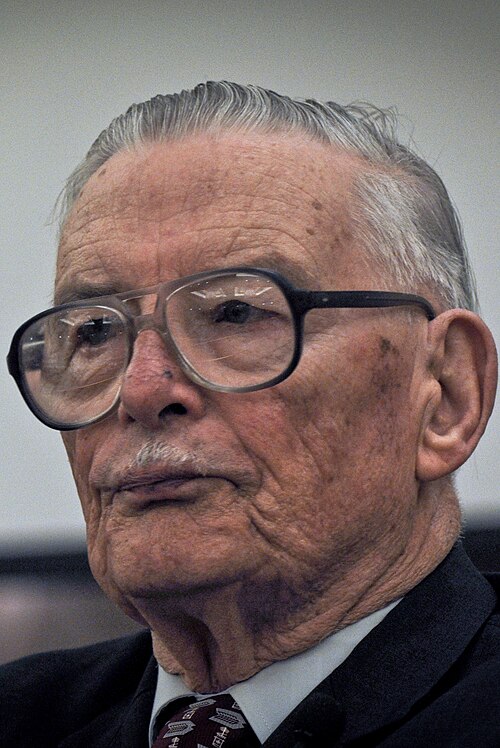
1919–2013 · American
James Buchanan
Public choice - 'politics without romance': politicians and bureaucrats respond to incentives just like the rest of us.
The idea in one paragraph
Economists had a strange double standard. In the market, everyone was assumed to chase their own interest - but the moment someone took a government job, they became a selfless servant of the public good. Buchanan called this romance, and dropped it. Politicians want votes the way bakers want customers; bureaucrats want bigger budgets; voters barely pay attention, because one vote almost never decides anything. Follow those incentives and you get government failure - the mirror image of market failure. The honest comparison is never perfect markets versus perfect government; it's flawed markets versus flawed government. And if you don't like the results, don't swap the players. Change the rules of the game.
The world they lived in
James Buchanan was born in 1919 in Murfreesboro, Tennessee, on a farm with no electricity. His grandfather had been a one-term populist governor of the state; Buchanan milked cows to pay for college, served as a Navy officer in the Pacific war, and arrived at the University of Chicago in 1946 a self-described socialist. Six weeks of price theory with Frank Knight cured him, he later said. In the library he stumbled on an untranslated 1896 dissertation by the Swedish economist Knut Wicksell, arguing that taxes and spending should be judged by whether citizens would consent to them - nearly unanimously - rather than by what experts deemed optimal. He translated it and carried it like a compass for fifty years.
The timing matters. In the postwar decades, economics had a tidy division of labor: markets fail - externalities, monopolies, slumps - and government, modeled as a benevolent and all-knowing corrector, steps in to fix them. Buchanan, working from Virginia rather than the prestige coasts - he built centers at the University of Virginia, Virginia Tech, and finally George Mason University - thought this was theology, not science. Nobody asked whether an actual government of vote-seeking politicians would, or could, follow the textbook. Asking that question won him the Nobel Prize in 1986.
What they argued
Buchanan's phrase for public choice was "politics without romance": take the assumption economists apply to everyone else - people respond to incentives - into the town hall. A politician facing re-election in two years will prefer benefits that arrive before the election and costs that arrive after; hence deficits. A bureau chief is rarely rewarded for spending less, so budgets grow. And since one vote among millions changes nothing, staying politically ignorant is, awkwardly, rational. None of this requires villains; that was the point. The machine produces these results with perfectly ordinary people inside it.
The machine has predictable failure modes. The classic one is concentrated benefits and dispersed costs. American sugar policy - quotas and tariffs that keep domestic sugar prices well above world levels - costs a typical family a few dollars a year, roughly a pizza - and is worth many millions a year to a small number of producers. Who hires the lobbyists, and who doesn't even notice? The policy survives not despite democracy but through it. Add logrolling - legislators trading votes so that a bundle of projects, each benefiting a small minority, passes with a comfortable majority - and you can explain much of any national budget without once mentioning the public interest. Chasing favors from the state, what economists now call rent-seeking (a concept from Buchanan's collaborator Gordon Tullock), quietly burns real resources: talent goes to Washington to redirect other people's money instead of making anything.
So is democracy hopeless? No - and here Buchanan turned constructive. The Calculus of Consent (1962, written with Tullock) drew a line between two levels of politics: choosing the rules of the game and playing the game. Within the rules, politics is interests colliding. But the rules themselves - what majorities may decide and what's off-limits - should command something close to unanimous consent, because behind the constitutional veil you don't know whether tomorrow's majority will be with you or against you. Majority rule, they showed, isn't sacred - just one rule among many, trading the cost of reaching agreement against the risk of being steamrolled. This became constitutional economics: if the game keeps producing bad plays, fix the rulebook, not the players.
The same logic powered his most controversial campaign. In Democracy in Deficit (1977, with Richard Wagner), Buchanan argued that Keynes had handed politicians an academic blessing for what they already wanted to do - spend without taxing. The old unwritten fiscal constitution, which treated peacetime deficits as shameful, had been demolished by clever economics; drop the romance, and the prediction was permanent deficits, boom or bust. His remedy was characteristically constitutional: a balanced-budget rule, binding fiscal policy at the level where politicians couldn't logroll around it.
Where it breaks down
The self-interest lens can be too dark. Political scientist Steven Kelman and economist Amartya Sen, among others, objected that public spirit demonstrably exists - whistleblowers and judges routinely act against their narrow interests, and civil servants are not budget-maximizing robots. The evidence partly agrees: people vote far more often than self-interest predicts. Public choice theorists reply that institutions should still be designed for the people we sometimes are, not the angels we occasionally are - but how selfish political actors really are remains contested.
There's also a status-quo problem, pressed early by the political philosopher Brian Barry and echoed by constitutional scholars since: requiring near-unanimity to change the rules privileges whoever the current rules favor; a frozen constitution can entrench old injustices as easily as it blocks new predation.
The sharpest attack came in 2017, when historian Nancy MacLean's Democracy in Chains portrayed Buchanan's program as a deliberate, donor-funded stealth plan to shackle majority rule, and tied its origins to Virginia's resistance to school desegregation. The book was a National Book Award finalist - and drew unusually broad scholarly pushback. Economists and historians including Michael Munger and Phillip Magness, joined by center-left scholars like Henry Farrell and Steven Teles who share none of Buchanan's politics, documented misread quotations and unsupported inferences. MacLean stands by her argument; the dispute - over both Buchanan's motives and the movement he built - remains genuinely contested, and worth reading in both directions.
Lasting influence
Public choice is now a standing field, and its vocabulary - rent-seeking, government failure, concentrated benefits and dispersed costs - has escaped the seminar room into everyday political argument. The Virginia school he built at George Mason University continues the program, and the Calculus's two-level framework shaped debates from EU fiscal treaties to independent central banks: the whole "rules versus discretion" movement - including Milton Friedman's money-growth rule - shares his instinct that binding the players beats trusting them.
His fingerprints are on real constitutions, too. Balanced-budget amendments in most US states and debt brakes in Switzerland and Germany descend from his argument that fiscal discipline must live in the rules. And he changed the burden of proof in policy debates: after Buchanan, showing that the market fails is not enough - you must also show that the government you actually have, staffed by the humans you actually have, will do better. He worked from his farmhouse nearly to the end, dying in 2013 at 93, a farm boy who spent his life asking who gets to write the rules.