Institutional economics
1899–todayEconomies run on habits, rules, and institutions - not just prices.
The big idea
Textbook economics starts with a rational shopper comparing prices. Institutionalists start one step earlier: who taught that shopper what to want, what counts as fair, and what a contract even is? Their answer is institutions - the habits, customs, laws, and organizations that channel behavior before any price gets quoted. You don't haggle at the supermarket, tip in Japan, or sell your kidney on eBay, and none of that is explained by supply and demand alone. Rules come first; markets grow inside them. Change the rules, and you change what the "same" market does.
When and why it rose
The school has two births. The first was in Gilded Age America, when Thorstein Veblen looked at the rational-actor model and laughed. People aren't lightning calculators of pleasure and pain, he argued - they're creatures of habit and status, buying diamonds precisely because they're expensive (his phrase "conspicuous consumption" stuck). John Commons and Wesley Mitchell built this into the "old institutionalism": study actual laws, unions, and business cycles, not blackboard abstractions. Its great public voice came later in John Kenneth Galbraith, who told postwar America that giant corporations, advertising, and unions - not textbook competition - ran the show.
The second birth was quieter. In 1937, Ronald Coase asked a deceptively simple question: if markets are so good, why do firms exist? His answer - transaction costs - meant the rules of the game could be analyzed with mainstream tools. Douglass North used that lens on history, arguing nations get rich or stay poor largely because of their institutions. And Elinor Ostrom showed that communities worldwide manage the commons with homegrown rules that fit neither "market" nor "state." This "new institutional economics" earned Nobels for all three.
What it got right
The core claim - institutions matter enormously - is now about as close to consensus as economics gets. Why is South Korea rich and North Korea poor? Same people, same peninsula, different rules. Veblen's status-driven consumer looks prophetic in the Instagram age, and Galbraith's warnings about corporate power and manufactured wants read freshly every holiday season. Ostrom's fieldwork overturned the fatalism of the "tragedy of the commons": real fishers and farmers often solve it themselves, and her design principles now guide everything from irrigation projects to open-source software.
Where it fell short
The old institutionalism's weakness was the mirror image of its strength: rich description, thin theory. Critics - Coase himself among them - said it produced "a mass of descriptive material waiting for a theory, or a fire," and by mid-century it had few tools to predict anything. Galbraith drew the same fire in sharper form; Milton Friedman and others argued his big claims (that advertising manufactures demand, that competition was obsolete) were asserted with style rather than tested with data, and some, like his awe of the planned Soviet firm, aged badly. Even the new institutionalism has a nagging problem its own practitioners admit: "good institutions cause growth" flirts with circularity, since we often spot the good institutions by looking at who grew.
Its fingerprints today
Every headline about "strengthening institutions," every World Bank governance index, every debate about why some nations fail - that's this school talking. Coase's transaction costs underpin how economists think about firms, contracts, and even climate policy on externalities. Ostrom's commons research shapes fisheries, forests, and Wikipedia. And whenever someone points out that people buy things for status rather than utility, Veblen smiles somewhere, wryly.
Key figures
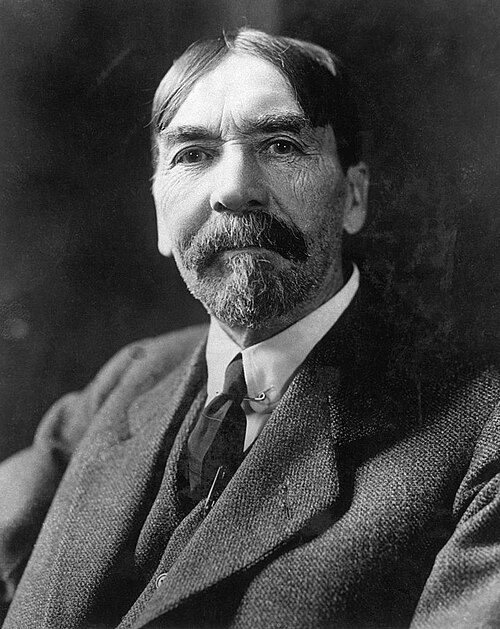
Thorstein Veblen
1857–1929 · American
Conspicuous consumption - we buy things to be seen buying them, and habit and status, not cool calculation, drive economic life.
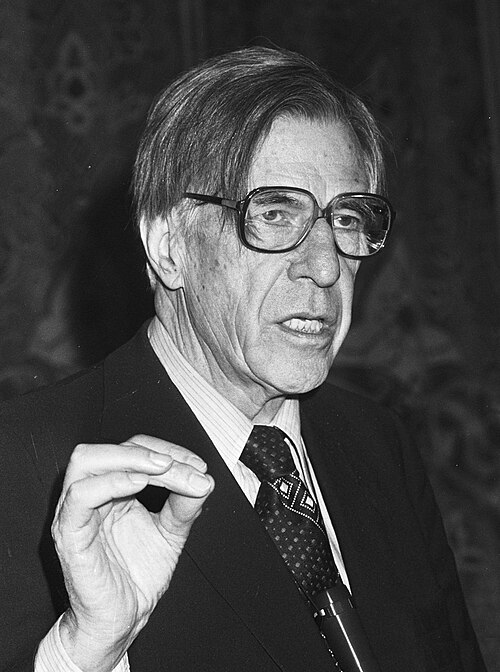
John Kenneth Galbraith
1908–2006 · Canadian-American
The Affluent Society - private opulence, public squalor, and wants manufactured by advertising.
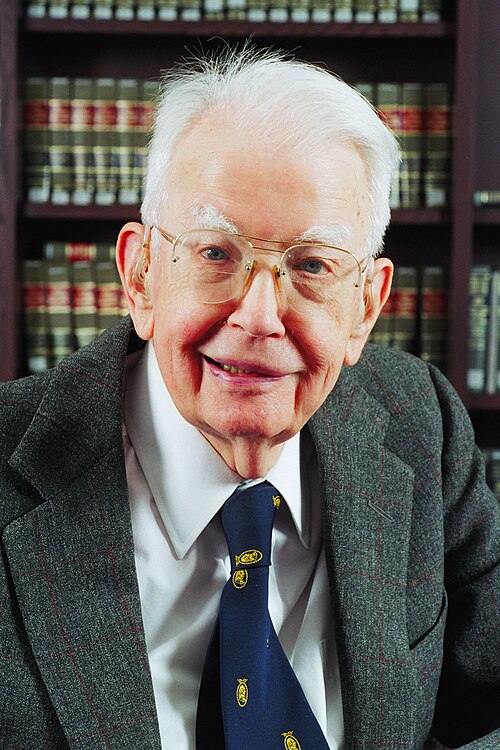
Ronald Coase
1910–2013 · British-American
Transaction costs - firms, contracts, and law all exist because using the market isn't free.

Elinor Ostrom
1933–2012 · American
Governing the commons - real communities manage shared resources for centuries without privatizing them or calling in the state.