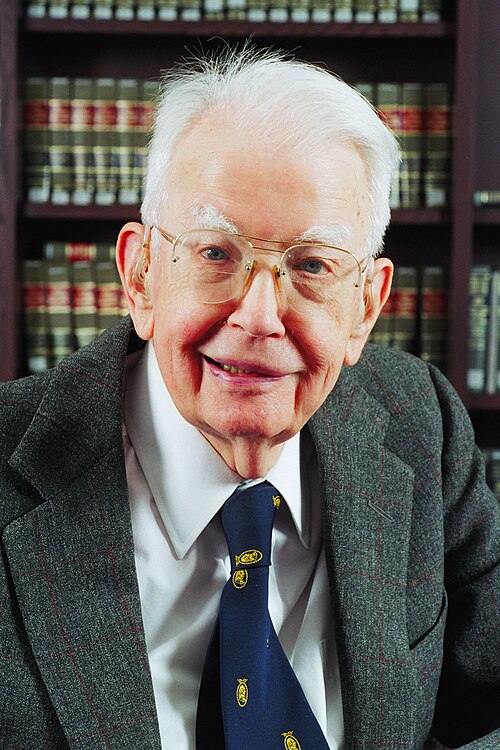
1910–2013 · British-American
Ronald Coase
Transaction costs - firms, contracts, and law all exist because using the market isn't free.
The idea in one paragraph
Here's a question so simple almost nobody thought to ask it: if markets are so wonderful, why do firms exist? Why does your employer give you a boss and a job description instead of auctioning every task to the lowest bidder each morning? Coase's answer: because using the market isn't free. Finding sellers, haggling, writing contracts, enforcing them - these transaction costs can outweigh the benefits of trading, so we organize some things inside firms instead. The same insight transformed law: when the costs of bargaining are low, people negotiate around bad rules; when they're high - which is nearly always - the rules matter enormously. Two papers, few equations, one Nobel Prize.
The world they lived in
Ronald Coase was born in a London suburb in 1910, the son of two post-office telegraphists. He drifted into economics at the London School of Economics almost by accident, having dodged Latin and disliked mathematics. In 1931, aged 20, a traveling scholarship sent him to America to study how industries were organized. He toured Ford and General Motors plants and stumbled on a paradox. Economists were busy arguing that central planning could never work - yet every big company was a little planned economy. If planning fails at the scale of Russia, why does it succeed at the scale of General Motors? His answer became "The Nature of the Firm," drafted before he turned 22.
Coase moved to the United States in 1951 and, after a decade at the University of Virginia alongside James Buchanan, joined the University of Chicago Law School in 1964, where he edited the Journal of Law and Economics for nearly twenty years. He was a strange fit for Chicago's whiteboard warriors: he published rarely, worked from real-world cases rather than models, and proudly did economics without math. It turned out you could win a Nobel Prize (1991) that way - essentially for two articles.
What they argued
Start with the firm. A bakery could, in theory, hire a dough-kneader by the hour at dawn, auction the oven-tending at noon, and negotiate a fresh contract for every tray of croissants. Nobody does this, because discovering prices, negotiating terms, and policing a hundred daily mini-contracts would eat the bakery alive. So the owner hires bakers on open-ended contracts and directs them - a small island of command inside the sea of price signals. Firms exist, Coase argued, exactly where organizing something in-house is cheaper than buying it. And that logic sets their size: a firm expands until doing one more task internally costs more than the market would charge. That single idea founded what's now called new institutional economics.
Twenty-three years later came "The Problem of Social Cost," among the most-cited papers in economics or law. Take a rancher whose cattle stray into a neighboring farmer's wheat - a textbook externality. The standard remedy, from Pigou onward, was obvious: the rancher is the villain, so tax or restrain him. Coase said: not so fast. The harm is reciprocal - restraining the rancher to help the farmer harms the rancher. Now suppose property rights are clear and bargaining is cheap. If the law lets cattle roam, and a fence costs less than the wheat it saves, the farmer will pay for the fence. If the law protects the wheat, the rancher builds the same fence. Either way, the efficient outcome happens; the legal rule only decides who writes the check. George Stigler christened this the "Coase theorem."
And here is the part everyone gets wrong - including, Coase grumbled, many economists citing him. The frictionless world of the theorem was never his point; he called it a preliminary step, a world he explicitly did not inhabit. His real claim was the opposite: transaction costs are never zero. Neighbors don't coolly bargain over cattle, and a thousand people downwind of a factory can't negotiate with it at all. Precisely because bargaining fails, it matters enormously how judges and legislators assign rights - they should ask where resources would end up if bargaining were possible, and put the rights there. Chicago took convincing: at a now-legendary 1960 evening at Aaron Director's house, twenty economists - Milton Friedman among them - started the night voting 20-to-1 against Coase and ended it unanimously converted.
He kept puncturing blackboard habits. Since John Stuart Mill, the lighthouse had been the textbook public good - every ship benefits, none can be charged, so only government can provide it. Coase went to the archives and found that British lighthouses had for centuries been built privately and financed by fees collected on ships at port. The lesson was a method: look at how the world actually works before declaring what's impossible - he derided the alternative as "blackboard economics."
Where it breaks down
The theorem's fine print is where the arguments live. Paul Samuelson objected that even two parties with clear rights may fail to reach the efficient deal - each can bluff and hold out for more, the way hagglers sometimes walk away from a trade good for both. Experimental bargainers often do surprisingly well, but the objection stands, and remains contested.
Critics on the left, including the legal scholar Duncan Kennedy, add a distributional point: "only who pays changes" is doing a lot of work in that sentence. Whether the farmer or the rancher holds the right decides who ends up richer, and in messier settings (through wealth effects) it can change the outcome itself. Efficiency, they argue, was never the only thing at stake - and invoking the theorem against regulation in general assumes exactly the zero-cost world Coase called fictional.
Even the lighthouse got audited. Later scholars, notably David van Zandt and Erik Lindberg, showed that "private" British lighthouses operated under government-granted monopoly rights with state-enforced fees - less a free market than a franchise. Whether the paper debunked the public-good story or merely complicated it is still contested.
Lasting influence
Coase's two questions - why do firms exist, and where should rights go when bargaining fails? - each spawned a field. The first grew into new institutional economics: Oliver Williamson built a theory of when companies should make versus buy, and Elinor Ostrom showed how communities manage shared resources without markets or states; both won Nobels citing Coase's foundations. Every debate about outsourcing, and about whether gig platforms will replace employers, is applied Coase: the internet keeps lowering transaction costs, shrinking what firms need to do in-house.
The second question created law and economics, now standard equipment in every American law school: judges routinely ask which rule gets resources where bargaining would have put them. And one Coase idea moved from heresy to policy in his own lifetime - his 1959 proposal to auction radio spectrum, ridiculed at the time, became how governments worldwide sell airwaves. Cap-and-trade markets for pollution run on the same logic: define the right, then let people trade it. Coase kept working to the end - he published a book on China's market transformation at 101, and died in 2013 at 102, still insisting economists should study the world, not the blackboard.