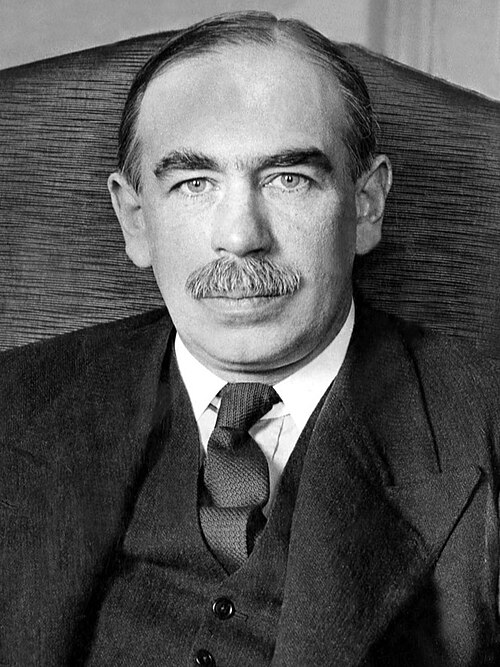
1883–1946 · British
John Maynard Keynes
Argued that economies can get stuck in slumps - and that government spending can pull them out
The idea in one paragraph
Before Keynes, the standard view was that economies fix themselves: if people lose jobs, wages fall, hiring gets cheap, and work returns - just wait. Keynes looked at the Great Depression, a decade of idle factories next to idle workers, and said: you can wait forever, because an economy can get stuck. My spending is your income and your spending is mine, so when everyone cuts back at once, the whole machine spirals down and settles at a level where millions stay unemployed - not because anything's broken, but because nobody's buying. His fix: when private spending collapses, the government should spend in its place, borrowing in the slump and repaying in the boom. Modern macroeconomics - and every stimulus package you've lived through - starts here.
The world they lived in
Keynes was born in Cambridge, England, in 1883, into the intellectual aristocracy: his father taught economics at the university, his mother became the city's mayor. Eton, then King's College, Cambridge; a fellowship, the Treasury, the Bloomsbury set of writers and painters. He made (and lost, and remade) a fortune speculating from bed each morning before breakfast. If anyone was raised to trust the elegant Victorian machine of the gold standard, balanced budgets, and self-correcting markets, it was Keynes. He spent his life watching that machine fail.
The first failure was the peace. Keynes represented the Treasury at the 1919 Versailles conference and resigned in disgust when the Allies loaded a broken Germany with reparations it couldn't pay. His furious little book, The Economic Consequences of the Peace, predicted the settlement would breed poverty, resentment, and another catastrophe. It made him world-famous, and events made him look like a prophet. The second failure was closer to home: Britain spent the 1920s in a slump with unemployment stuck near ten percent, made worse (Keynes argued, loudly) by the decision to jam the pound back onto the gold standard at its prewar value.
Then came the third failure, the one that broke the old economics outright. After 1929, output in the United States fell by roughly a quarter and one worker in four was unemployed. The classical prescription - cut wages, balance the budget, wait - was tried, and the patient got sicker. Into that world, in 1936, Keynes published The General Theory of Employment, Interest and Money: a deliberately revolutionary book arguing that the old theory wasn't wrong so much as a special case - true only in the sunny weather it had been written in.
What they argued
Aggregate demand: my spending is your income
Start with something you've felt. A factory town's big employer announces layoffs. The laid-off workers stop eating out, so the café cuts a shift; the café worker cancels her gym membership; the gym trims staff. Nobody did anything irrational - every household was being sensibly careful - yet each person's caution became someone else's lost income. Keynes's core move was to add all that up into one number, total spending across the economy, or aggregate demand, and to argue that this number, not prices or thrift, is what sets output and employment in the short run. When it falls, businesses don't neatly cut prices and carry on; they cut production and people. And there's a multiplier in the machinery: each dollar not spent subtracts more than a dollar from the town, because it would have been re-spent again and again down the line.
Animal spirits: the economy runs on nerve
The most unstable part of spending is investment - factories, buildings, machines - because it's a bet on a future nobody can calculate. What will demand for your product be in 2040? There is no spreadsheet; the honest answer is "we simply do not know." So, Keynes argued, investment decisions ultimately rest on what he called animal spirits - a businessman's gut-level urge to act rather than sit still. When confidence is high, investment pours in and creates the very incomes that justify it. When something spooks the herd, investment stops, and the fear becomes self-fulfilling: pessimism causes the slump that confirms the pessimism. He compared professional investing to a newspaper beauty contest where you win not by picking the prettiest face, but by guessing which face everyone else will pick - a market that can float free of reality for a long time.
The paradox of thrift: what's wise for you can be ruinous for everyone
Here's the argument that most offended Victorian instincts. For your household, saving more in scary times is plain prudence. But in a slump, if everyone saves more at once, spending falls, so incomes fall - and since savings come out of income, the economy can end up saving no more than before, just at a lower level of activity, with more people out of work. Thrift is a private virtue that can be a public menace, at the wrong time. Note the qualifier, because Keynes meant it: in a boom, saving is exactly what he'd prescribe. The point isn't that saving is bad; it's that timing is everything, and a depression is the one moment the economy needs somebody, anybody, to spend.
Why wages don't just fall (and why it wouldn't save you if they did)
The classical answer to unemployment was that wages should fall until hiring workers becomes a bargain. Keynes had two replies. First, look around: wages don't fall easily. Workers fiercely resist pay cuts (would you shrug one off?), contracts and customs hold rates in place, and firms have their own reasons not to demoralize their staff - economists now call this "sticky wages." Second, and more radically: even if wages did fall smoothly, wages are also incomes. Cut everyone's pay 20 percent and you've also cut 20 percent from what workers can spend at the businesses that were supposed to do the new hiring. The escape hatch the classical model relied on opens onto the same locked room. Falling prices bring their own poison, too: deflation makes debts heavier in real terms, squeezing borrowers into yet more cutbacks.
So somebody has to spend
If the private sector won't spend and wage cuts can't help, only one actor is left with the ability to act against the mood: government. Cut interest rates first - but Keynes warned that in a deep slump cheap money can be like "pushing on a string," because no rate is low enough to make a terrified businessman build a factory. That's when fiscal policy takes over: the state borrows the savings nobody else will use and spends them - roads, houses, schools - putting incomes in pockets, which get spent, which become other incomes. Keynes joked that burying banknotes in bottles for people to dig up would be better than nothing, though houses would be more sensible. The flip side, which his fans remember less often, is symmetry: "the boom, not the slump, is the right time for austerity at the Treasury." Deficits in the bust, surpluses in the boom. He wanted a thermostat, not a permanently open tap.
Where it breaks down
The 1970s hit Keynes's heirs the way the 1930s hit the classicals. Postwar Keynesians had come to rely on a stable trade-off: a bit more inflation buys a bit less unemployment. Then came stagflation - inflation and unemployment rising together, which the simple Keynesian playbook said shouldn't happen and couldn't cure. Stimulating demand now just seemed to feed prices. It was the moment the doctrine lost its monopoly.
The sharpest critic was Milton Friedman, who had predicted exactly that failure in 1968. His argument: you can fool workers with inflation for a while, but they catch on and demand higher wages, so the unemployment "bought" with inflation evaporates while the inflation stays. Friedman also attacked the foundations - his permanent-income theory said households smooth spending over their lifetimes, making one-off stimulus checks weaker than Keynesians hoped, and his history of U.S. money argued the Depression itself was caused less by collapsing animal spirits than by the Federal Reserve letting the money supply collapse. On that reading, the Depression indicts the central bank, not capitalism. (How much each mechanism mattered is still contested among economic historians.) Later, Robert Lucas and the rational-expectations school added that people who anticipate policy will act in ways that defang it.
A second line of attack targets the politics rather than the economics. James Buchanan and Richard Wagner's Democracy in Deficit (1977) pointed out the asymmetry Keynes waved away: deficit spending in a slump is politically delicious, while the prescribed boom-time surpluses are politically poisonous - so in practice democracies run the deficit half of Keynesianism forever. Decades of rich-world debt ratcheting upward in good years and bad is their Exhibit A, though defenders reply that plenty of debt surges came from wars and crises, not stimulus.
And there was Friedrich Hayek, Keynes's great sparring partner in the early 1930s - a duel of reviews and rebuttals between Cambridge and the LSE. Hayek argued that slumps are the hangover from a credit binge: artificially cheap money lures businesses into investments the economy can't actually support, and pumping up demand just delays the reckoning while distorting prices further. Keynes thought liquidating your way through a depression was madness; Hayek thought reflating your way out was a trap. Their argument - spend or cleanse - still restages itself in every recession, which is why this site gives each of them a full profile.
Lasting influence
Keynes didn't just leave a theory; he left a toolkit, and governments have never put it down. The very idea of managing "the economy" as a single object - tracking GDP, forecasting demand, leaning against the business cycle - is Keynesian furniture. So are automatic stabilizers like unemployment insurance, which quietly do his counter-cyclical spending without anyone voting on it. When the 2008 financial crisis hit, and again during COVID in 2020, governments of every political stripe reached for enormous, explicitly Keynesian rescue packages. Even his monetarist rival conceded the frame had won: "in one sense, we are all Keynesians now," Friedman admitted - before adding that in another, nobody was.
His fingerprints are on the world's institutions, too. Dying of heart trouble, Keynes spent his last years negotiating the postwar order at Bretton Woods in 1944, midwifing what became the IMF and the World Bank. He didn't get the plan he wanted - the Americans had the money, so the Americans had the votes - but the idea that economic catastrophe anywhere is everyone's problem is his monument. Today's mainstream macroeconomics is a synthesis that folds Friedman's and Lucas's critiques into a recognizably Keynesian frame: central banks manage demand through monetary policy in normal times, and when the big one hits, the Treasury checkbook comes out. He predicted his own kind of immortality, wryly: "practical men, who believe themselves to be quite exempt from any intellectual influence, are usually the slaves of some defunct economist." Ninety years on, the defunct economist in question is usually him.