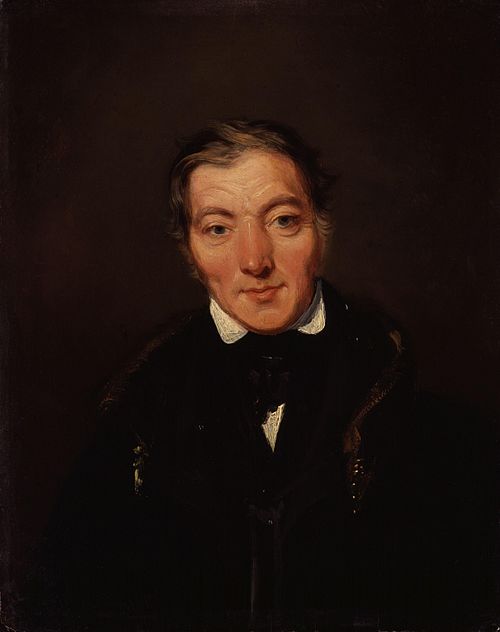
1771–1858 · Welsh
Robert Owen
Proved at New Lanark that a humane factory could still turn a profit - then bet his fortune that cooperative villages could replace capitalism.
The idea in one paragraph
People's characters are made for them, not by them - by upbringing, work, and surroundings. So if a mill town produces exhausted, drunken, illiterate people, don't preach at the people; redesign the town. Owen ran the experiment at his New Lanark cotton mills: no children under ten on the factory floor, shorter hours, decent housing, schools - and the mills still made money. Then came the leap that defined and undid him: if one village could be re-engineered, why not all of society, organized into cooperative villages where competition itself disappears? The first half of that sentence made him the father of humane management and the co-op movement. The second half swallowed his fortune in Indiana.
The world they lived in
Robert Owen was born in Newtown, Wales, in 1771, was apprenticed to a draper at ten, and rose fast through Manchester's booming cotton trade. In January 1800 he took over the New Lanark mills in Scotland, and found the Industrial Revolution at its rawest: around five hundred pauper children, some as young as five or six, working thirteen-hour days at the machinery. This was not an unusually cruel mill. It was a normal one - which was exactly Owen's point.
A word about where he sits on this site: we file him with the Marxist era, but he came a full generation before Karl Marx, who was a schoolboy when Owen was Britain's most famous reformer. In fact the word "socialist" entered the language largely to describe Owen's followers. Marx and Engels later labeled his approach "utopian" socialism, in pointed contrast to their own "scientific" kind - more on that below. Owen's moment was the hungry aftermath of the Napoleonic Wars, when slumps and unemployment pushed him from fixing one factory toward redesigning society, while ministers and foreign royalty trooped through New Lanark to see for themselves.
What they argued
Start with what he actually did, because Owen argued in brick and payroll. At New Lanark he stopped employing children under ten and sent them to school instead; he cut children's working hours from thirteen a day to ten; he built decent housing and a store selling goods near wholesale prices; and in 1816 he opened his Institute for the Formation of Character, which included Britain's first infant school. His partners grumbled at the expense, so he replaced them with investors (including the philosopher Jeremy Bentham) who would accept steady returns. And here is the part that amazed visitors: the mills stayed commercially successful. Kindness, Owen insisted, was not charity. It was competent management of what he called the living machinery, which repaid care at least as well as the iron kind.
Behind the practice sat a doctrine, laid out in A New View of Society (published in essays from 1813): character is formed by circumstances, above all in childhood. Blaming the poor for vices their environment manufactured struck Owen as both cruel and stupid - you don't punish a machine for the way it was built. The rational response to bad character is not sermons or prisons but better circumstances: education, sane working hours, healthy surroundings. It followed that society's misery was an engineering problem, and engineering problems have solutions.
His Report to the County of Lanark (1821) scaled the blueprint up: "villages of unity and cooperation," self-supporting communities of roughly a thousand people combining farming and manufacturing, where work - not money - would be the measure of value, an idea close to the labor theory of value, later tested in Owenite labor-note exchanges. This is also where he crossed swords with Thomas Malthus: where Malthus argued population must outrun food, Owen countered that properly organized communities could raise production faster than the mouths arrived. Pessimism about the poor, in his view, was just bad system design blaming its victims.
He also gave labor its most durable slogan. By 1817 Owen had boiled the day into "eight hours labour, eight hours recreation, eight hours rest," and in 1833 joined union leaders to campaign for the eight-hour factory day - a century before it became the norm.
Where it breaks down
The grand communes failed, and quickly. In January 1825 Owen bought the town of Harmony, Indiana, renamed it New Harmony, and invited the world to build the future. The world showed up: idealists, scientists, cranks, and a fair number of people keen on the "equal shares" part but less keen on the "work" part. With rewards detached from effort, the incentive problem did its quiet demolition work; the community splintered into factions and dissolved within about two years, taking much of Owen's fortune with it. New Lanark had a paying business, a disciplined workforce, and Owen on site. New Harmony had a theory.
The sharpest critique came from an admirer. Friedrich Engels, in Socialism: Utopian and Scientific, called Owen a man of "almost sublime, childlike simplicity of character" and "one of the few born leaders of men," and credited him with transforming New Lanark. But that, Engels argued, was precisely the utopian trap: Owen treated socialism as a timeless truth that a genius discovers, demonstrates in a model village, and sells to the rich by persuasion. History doesn't work that way, said Engels - the owners of the means of production would never be argued out of them; change would come from the working class's own struggle, driven by economic development, not from benevolent blueprints. Every commune that failed seemed to prove his point.
There's a quieter problem too. If character is wholly made by circumstances, someone has to design the circumstances - and Owen's answer was always, in effect, someone like Owen. A village needs a benevolent planner; a world of villages needs a world of them. Scale that up and you meet every difficulty later associated with central planning, plus a question Owen never quite answered: who forms the character of the character-formers? Skeptics note that New Lanark may prove less about cooperation than about what one exceptional manager can do with a profitable firm.
Lasting influence
Follow the threads and they run surprisingly far. The co-operative movement is the most direct descendant: the Rochdale Pioneers of 1844 drew on Owenite ideas, and today's co-ops and credit unions descend through them. Labor law is the second thread: the factory acts Owen demanded arrived slowly across the nineteenth century, and his eight-hour slogan became the international labor movement's banner and, eventually, the ordinary working day. New Lanark itself still stands, preserved as a World Heritage village - a monument you can walk through.
The third thread runs through every modern workplace. The claim that treating workers well is profitable - the premise of every HR department and every mission statement declaring people the company's greatest asset - is Owen's New Lanark pitch, made two centuries early to mill owners who lavished maintenance on their spinning machines while their workers wore out. And through Marx and Engels, who kept his ambition while discarding his methods, even his failures were fertile: "utopian socialism" is remembered mostly as the thing scientific socialism defined itself against. Not a bad afterlife for a draper's apprentice from Newtown: the humane factory succeeded so thoroughly we stopped noticing it, and the utopia failed so instructively that everyone who came after had to answer him first.