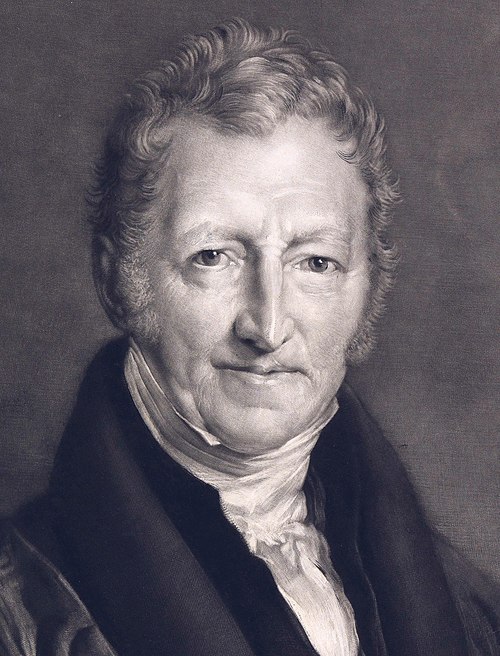
1766–1834 · English
Thomas Malthus
Population grows faster than food - so prosperity keeps getting eaten by extra mouths. Until, suddenly, it didn't.
The idea in one paragraph
Give a village a better plow and within a generation it won't have richer villagers - it will have more villagers, just as hungry as before. That was Malthus's dark arithmetic: population, when unchecked, doubles like compound interest (2, 4, 8, 16), while food output grows by addition (2, 3, 4, 5). Any gain in living standards therefore gets swallowed by extra mouths, and humanity stays pinned near subsistence - the "Malthusian trap." He published this in 1798, and history immediately played its greatest practical joke: the Industrial Revolution broke the trap for the first time ever, at almost exactly the moment he described it.
The world they lived in
Malthus was born in Surrey in 1766, son of a gentleman intellectual who admired Rousseau and believed humanity was perfectible. The younger Malthus - a mild, well-liked clergyman with a mathematics degree from Cambridge - kept losing dinner-table arguments to his father's optimism, so he wrote them down. The result, published anonymously in 1798, was aimed squarely at utopians like William Godwin and the Marquis de Condorcet, who saw a future of endless improvement. Malthus asked the rude question: improvement for how many? Around him, the evidence looked grim. England was at war with revolutionary France, harvests had failed, bread prices were punishing, and spending on poor relief was climbing fast.
The next two decades hardened the argument's stakes. The Napoleonic wars choked off imported grain; when peace came in 1815, Parliament passed the Corn Laws - a tariff wall keeping bread dear to protect English landlords, which Malthus (almost alone among economists) defended. Meanwhile the first stirrings of industrial England - mills, canals, crowded new towns - were making the population question urgent: the first census, in 1801, startled everyone with how many Britons there were. Malthus became the country's first professor of political economy in 1805, and struck up one of the great friendships in the history of the subject, with his fiercest opponent: David Ricardo.
What they argued
Start with the famous ratios. "Population, when unchecked, increases in a geometrical ratio," Malthus wrote. "Subsistence increases only in an arithmetical ratio." People can double their numbers every generation or so; fields cannot double their yield on the same schedule, because good land runs out. Something has to give - and what gives, he argued, is the standard of living. Wages rise, couples marry earlier and have more children, the labor market floods, and wages sink back toward bare survival. Prosperity is self-canceling.
But the caricature - Malthus as the prophet of inevitable famine - sells him short. He distinguished two brakes on population. The positive checks were the horrors: famine, disease, war, raising the death rate. The preventive checks worked through the birth rate: later marriage and what he called "moral restraint." In the much-expanded second edition of 1803, and in the four editions after it, restraint moved to center stage. Humanity wasn't doomed to starve; it could choose prudence instead. His hard edge showed in policy: he argued that the Poor Laws, by subsidizing large families, gave people an incentive to have children they couldn't feed - kindness that manufactured the misery it meant to relieve. You can dispute that (many did, loudly), but it's an argument, not a snarl.
The trap itself was his deepest insight. If every gain in output turns into more people rather than richer people, then living standards can't permanently rise - which is a startlingly good description of most of human history. A peasant in 1700 ate roughly as well as one in ancient Egypt, despite three thousand years of invention. Malthus explained why: technology raised the number of people the land supported, not how well each one lived.
His second act came after 1815, when Britain slumped after the wars and Malthus asked whether a country could suffer a "general glut" - too much production chasing too little spending. Impossible, said Jean-Baptiste Say and Ricardo: supply creates its own demand, since every sale becomes someone's income. Malthus insisted the ledger could still fail: if too much income is saved rather than spent, goods pile up and workers go idle. He lost the debate - Ricardo's logic was tighter - but he had groped toward what we now call a shortfall of aggregate demand. A century later, John Maynard Keynes re-fought the argument and declared Malthus its true winner.
Where it breaks down
Malthus made two great errors, and they were the same error: betting against surprise. First, food. He assumed farm output could only crawl; instead, mechanization, fertilizer, and eventually the twentieth century's Green Revolution made food grow faster than people. England's population roughly quadrupled in the century after the Essay - while ordinary living standards rose, not fell. Second, babies. The demographic transition ran his mechanism in reverse: as families got richer, they had fewer children, not more, trading quantity for education and comfort. On his own logic, prosperity should have been self-canceling; it turned out to be self-reinforcing.
Fairness demands the other half of the verdict. For the world before 1800, the model fits the evidence remarkably well - economic historians such as Gregory Clark have argued that pre-industrial incomes really did move the way Malthus said, with plagues raising wages and good times erasing them. He wasn't wrong about the world he could see; he was standing at the one moment in history when its rules were being rewritten. As the Concise Encyclopedia of Economics dryly notes, the timing, not the reasoning, was his undoing.
Lasting influence
The Essay's most famous reader wasn't an economist. Charles Darwin picked it up "for amusement" in 1838 and found the engine of natural selection: more offspring are born than can survive, so the environment selects. Alfred Russel Wallace credited the same book. A theory about parish poverty ended up reorganizing biology.
Within economics, Malthus seeded two traditions. His population mechanics shaped Ricardo's theory of wages and rent and gave Karl Marx a foil he attacked furiously (Marx thought "overpopulation" was a property of capitalism, not nature). And his heresy about gluts became an ancestry: Keynes, in his Essays in Biography, wished that economics had descended from Malthus rather than Ricardo, claiming him as the first of the Cambridge economists. Beyond the discipline, his name became an adjective. Every warning that we are outrunning the planet - from the 1970s Limits to Growth to modern climate anxiety - gets called Malthusian, and every rebuttal cites the trap that technology broke. Two centuries on, we are still holding the dinner-table argument between Malthus and his optimistic father.