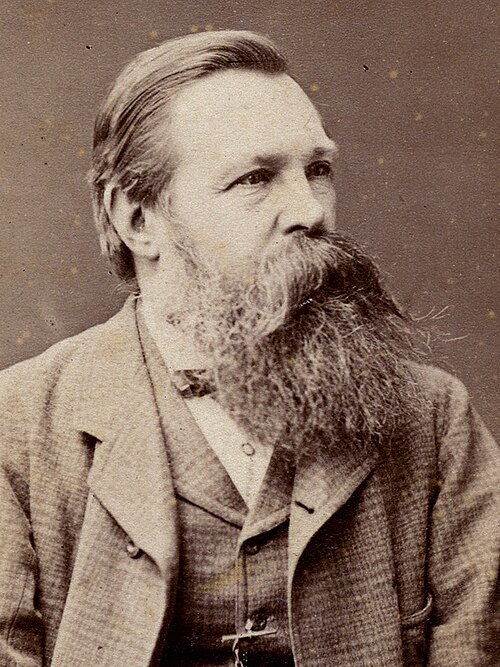
1820–1895 · German
Friedrich Engels
Co-author of the Communist Manifesto, first great reporter of industrial poverty, and the man who turned Marx's ideas into Marxism
The idea in one paragraph
Friedrich Engels lived a double life that sounds invented: a factory owner's son who managed a Manchester cotton mill by day and worked to overthrow capitalism the rest of the time. He wrote the first great exposé of industrial poverty at twenty-four, co-authored the Communist Manifesto with Karl Marx, and then spent twenty years in a job he hated so his penniless friend could write Capital. When Marx died, Engels assembled volumes 2 and 3 from crates of near-illegible manuscripts - and in his own books he turned Marx's sprawling ideas into a system the world could learn, a system he named "scientific socialism." If Marx built the theory, Engels built the movement.
The world they lived in
Engels was born in 1820 in Barmen, a Prussian mill town so smoky and pious it was nicknamed the "German Manchester." His father owned textile factories and expected his eldest son to run them. His father got his wish, in the least imaginable way: in 1842 the family sent young Friedrich - already flirting with radical journalism - to work at the firm's cotton-thread mill in Manchester, England, hoping business would knock the politics out of him.
Manchester in the 1840s was the future arriving early, and it was terrifying. It was the fastest-growing industrial city on Earth - cotton mills running day and night, fortunes being made - while the workers who ran the machines lived in cellar rooms behind the shopping streets, packed families to a room, with cholera in the water and children in the factories. Britain's establishment called it "the Condition of England question" and wrung its hands. Engels went and looked. Guided through the slums by Mary Burns, an Irish factory worker who became his lifelong partner, he spent his evenings walking the districts that respectable Manchester had literally built its streets to hide.
The other thing in the air was revolution. Across Europe in the 1840s, old monarchies were creaking, harvests were failing, and radical clubs were multiplying. In 1844, on his way home from Manchester, Engels stopped in Paris to meet a fellow radical editor he'd corresponded with: Karl Marx. They talked for ten days straight and found they agreed on essentially everything. The partnership lasted forty years, and 1848 - when revolutions really did break out across Europe, just as their freshly printed Manifesto hit the streets - bound them together for good.
What they argued
Go and look: The Condition of the Working Class in England
Engels's first major work, written when he was twenty-four, was something new: economics done with your own eyes. The Condition of the Working Class in England (1845) is a walking tour of Manchester's slums - the courtyards where one privy served a hundred people, the mill children deformed by machine work, the life expectancy gaps between rich and poor districts that he tallied street by street. His argument was that none of this was an accident or a moral failing of the poor. The poverty was produced by the same system producing the wealth - the factory owner's profit and the worker's cellar were two ends of one transaction. Modern investigative journalism, urban sociology, and every "I went to see for myself" exposé since owes something to this book.
The partnership - and the money
Engels always said he played "second fiddle" to Marx, and he meant it as a plain description: Marx was the deeper theorist, and Engels knew it. But the fiddle mattered. Engels was the clear writer, the quick study, the one who had actually worked inside a capitalist firm and knew how capital behaved from the inside. He drafted the catechism-style pamphlet that Marx transformed into the Communist Manifesto. And after the 1848 revolutions collapsed and Marx landed in London - exiled, unemployable, and chronically broke - Engels made the least romantic sacrifice imaginable: he went back to Manchester and spent nearly twenty years at a desk in the family firm, work he privately called "the huckstering business." A steady share of his income went straight to the Marx household; without it there is no Capital. He even wrote Marx's newspaper articles for him - dozens of pieces for the New York Tribune ran under Marx's byline - so his friend could keep both the fee and the reputation.
Finishing Capital
Marx published only volume 1 of Capital (1867) in his lifetime. When he died in 1883, he left behind a mountain of drafts, variant chapters, and notebooks in handwriting that at times only Engels on Earth could read. Engels spent most of his remaining twelve years as editor and reconstructor, publishing volume 2 in 1885 and volume 3 - which contains much of the system's machinery, including how surplus value gets shared out as profit, interest, and rent - in 1894, the year before his own death. Scholars still debate his editorial choices, but the blunt fact stands: two-thirds of Capital exists because Engels built it from the wreckage.
Scientific socialism: turning ideas into a system
Engels's most distinct contribution came late, and it's the reason "Marxism" is a word. In Anti-Dühring (1878) and its wildly popular short version, Socialism: Utopian and Scientific (1880), he did what Marx never quite did: explained the whole framework, in order, in prose a self-educated factory worker could follow. Earlier socialists - Owen, Fourier, Saint-Simon - were "utopians," he argued: decent people who sketched ideal communities and hoped the rich would fund them. Engels's socialism claimed to be scientific: history moves through stages driven by how societies produce things, capitalism is one stage, and its own internal conflicts - above all, between the class that owns the means of production and the class that owns only its labor - generate the forces that end it. You don't have to share the conclusion to see the appeal: it told workers that history was on their side, the way gravity is on water's side.
There was steel in the argument, too, not just prophecy. Engels pointed at things everyone could see: booms and busts arriving in regular waves, small firms being swallowed by giant ones, wealth concentrating while the people producing it stayed poor. The labor theory of value he and Marx built on - the claim that labor is the source of value, and profit is the unpaid part of the worker's day - gave those observations a single engine. Whatever its fate among economists (see below), as an organizing story it was the most successful piece of economic writing of the nineteenth century.
Where it breaks down
Start with the book that made him. Historians W. H. Chaloner and W. O. Henderson argued in the 1950s that The Condition of the Working Class in England cherry-picked its sources, recycled outdated reports, and painted 1844 with data from the hungry 1830s. Other historians - E. P. Thompson and Eric Hobsbawm among them - countered that Engels's broad picture holds up well against what we now know. The fair verdict is contested: a passionate eyewitness account with real statistics and a thumb on the scale.
The bigger problem was the prediction at the theory's heart. Engels and Marx expected workers under capitalism to grow steadily more miserable until the system snapped. Instead, real wages in Britain roughly doubled over the second half of the nineteenth century, and the immiseration never came - something Engels himself half-conceded when he grumbled that English workers were becoming comfortable and respectable. The labor theory of value fared no better: in the 1870s, economists like Jevons, Menger, and Walras rebuilt value theory on what buyers actually want (a diamond isn't valuable because of the labor in it - dig one up by accident and it's worth just as much), and Eugen von Böhm-Bawerk's Karl Marx and the Close of His System (1896) pressed the case that volume 3's profit theory contradicted volume 1's. Mainstream economics never went back.
"Scientific" socialism drew its own fire. The philosopher Karl Popper argued that a theory that treats every outcome - revolution or no revolution, wage rises or wage falls - as confirmation isn't science at all, because nothing could ever count against it. And some scholars, notably Terrell Carver, argue that Engels's tidy system - especially his attempt to extend "dialectics" into a law of nature itself - flattened Marx's subtler ideas into the catechism that later hardened into Soviet dogma. Whether Engels clarified Marx or distorted him is genuinely contested; what's not contested is that the twentieth century's planned economies claimed his framework, and their fate - see Mises and Hayek on why central planning starves itself of information - is part of his ledger too.
And yes, critics have always enjoyed the irony: the great theorist of exploited labor was financed by a cotton mill's profits. Engels knew. He called the contradiction his cross to bear, and bore it for twenty years.
Lasting influence
Every time someone says "Marxism," they're using a thing Engels largely assembled. Socialism: Utopian and Scientific outsold everything Marx wrote during their lifetimes and became the standard introduction to the doctrine for millions; the official philosophy of the Soviet bloc, "dialectical materialism," descends more from Anti-Dühring than from anything in Capital. That's a legacy with a heavy shadow, and he owns a share of it.
But his fingerprints are on gentler things, too. The Condition of the Working Class in England is an ancestor of the factory inspection report, the public-health survey, and the muckraking exposé - the whole tradition of arguing about poverty with door-to-door evidence. The Origin of the Family helped found the anthropology of household and gender. Capital volumes 2 and 3 exist. And he remains history's best argument that an editor, a funder, and a loyal friend can bend the course of ideas as surely as a genius can - Marx said as much, and for once the second fiddle deserves the last note.