Marxist Economics
1848–todayCapitalism runs on unpaid labor, breeds crisis, and digs its own grave.
The big idea
Marxist economics starts with a question about your paycheck: if a day's work produces, say, ten hours' worth of value, why does your wage buy only six? The gap - what Karl Marx called surplus value - goes to whoever owns the factory, the shop, the means of production. Profit, in this view, isn't a reward for cleverness; it's the unpaid portion of labor. And the system that runs on it is not eternal but historical: capitalism was born, it will convulse, and it will die, making way for socialism.
When and why it rose
Look at Manchester in the 1840s and the theory almost writes itself. Children worked twelve-hour shifts in cotton mills. Families slept eight to a cellar. Friedrich Engels, sent there to help run his family's factory, instead documented the misery in The Condition of the Working Class in England - then spent decades funding and co-writing with Marx, whose Capital (1867) gave the movement its cathedral.
Marx built with the classical economists' own bricks. He took Ricardo's labor theory of value seriously - more seriously than Ricardo had - and pushed it to a radical conclusion. History, he argued, moves through class struggle; capitalism's competitive pressure forces bosses to squeeze workers and replace them with machines; the result is recurring crises, each one bigger, until the workers take over the machinery their labor built.
What it got right
Steelman first: Marx was one of the nineteenth century's sharpest observers of capitalism, and some calls have aged well. He predicted globalization - capital restlessly chasing markets "over the entire surface of the globe" - when most economists were still thinking nationally. He predicted recurring crises at a time when mainstream theory said economy-wide gluts were impossible; the panics of his century and ours kept proving him more right than Say. He saw concentration coming: small firms swallowed by giants describes Amazon-era capitalism uncomfortably well. And his insistence that economic arrangements shape politics, culture, and power - not just prices - founded whole fields of social science used by people who reject everything else he wrote.
Where it fell short
The predictions at the theory's heart failed. Workers' living standards in capitalist countries rose spectacularly rather than immiserating - the revolution was supposed to start in industrial Germany or Britain, not agrarian Russia. The labor theory of value ran into the same problem that sank it for the classicals, plus one of its own: the "transformation problem" of squaring labor values with actual prices, which economists from Böhm-Bawerk (1896) onward argued was never solved (Marxist economists contest this; the debate is genuinely unresolved). And the deepest wound came later: Ludwig von Mises and Friedrich Hayek argued that abolishing market prices destroys the information an economy needs to plan - a critique the Soviet experience of shortages and gluts made hard to dismiss. Whether the USSR's failure discredits Marx's analysis of capitalism, as opposed to attempts to build socialism, is itself contested.
Its fingerprints today
Marx's vocabulary is now everyone's: "capitalism" as the name of the system, "class conflict," "exploitation," "late capitalism" as a wry hashtag. Labor movements, the eight-hour day, and welfare states owe much to pressure his ideas organized - reforms that, ironically, helped capitalism outlive him. Roughly one in five humans still lives under a state that claims his banner, mostly running market economies he'd barely recognize. And after every financial crisis, sales of Capital tick upward.
Key figures
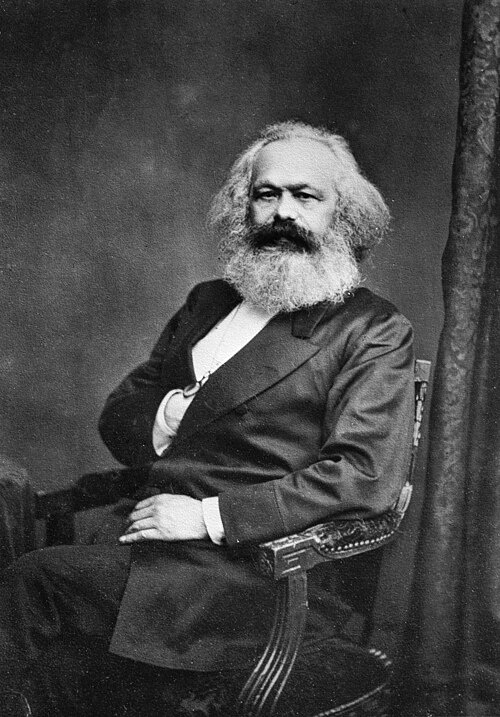
Karl Marx★
1818–1883 · German
Profit, he argued, is unpaid labor - capitalism runs on extracting surplus value from workers, and its own contradictions would bring it down.
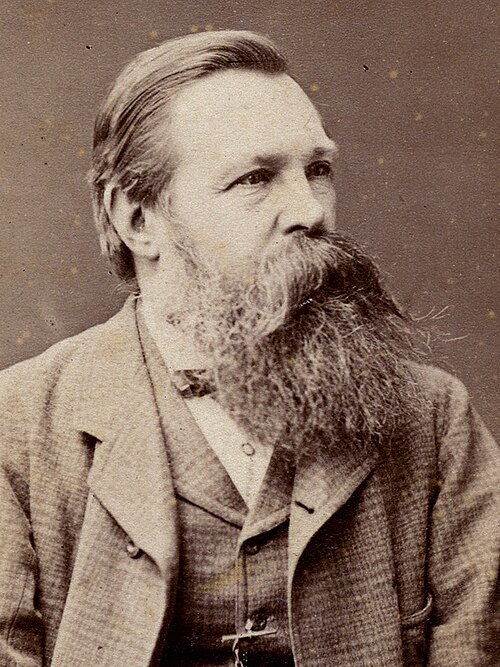
Friedrich Engels★
1820–1895 · German
Co-author of the Communist Manifesto, first great reporter of industrial poverty, and the man who turned Marx's ideas into Marxism
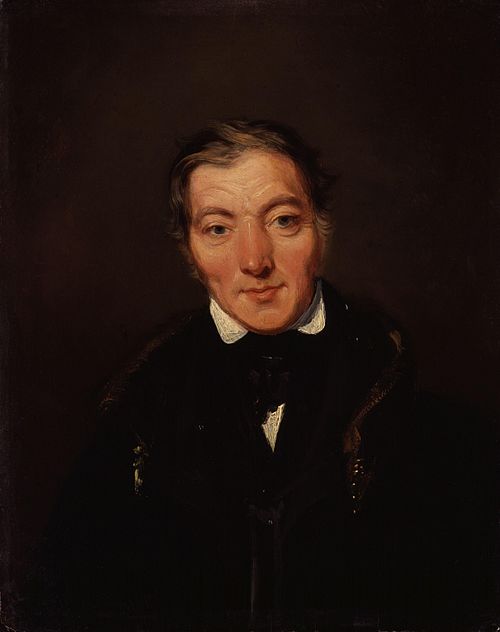
Robert Owen
1771–1858 · Welsh
Proved at New Lanark that a humane factory could still turn a profit - then bet his fortune that cooperative villages could replace capitalism.