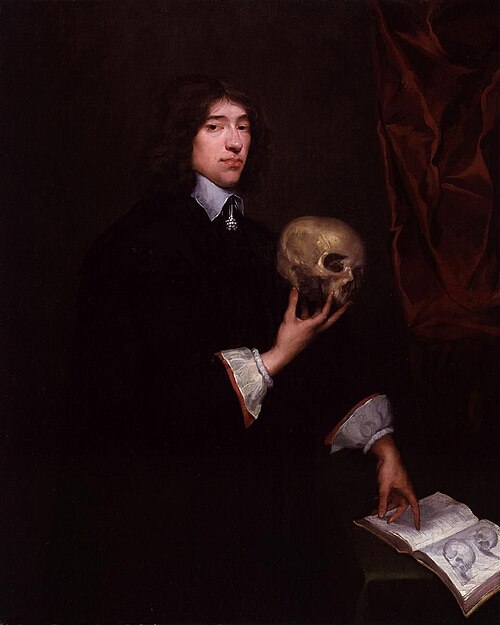
1623–1687 · English
William Petty
Political arithmetic - the first serious attempt to measure a nation's income, wealth, and people in 'number, weight, and measure.'
The idea in one paragraph
Before you argue about an economy, count it. That was William Petty's whole method, and in the 1660s it was revolutionary. While others traded elegant opinions, Petty tried to put numbers on England: what the nation earned, what it spent, what its land, houses, ships, and people were worth. He called it "political arithmetic" - speaking in "number, weight, and measure" instead of adjectives - and it made him the great-grandfather of every statistic in the news, GDP included. Along the way he noticed that money's speed matters as much as its amount, and that all value traces back to two parents: land and labor. Crude numbers, he bet, beat confident guesses.
The world they lived in
Petty's life reads like an adventure novel with footnotes. The son of a poor Hampshire clothier, he went to sea as a cabin boy at thirteen, was put ashore in France with a broken leg, talked his way into a Jesuit college, studied medicine across Europe, and rose to professor of anatomy at Oxford. Then came the career swerve: in the 1650s he became physician-general to Cromwell's army in Ireland, where he took on the job nobody thought possible - surveying the whole conquered country so its land could be parceled out to soldiers and creditors. His "Down Survey" mapped Ireland in about thirteen months, made him rich in Irish acres, and trailed accusations of self-dealing for the rest of his life.
He belonged to the generation that invented modern science, and it shows. A founding member of the Royal Society, a friend of Hobbes, a tinkerer who designed a twin-hulled boat, Petty simply applied the new experimental spirit to the state itself. Restoration England gave him plenty to measure: a monarchy short of revenue, expensive wars against the Dutch, plague, the Great Fire, and a nagging national anxiety that little England could never compete with mighty France or rich Holland. Petty's numbers were built to answer exactly those worries.
What they argued
Political arithmetic starts with a startlingly modern move: estimate national income by adding up what everyone spends. Petty reckoned England's people laid out about £40 million a year, checked that against what land and labor could plausibly earn, and drew conclusions no one had been able to draw before. The biggest: most of England's income came not from land - the thing seventeenth-century minds equated with wealth - but from labor. If the people's hands and skills were the real asset, then England, small as it was, could out-earn France. It's the same logic your bank uses when it cares more about your salary than your furniture, scaled up to a kingdom.
Counting the coin came next, and here Petty asked a question nobody had posed clearly: how much money does a nation actually need? His answer: it depends on how fast money moves. If workers are paid weekly rather than quarterly, the same few shillings pass through many hands, and a small stock of coin can carry a large volume of trade. That insight - velocity - is the crucial missing piece of what later became the quantity theory of money. Petty even supplied the image: money is the fat of the body politic - too little and it sickens, too much and it clogs the works. A country could, in other words, have too much money: heresy to a gold-hoarding mercantilist, common sense to a doctor.
Underneath the counting sat a theory of value: "labour is the father and active principle of wealth, as lands are the mother." A bushel of corn is worth what it costs in land and labor to produce; Petty spent years hunting for a "par" - a fixed exchange rate between an acre and a day's work - so that everything could be valued in one unit. He never found it, but the search planted the seed of the labor theory of value that would grow through Smith and Ricardo into Marx.
His Treatise of Taxes applied the method to the state's touchiest subject. Taxes, he argued, should be certain rather than arbitrary, proportioned to what people actually consume, and cheap to collect - he favored excises on spending over crude levies on land. And he insisted that money taken in taxes and spent at home isn't destroyed, it circulates; better, he said, for the state to pay men to build even a useless monument on Salisbury Plain than to let them stand idle - a startling anticipation of arguments John Maynard Keynes would formalize 250 years later.
Where it breaks down
The obvious critique: many of Petty's numbers were guesses wearing lab coats. He extrapolated national totals from thin samples, chimney counts, and burial records, and his precision often outran his evidence - sometimes conveniently, when a patron needed a particular answer. Later readers were blunt about it. Adam Smith wrote, "I have no great faith in political arithmetick." Jonathan Swift went further: A Modest Proposal, with its coolly computed case for eating Irish babies, is widely read as a parody of exactly Petty's style - the ledger voice applied to human beings.
Swift's target was well chosen, because Petty's arithmetic served conquest. The Down Survey was not neutral science; it was the instrument by which Irish land passed wholesale to English hands, with Petty among the beneficiaries. Counting people as "capital" and colonies as assets is the dark twin of national accounting, and historians have not let him off that hook. His value theory fared little better: the land-labor "par" never worked, and economists after the 1870s abandoned cost-based theories of value altogether, arguing that value lives in buyers' heads, not in acres or hours. His velocity insight, finally, was a sketch rather than a theory - it took two more centuries to nail down when money's quantity drives prices and when it doesn't.
Lasting influence
Every national statistic you've ever heard a politician cite descends from Petty. The line runs from political arithmetic through the first census takers to Simon Kuznets building modern GDP accounts in the 1930s - and to every unemployment rate, inflation print, and debt-to-GDP ratio in this morning's news. His velocity of money became the engine of the quantity theory, refined by Irving Fisher and revived by Milton Friedman. His land-and-labor theory of value flowed into the classical mainstream via Richard Cantillon - who sharpened Petty's ideas even while criticizing them - and then into Smith and Ricardo.
And he earned an unlikely admirer. Karl Marx, not a man free with compliments, called Petty the founder of political economy and treated him as the true discoverer of the labor theory of value that Capital is built on. It is a fitting legacy for a cabin boy who mapped a country: both the economists who defend markets and the one who tried to bury them trace their family tree back to his ledgers.