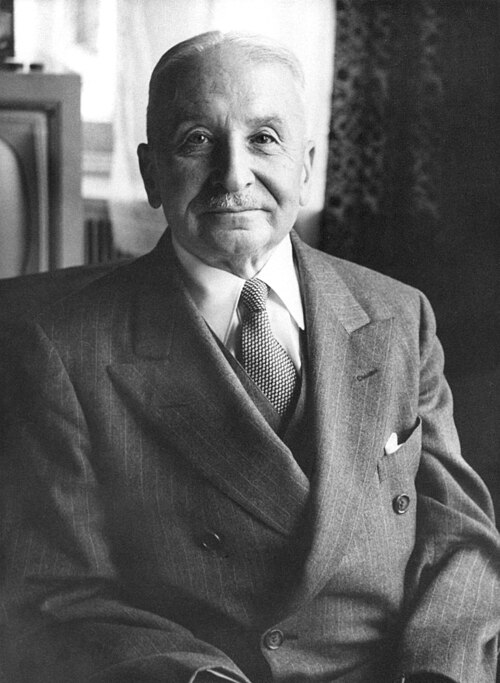
1881–1973 · Austrian-American
Ludwig von Mises
The economic calculation problem - why central planners can't do the math without market prices
The idea in one paragraph
Imagine you're in charge of a whole economy and you have to decide: should the new railway go through the mountain, or around it? Through uses less steel but more engineering; around uses more land, more fuel, forever. Which choice wastes less? In a market economy you'd compare costs in money and get an answer. But money prices come from people trading things they own - and under socialism, nobody owns the mines, machines, or land, so nothing is traded and no real prices exist. Mises's 1920 claim, decades before the queues and shortages: a planned economy isn't just harder to run than a market one. Without prices, rational economic calculation is impossible - planners are "groping in the dark."
The world they lived in
Mises was born in 1881 in Lemberg, a provincial capital of the Austro-Hungarian Empire (today it's Lviv, Ukraine), and made his career in Vienna - one of the most intellectually electric cities on Earth, and the birthplace of the Austrian school of economics. He studied under the school's second generation, absorbed its core idea that value is subjective (things are worth what people want them to be worth, not what they cost to make), and by 1912 had written the leading treatise on money in the German language. Then the First World War destroyed the empire he lived in.
What came next made his life's question urgent. Revolutionary Russia was abolishing markets in earnest; "Red Vienna" was governed by socialists; hyperinflation was eating through Austria's currency. Everywhere, the ideas of Karl Marx seemed to be winning - and Marx, deliberately, had written almost nothing about how a socialist economy would actually be organized day to day. Mises took that missing chapter as his target. His 1920 essay and the 1922 book that grew out of it, Socialism, launched what historians call the socialist calculation debate - the great argument over whether a modern economy can run without markets. Working alongside him and running his famous private seminar was a younger economist named Friedrich Hayek, who would carry the argument further.
Mises's uncompromising liberalism made him unemployable in the increasingly fascist Austria of the 1930s; as a Jewish classical liberal he was doubly a target. He left for Geneva in 1934 and fled to New York in 1940, where he taught at NYU until 1969 - out of fashion for decades, and stubbornly unbothered by it. He died in 1973, sixteen years before the Berlin Wall came down.
What they argued
The calculation problem
Here's the everyday version. You know roughly what your weekly groceries cost, so when a fancier apartment tempts you, you can weigh rent against everything else in one common unit: money. Now scale that up. A modern economy makes millions of goods with millions of possible methods. Should this factory's new roof be steel or concrete? Should the wheat go to bread, whiskey, or seed? Should the last railcar of coal heat homes or smelt iron? Every choice uses resources that then can't be used for something else - an opportunity cost - and a sane economy needs some way to compare those alternatives in a common unit.
Mises's point is that market prices are that common unit, and they only exist because of trade. A steel price emerges from thousands of buyers and sellers of steel, each putting their own money where their own judgment is. Abolish private ownership of the means of production - as socialism, by definition, does - and those trades never happen, so the prices never form. The planner can still list what's physically possible. What he can't do is tell which option squanders the least value, because there's no unit to measure value in. It's not that the planner's math is hard; it's that the numbers he'd need don't exist. "Without economic calculation there can be no economy," Mises wrote. The plan isn't evil so much as blind.
Consumer goods aren't the problem - capital goods are
A common misreading: "But planners can see what consumers want!" Mises actually granted a version of this - even a socialist state can let people trade ration coupons and observe what's popular. The impossible part is upstream, in the world of capital goods: the mines, machine tools, factories, and freight lines that make consumer goods. These can be combined in effectively infinite ways, and each combination shuts the door on others. Should the machine works build looms or turbines? Real prices for capital goods come from entrepreneurs bidding against each other, backing their competing guesses about the future with money they can lose. That contest is precisely what public ownership abolishes. So the planner faces the hardest choices in the economy - the long-term, everything-depends-on-this choices - with no measuring stick at all.
Praxeology: economics from the armchair, on purpose
Mises also had strong, controversial views about what kind of science economics is. He called his approach praxeology - the logic of human action. Start from one undeniable truth: people act, choosing means to pursue ends. From that, he argued, you can deduce economic laws the way you prove theorems in geometry - no laboratories, no statistics required. Demand curves slope down not because we've measured them but because that's what choosing means. In Human Action (1949), his thousand-page summa, he built the whole discipline this way. This is why he was so confident against apparent counterevidence: if the reasoning is valid, a bad decade doesn't refute it, any more than a wobbly drawing refutes the Pythagorean theorem. Most economists, it's fair to say, did not follow him there - more on that below.
Sound money
Before the calculation debate, Mises was a money man. The Theory of Money and Credit (1912) knit money - until then treated separately - into the marginal utility framework of mainstream value theory. Its practical core: when banks expand credit beyond real savings, they push interest rates artificially low and set off a boom of investments that can't all be completed - the seed of the Austrian business cycle theory Hayek later elaborated, and a warning issued well before 1929. Mises watched Austria's post-war hyperinflation confirm his darkest lectures about printing money, and he drew a lifelong conclusion: inflation is not weather; it's policy. Governments will always be tempted to fund themselves with cheap credit, so money must be anchored - for Mises, ideally by gold - beyond the reach of political convenience.
Where it breaks down
Oskar Lange's counterattack. The most famous reply came in the 1930s from the Polish economist Oskar Lange. Concede the point, he said: an economy needs prices. But who says prices need private ownership? Let a Central Planning Board post prices, watch where shortages and surpluses appear, and adjust - trial and error, just like the market, minus the capitalists. Lange was so pleased with the result that he suggested socialist governments erect a statue of Mises for forcing the question. At mid-century, most economists thought Lange had won. The rebuttal from Mises and Hayek - that posted prices without owners risking their own money are play-acting, missing the entrepreneurial discovery that makes prices informative - gained force as the Soviet economy stagnated, and the 1989 collapse swung the consensus their way. But be careful with tidy endings: how much of that collapse traces to calculation, versus incentives, politics, or history, remains contested among specialists.
"Impossible" is a strong word. The USSR lasted seven decades, industrialized a peasant empire, and put the first satellite in orbit. Planned economies performed worst exactly where Mises predicted - quality, variety, innovation, anything requiring fine-grained tradeoffs - but "impossible" invites the reply that they did, visibly, exist. Defenders answer that Soviet planners quietly leaned on world market prices as a crib sheet, which is itself evidence for the thesis. Later socialists, including Lange in the 1960s, argued computers could one day solve the planning equations; Austrians reply that the problem was never arithmetic but the data - dispersed, tacit, and constantly changing. That argument has been renewed in the age of big data, and it is very much still contested.
Praxeology found few takers. Deriving economics from pure logic struck most of the profession as a refusal to let evidence bite. Milton Friedman - no socialist - insisted economics must make testable predictions, and historians of economics like Mark Blaug dismissed apriorism outright. If no observation could ever count against a theory, critics ask, in what sense is it science? Mises's heirs remain split between softening the method and defending it whole.
Markets fail too. Mises's framework has little comfort for problems where prices genuinely mislead - pollution the polluter never pays for, public goods everyone wants and no one buys. And Ronald Coase noted a wrinkle closer to home: every corporation is a little planned economy inside - command works fine at firm scale. Why planning works for a company of 100,000 people but not a country is a question Coase's followers answer with transaction costs - a more nuanced boundary than Mises drew.
Lasting influence
For a man who spent his last decades professionally sidelined, Mises casts a long shadow. The calculation problem became the intellectual autopsy report for twentieth-century planning: when Soviet-bloc economies were opened up in 1989, what was found - heroic steel output, empty shelves, prices that meant nothing - looked strikingly like the 1920 essay's predictions. Even market-socialist and social-democratic thinkers now start from the premise that an economy needs real prices; the surviving debates are about where markets should stop, not whether they're needed.
His students and seminar alumni carried the torch: Hayek above all, who turned the calculation problem into the broader knowledge problem and won a Nobel in 1974 - a prize many felt honored Mises's work posthumously (he had died the year before). In America, his NYU seminar seeded a revival of the Austrian school that continues today, along with an institute bearing his name. And his monetary warnings - that credit booms end in busts, that inflation is a choice governments make - get rediscovered on schedule, roughly once per financial crisis. The interactive below lets you sit in the planner's chair he wrote about: same economy, no prices. See how long you last.