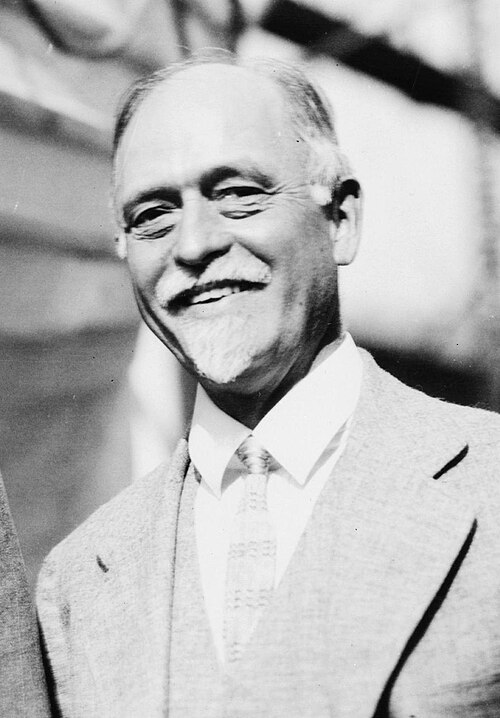
1867–1947 · American
Irving Fisher
Made money mathematical - MV = PT, real vs. nominal interest - and explained how debt plus deflation becomes depression.
The idea in one paragraph
Two things you already half-know, Fisher made exact. First: when the amount of money in an economy grows faster than the amount of stuff, prices rise - he compressed that into one tidy equation, MV = PT. Second: a 5% return with 4% inflation is really a 1% return - the gap between the interest rate you're quoted and what your money actually earns is now called the Fisher equation, and it's on every economics exam on Earth. He measured prices scientifically, explained how debt and falling prices can drag an economy into depression - and made the single most famous wrong prediction in financial history, nine days before the 1929 crash.
The world they lived in
Fisher's America believed in measurement. Between his birth in 1867 and his prime, the country got electric light, mass-produced cars, and a Progressive-era conviction that science could fix anything. Money was the great unsolved problem. The dollar was tied to gold, there was no central bank until 1913, and the money question dominated politics - William Jennings Bryan nearly won the presidency in 1896 crusading against the "cross of gold," and the Panic of 1907 showed how fast the system could seize up. Everyone argued about money; almost nobody could say precisely how it moved prices.
Fisher arrived as the man with the instruments. Born in Saugerties, New York, he lost his father to tuberculosis at 17, paid his way through Yale by tutoring math, stayed for life, and took its first economics PhD (1891) under the great physicist Willard Gibbs. He treated the economy the way Gibbs treated gases - as a system you could write equations for. Tuberculosis nearly killed Fisher too at 31, and the recovery turned him into a lifelong health crusader: fresh air, vegetarianism, Prohibition, a bestselling hygiene manual - and, far less charmingly, eugenics, a cause that has aged as badly as causes can. He invented a card-filing system, ancestor of the Rolodex, and the company it became made him rich. By the 1920s he was America's celebrity economist, his forecasts syndicated in newspapers.
What they argued
Fisher's masterstroke was turning a slogan into arithmetic. Thinkers from Cantillon onward had said "more money means higher prices"; in The Purchasing Power of Money (1911) Fisher wrote it as MV = PT. In plain English: M is the money supply - every dollar out there. V is velocity - how many times a year the average dollar changes hands (your grocery money becomes the grocer's wages, then a clerk's rent). P is the price level, and T is the total volume of transactions - everything bought. Money spent must equal stuff bought, so the two sides balance by definition. The punch comes from an assumption: if V is set by stable habits and T by the economy's real capacity, then pumping up M has nowhere to show up but P. Double the money, and eventually you double prices. That gave the old quantity theory of money its modern, testable form.
His second great distinction was real versus nominal. The interest rate a bank quotes you is in dollars; what you care about is purchasing power. So the real rate is roughly the nominal rate minus expected inflation - the Fisher equation. It sounds obvious and changes everything: savers earning 5% during 6% inflation are losing money while feeling prudent. Fisher called that feeling "money illusion" - judging by dollar amounts instead of what dollars buy - and argued that savers, workers, and governments fall for it constantly.
If prices are the key variable, you'd better measure them properly, so Fisher became the world's authority on index numbers - the recipes for boiling millions of prices down into one figure like "prices rose 3%." Between The Making of Index Numbers (1922) and the weekly indexes his institute wired to newspapers, every inflation statistic you've ever read descends from his unglamorous craftsmanship.
Then the Depression gave him his darkest insight. In a 1933 paper written after he had lost everything, Fisher explained the abyss: an economy gets overindebted, and then deflation does the rest. Households and firms scramble to pay down debt - selling assets, cutting spending - and the scramble pushes prices further down. But debts are fixed in dollars, so falling prices make every remaining debt heavier in real terms. His chilling summary: "The more the debtors pay, the more they owe." The whole economy becomes a swimmer whose struggling tightens the rope. The cure was reflation - stop the price fall - a job only government and the central bank can do.
Where it breaks down
MV = PT is bulletproof as accounting and vulnerable as forecasting, because V is not a constant - it's human behavior wearing an algebraic disguise. Fisher assumed velocity was stable; the twentieth century disagreed. The sharp lesson came in the early 1980s: central banks inspired by Milton Friedman tried steering by money-supply targets; financial innovation made velocity lurch unpredictably, and by the mid-1980s most central banks had quietly dropped money targets for interest rates. The quantity theory survives as a long-run truth about big inflations, not a dial you can steer by.
And then there is October 15, 1929, when Fisher announced that stock prices had reached "what looks like a permanently high plateau." Nine days later came Black Thursday. The story is kinder than the punchline: Fisher wasn't hyping stocks he didn't own. He believed his models - new technology justified high stock values - and backed that belief with his entire multimillion-dollar fortune, which evaporated. Yale eventually bought his house to save him from eviction and rented it back to him. The public never trusted him again, so his debt-deflation paper - arguably the best explanation of why he had been wrong - landed in silence while Keynes swept the field. The lesson isn't that Fisher was a fool; it's that a brilliant model is still not a crystal ball, and the person most in love with the model is the last to see it fail.
Lasting influence
Rehabilitation came slowly, then completely. The Fisher equation is now bedrock - it's how markets read inflation expectations from bond prices, and inflation-indexed bonds like TIPS, which he championed decades early, are standard issue. His index-number craft lives on in every CPI release - US GDP price measures still use a "Fisher ideal" formula - and every index fund tracks a descendant of his measurement toolkit. His stable-money crusade is a fair ancestor of modern inflation targeting.
The debt-deflation paper had the strangest afterlife: ignored for decades, kept alive by mavericks like Hyman Minsky, then built into mainstream theory by Ben Bernanke - who, as Fed chairman in 2008, faced Fisher's spiral and flooded the system to stop it. The rediscovery was explicit; post-2008 economics cites Fisher's 1933 paper constantly. Monetarism itself was Fisher refined: Friedman, echoing Joseph Schumpeter's verdict, called him "the greatest economist the United States has ever produced." Not bad for the profession's most famous wrong man - proof, he might note, that reputations are nominal, but contributions are real.