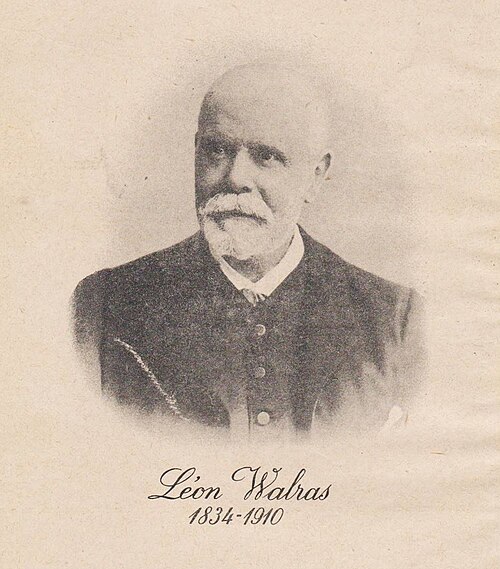
1834–1910 · French
Léon Walras
General equilibrium - every price in an economy depends on every other price, and he wrote the equations to prove it.
The idea in one paragraph
A frost hits Brazil and your coffee gets pricier - but so, faintly, does tea (people switch), milk (cafés adjust), even café wages. In an economy, everything depends on everything else. Walras's audacious move was to take that dizzying thought literally: write a supply and demand equation for every good and every market, then solve them all simultaneously. If a solution exists - one set of prices clearing every market at once - then the market economy is not chaos but a system, coherent all the way down. He published this "general equilibrium" in 1874, completing the trio with Jevons and Menger, who had reached marginal utility independently in 1871.
The world they lived in
Walras came to economics by failing at nearly everything else. Born in Évreux, France, in 1834, son of an economist who never landed an academic post, he twice failed the École Polytechnique entrance exam - his mathematics wasn't good enough, which historians still find funny - then bounced through mining school, a novel, journalism, bank clerking, and a railway office. All the while he carried his father's conviction that economics could be made a true science, mathematical like mechanics. In 1860 he impressed the right people at an international tax congress in Lausanne; in 1870 the Academy of Lausanne in Switzerland gave the failed novelist his first real job, a professorship of economics. He repaid it with the Éléments d'économie politique pure (1874), a book that set out to do for markets what mechanics had done for the planets.
France around him was living the question. The Second Empire had industrialized in a rush and collapsed into the Franco-Prussian war; the Paris Commune rose and was crushed in blood in 1871; "the social question" - poverty amid new wealth - dominated every serious conversation. Walras absorbed both sides of it. From the French liberal tradition of Jean-Baptiste Say he took the conviction that free competition coordinates; from his father he took a radical reform program, including the state purchase of all land. He saw no contradiction - and spent forty years politely baffling both socialists and liberals.
What they argued
Economists before Walras studied markets one at a time: here is the market for coffee, hold everything else fixed. Walras pointed out that "everything else" refuses to hold still. The coffee frost shifts demand for tea; tea prices affect sugar; sugar affects land use in the tropics; and round it goes. So he posed the general question: is there a set of prices - one for every good, every service, every kind of labor - at which every market clears, with no shortage or glut left anywhere? The Éléments answers with systems of simultaneous equations, built on rareté - his independent version of marginal utility - plus the accounting insight now called Walras's Law: if every market but one clears, the last must too. He counted equations, counted unknowns, found the numbers matched, and declared the system solvable.
But who actually solves it? Real people know their own wants, not a million equations. Walras's answer was a thought experiment: the auctioneer. Imagine a great crier calling out a full list of prices; everyone writes down what they would buy and sell; where demand exceeds supply the auctioneer raises the price, where supply exceeds demand he lowers it; and - crucially - no one trades until the final list is right. He called the process tâtonnement, "groping." Prices grope their way toward the configuration where everything balances, like water finding its level.
Step back and see what this bought. Adam Smith's invisible hand was a metaphor; Walras turned it into a theorem - a demonstration that a decentralized economy with no one in charge can be coherent, that millions of self-interested plans can in principle mesh exactly. That is why economists still treat 1874 as a landmark: it defined what "markets work" would even mean, precisely enough to check.
In fairness - because Walras is often misremembered as a laissez-faire mascot - he called himself a scientific socialist. He argued that the state should buy up all land and fund itself from the rents, abolishing taxation - an idea inherited from his father. Free competition in production, collective ownership of land: that was his actual program, and it fits no modern political box.
Where it breaks down
Start with the math itself. Counting equations and unknowns doesn't prove a solution exists; proving it properly took until the 1950s and Kenneth Arrow and Gérard Debreu. Then came a deeper blow from inside the fortress: results by Hugo Sonnenschein, Rolf Mantel, and Debreu himself in the 1970s showed that even a well-behaved Walrasian economy can generate market demand curves of almost any shape - so there may be many equilibria, and no guarantee the economy gravitates to any particular one. In plain terms: the equations can balance in several places at once, and the theory itself can't promise the groping ever settles. How damaging this is for practical economics is contested; that the pure theory hit this wall is not.
The second critique matters most for this site. Walras's auctioneer is precisely what real markets don't have. No one collects everybody's bids, forbids trading at "wrong" prices, and announces the answer. Real prices emerge from actual deals struck by scattered people acting on knowledge no one else has - the shopkeeper sensing demand shift, the builder who knows local timber is short. Friedrich Hayek made the point sharply: the interesting thing about markets is the discovery process the auctioneer assumes away. The irony became historical: in the 1930s, socialist economists led by Oskar Lange argued a planning board could simply play Walras's auctioneer - proof, they said, that central planning could work. Hayek and Ludwig von Mises replied that the auctioneer was a fiction in both systems, but only markets have the millions of real bidders whose trades generate price signals at all.
Finally, critics from Keynes's tradition, notably Joan Robinson, objected that a timeless, frictionless equilibrium - no money that matters, no uncertainty, no unemployment - is a strange centerpiece for a science of actual economies that spend so much time out of balance.
Lasting influence
Joseph Schumpeter, in his History of Economic Analysis (1954), delivered the most famous verdict: so far as pure theory is concerned, Walras is "the greatest of all economists." His chair at Lausanne passed to Vilfredo Pareto, who extended the system; Irving Fisher carried it to America; Arrow and Debreu made it rigorous and won Nobel Prizes on Walrasian foundations. His equations' descendants - general equilibrium models - sit today inside central banks and trade ministries, simulating how a tariff here ripples into wages there. Every time a policymaker asks "but what happens in all the other markets?", that is Walras's question.
He died in 1910, having spent decades mailing his book to economists across Europe, mostly unread, convinced posterity would get it. Posterity did - including the caution. Modern economics holds both Walrasian truths at once: everything really does depend on everything else, and no auctioneer is coming to solve it for us. The coordination, where it happens, is done by prices discovered the hard way.