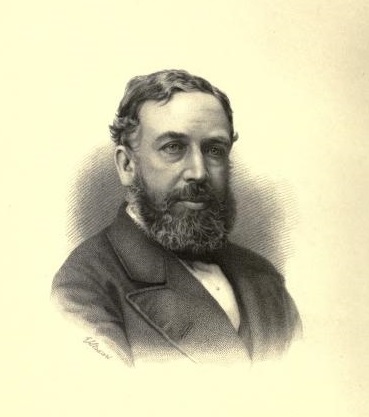
1835–1882 · British
William Stanley Jevons
Marginal utility - value lives in the last unit consumed, not the first - worked out in mathematics.
The idea in one paragraph
Why do diamonds cost more than water, when water keeps you alive and diamonds merely sparkle? For a century economists answered with labor: things are worth what they cost to make. Jevons said no - value lives at the margin. Nobody ever chooses between all the water in the world and all the diamonds; you choose one more glass, one more stone. Water is plentiful, so the last glass is worth almost nothing; diamonds are scarce, so the last one is worth a fortune. He called this the "final degree of utility," wrote it in calculus, and published in 1871 - the same year as Carl Menger in Vienna, three years before Léon Walras in Lausanne.
The world they lived in
Jevons was born in Liverpool in 1835, into an iron-merchant family that lost nearly everything in the railway bust of 1848. Money stayed tight, so at eighteen he broke off his chemistry studies in London and took the best-paying job on offer - on the other side of the planet. For five years he worked as an assayer at the new Sydney Mint, weighing gold in the middle of Australia's gold rush, filling his spare hours with weather records and long walks, and deciding his real subject was people. He sailed home, finished his degree, and set out to rebuild economics from the ground up.
The economics he came home to considered itself finished. David Ricardo had built the system, John Stuart Mill had polished it, and Mill had declared the theory of value happily complete. At its core sat the labor theory of value: things are worth the toil that made them. Jevons, an outsider with a chemist's habits, thought the whole edifice pointed the wrong way - and said so bluntly. Fame came first from something else: The Coal Question (1865), a bestseller arguing that Britain's industrial supremacy rode on a finite seam of coal. Gladstone cited it; Mill praised it in Parliament. The unknown assayer suddenly had a platform.
What they argued
Start with a hot day and a jug of water. The first glass is bliss. The second is very good. By the fifth you're watering the plants. Each glass is identical, yet each satisfies a less urgent want than the one before. Jevons's claim was that the price of water is governed by that last, least-urgent glass - what he called the final degree of utility and we now call marginal utility. "Value," he wrote, "depends entirely upon utility." Not on labor, not on cost, but on the usefulness of the next unit to an actual person. The diamond–water paradox that had puzzled Adam Smith dissolves instantly: water's total usefulness is enormous, but its marginal usefulness is trivial, because there is so much of it.
The demolition of the labor theory followed. Once a fish is on the dock, buyers don't care whether it took one hour to catch or ten; its price is set by their demand for one more fish. Labor spent is spent - "bygones are for ever bygones," in Jevons's phrase - and influences value only indirectly, by changing how much gets produced. This flipped Ricardo's causation on its head: labor doesn't make things valuable; the value of things makes labor worth hiring. Jevons knew exactly whose statue he was toppling, complaining that "that able but wrong-headed man, David Ricardo, shunted the car of Economic science on to a wrong line." He never engaged Karl Marx directly, but the timing was brutal: Capital had staked everything on the labor theory of value in 1867, four years before the marginal revolution began pulling the foundation out from under it.
Just as radical was how Jevons argued. Economics, he insisted, deals in quantities - more and less, faster and slower - and any science of quantities "must be mathematical." He wrote utility as a function, maximized it with calculus, and derived his famous exchange equations, calling economics the "mechanics of utility and self-interest." He backed it with a pioneering statistician's toolkit: index numbers, charts, and data series where predecessors had offered only reasoning. Modern economics - for better and worse - looks the way it does partly because Jevons won this argument.
Then there is the sunspot theory, which deserves to be remembered fondly. Late in life Jevons became convinced that commercial crises recurred roughly every ten and a half years, and went hunting for a cause with cosmic regularity. He found one: the solar cycle. Sunspots alter sunshine, sunshine alters harvests - especially in India - and harvests alter trade, so the business cycle was, at bottom, written on the face of the sun. When astronomers revised the length of the solar cycle, Jevons gamely revised his crisis statistics to match. Contemporaries were unkind, and the data never cooperated. But notice what he was actually doing: insisting that booms and busts are not random moral failures but recurring phenomena with causes you can hunt for in data. The answer was wrong; the question founded a field.
Where it breaks down
The measurement problem came first, and from friendly fire. Jevons's system treats pleasure as a quantity, yet he admitted nobody can measure a unit of it. Later economists - Vilfredo Pareto above all - showed the theory survives on rankings alone ("I prefer this to that"), quietly retiring Jevons's hedonic arithmetic while keeping his insight.
Second, marginal utility alone is only half a theory of price. Alfred Marshall made the point with his famous scissors: demand is one blade, supply and cost the other, and asking which blade does the cutting is a confused question. Jevons, flush with revolutionary zeal, had over-corrected - Ricardo's cost side was down but not dead.
Finally, his predictions aged badly. The Coal Question underestimated substitutes - oil, gas, efficiency, imports - and Britain's fate turned on none of the things he forecast; as the Concise Encyclopedia of Economics notes, he underrated entrepreneurs' ability to find alternatives. And the sunspot theory collapsed outright: the correlations were coincidences, a standing warning about how easily a determined researcher finds patterns in noise.
Lasting influence
Jevons didn't get long to enjoy his revolution. Ignoring his doctor's warnings, he kept up his beloved swimming, and in 1882 he drowned off the Devon coast at forty-six, leaving his most ambitious book unfinished on his desk. The economists who buried him built on him. Marshall folded marginal utility into the neoclassical synthesis that still structures every introductory textbook; Irving Fisher carried the mathematical program to America; John Maynard Keynes, no easy grader, wrote a glowing biographical essay on him and inherited his fascination with index numbers and cycles.
Two of his ideas are having a second life. The "Jevons paradox" - his observation that more efficient steam engines led Britain to burn more coal, not less - is now a staple of climate policy debates about whether efficiency gains rebound into higher consumption. And in 1881, the year before he died, Jevons rediscovered a forgotten manuscript by Richard Cantillon and declared it the "cradle of political economy" - a fitting parting gift from the man who made economics check its stories against the data.