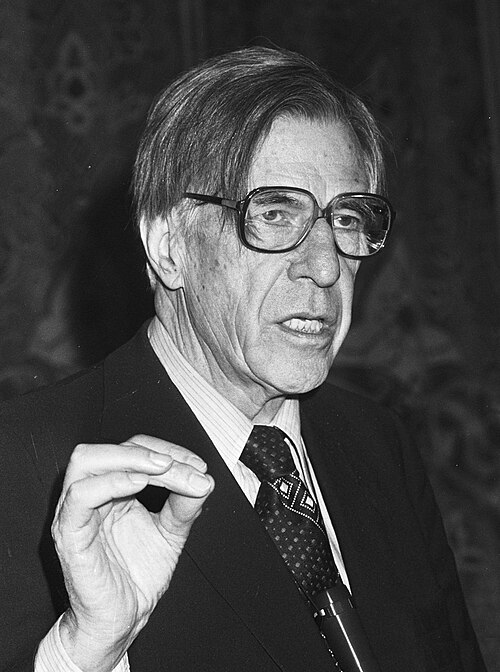
1908–2006 · Canadian-American
John Kenneth Galbraith
The Affluent Society - private opulence, public squalor, and wants manufactured by advertising.
The idea in one paragraph
Picture a gleaming new car bumping down a potholed road, past shuttered libraries, toward a park nobody maintains. That, said Galbraith, is the signature of the richest society in history: "private opulence and public squalor." The Affluent Society (1958) argued that America had solved scarcity for most people - and that much of what we still crave isn't ours at all, but planted by advertising: production first creates the want, then sells the cure. So piling up more private stuff while starving schools, transit, and clean air isn't prosperity; it's an accounting error. Economists mostly rolled their eyes. The public made him the most-read economist alive.
The world they lived in
Galbraith was born on a farm in southern Ontario in 1908 and kept a farmer's suspicion of elegant theory all his life. He trained in agricultural economics at Ontario Agricultural College and Berkeley, then arrived at Harvard in the 1930s just as Keynes's revolution landed. The Depression, not the seminar room, was his formative classroom - and the war gave him power almost no economist has held before or since. As the young deputy chief of the Office of Price Administration, Galbraith was America's wartime price czar, personally overseeing controls on virtually every price in the U.S. economy until the accumulated fury of business lobbies drove him out in 1943. Most economists drew the lesson that price controls are a nightmare. Galbraith, characteristically, drew the opposite one: that a modern economy could stand a lot more management than the textbooks admitted.
What followed was the most public life in American economics: editor at Fortune, director of the postwar bombing survey, speechwriter for Adlai Stevenson, adviser and friend to John F. Kennedy, ambassador to India, president of the American Economic Association, and author of bestsellers that made "conventional wisdom" - his coinage - part of the language. At six foot eight, he was literally the biggest figure in the field, and his wit matched: modesty, he said, was a "vastly overrated virtue." He died in 2006, two Presidential Medals of Freedom later, still arguing.
What they argued
Start with American Capitalism (1952) and a puzzle: textbook theory said an economy of giant firms should gouge everyone, yet postwar America was booming. Galbraith's answer was countervailing power. Big sellers get checked, not by swarms of small competitors as in the textbook market economy, but by big buyers facing them across the table: chain stores squeezing food processors, unions squeezing General Motors, government squeezing everybody. Where competition had quietly died, a balance of organized power did its job. The policy moral: don't panic about bigness itself - watch whether anything big stands on the other side of the deal.
The Affluent Society pushed further. Economics was built for scarcity - for societies where more production straightforwardly meant less hunger. But when a society is rich, Galbraith argued, the urgency of private wants no longer speaks for itself, because the wants are increasingly manufactured by the same machine that satisfies them. This is the dependence effect: advertising and salesmanship create the demand that production then meets. "One cannot defend production as satisfying wants," he wrote, "if that production creates the wants." Meanwhile the things advertising doesn't sell - schools, parks, sanitation, police - fall into "social imbalance": we grow privately fat and publicly poor. Since a public good has no marketing department, he argued, affluent societies systematically underfund exactly what they need most, and should tax private consumption to restore the balance.
The New Industrial State (1967) completed the picture with the technostructure. The modern giant corporation, he argued, isn't run by a swashbuckling boss, and certainly not by shareholders; it's run by committees of specialists - engineers, marketers, planners - whose real goals are survival and growth, not maximum profit. Such firms don't submit to the market; they plan around it: administering prices, locking in supplies, and using advertising to make consumer demand behave. The market of the textbooks, he concluded, had been half-replaced by a private planning system - one not so different in method, he mischievously added, from the planners on the other side of the Cold War.
Underneath all three books ran one method, inherited from Thorstein Veblen: look at institutions as they are - the corporation, the ad agency, the regulatory agency - rather than at the frictionless markets of theory, and say what you see in prose the public can actually read. Galbraith regarded the second part as a professional duty. The profession regarded it, on the whole, as showing off.
Where it breaks down
The economists' counterattack was led by people as sharp as he was. Robert Solow, reviewing The New Industrial State in 1967, delivered the profession's most famous savaging: beneath the magnificent prose, he argued, the big claims dissolved - corporations remain thoroughly disciplined by competition and capital markets, consumers are not the puppets Galbraith supposed, and the book offered assertions where evidence should be. Friedrich Hayek had already gone after the core idea in "The Non Sequitur of the Dependence Effect" (1961): nearly all civilized wants - music, literature, medicine - are learned from our culture rather than born in us, so showing that wants are socially created proves nothing about whether satisfying them is worthless. And Milton Friedman, his lifelong sparring partner, argued that advertising manifestly fails whenever consumers aren't buying - ask Ford about the Edsel - and that Galbraith's confidence in government spending assumed public money gets spent wisely, which is, to put it gently, contested.
History scored some rounds too. The technostructure thesis - serene giant firms planning consumer demand - aged badly through the 1970s and 80s, as oil shocks, corporate raiders, Japanese competitors, and eventually Silicon Valley demonstrated that the planning system could be creatively destroyed like anything else. His enthusiasm for permanent price controls never won mainstream support; most economists judge the 1970s experiments with controls a failure. Whether advertising mostly creates wants or mostly steers them remains contested to this day - though the behavioral economists later gave Galbraith's side better ammunition than he ever had.
Lasting influence
Galbraith lost the battle for the economics journals and won the battle for the language. "Conventional wisdom," "countervailing power," "the affluent society," "private opulence and public squalor" - the phrases outlived every model that dismissed them. Whenever a commentator notes billionaires' rockets over crumbling bridges, they are quoting him, knowingly or not.
The ideas keep resurfacing wearing new credentials: behavioral economics rediscovered manipulable consumers; the new antitrust movement rediscovered countervailing power as workers and suppliers face concentrated giants; every infrastructure bill relitigates social balance. His books still sell, his sentences still cut, and his central bet - that an economist heard by millions matters more than one cited by hundreds - looks shrewder every year. The profession's verdict and the public's never did converge. Galbraith would have considered that a data point in his favor.