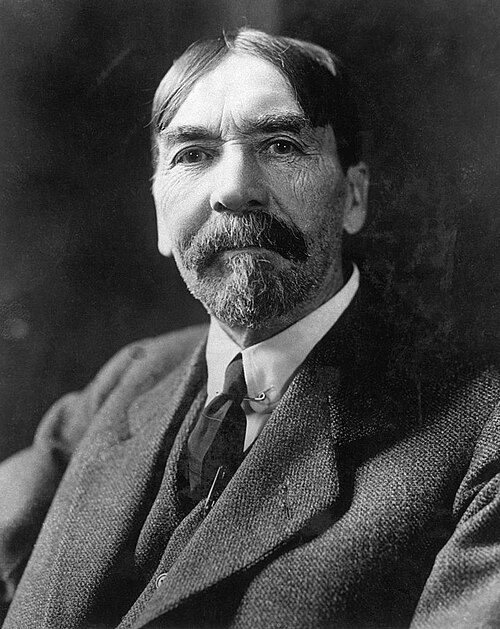
1857–1929 · American
Thorstein Veblen
Conspicuous consumption - we buy things to be seen buying them, and habit and status, not cool calculation, drive economic life.
The idea in one paragraph
A $30 watch tells the time. A $30,000 watch tells everyone else something about you - and that, not the time, is what you're paying for. Veblen's point was that a huge share of what we buy is display: proof of wealth, aimed at an audience. Raise the price of such a good and people may want it more, because the price is the message. From that one observation he built a whole rebel economics: humans are not calculators of costs and benefits but creatures of habit, status, and imitation, and the real drivers of economic life are institutions - the settled customs a society stops noticing. He said all this in 1899, in the most quotable unreadable book economics ever produced.
The world they lived in
Veblen wrote in Gilded Age America, and the age gave him his material. The railroad, steel, and oil fortunes of the 1870s–90s were the largest private piles of money the world had ever seen, and their owners spent loudly: seventy-room Newport "cottages," costume balls, dinners served on gold plate. An old question - why do the rich waste so magnificently? - was suddenly on daily display, and nobody in economics had a good answer. The textbooks of the day assumed sober consumers maximizing satisfaction. The society pages said otherwise.
Veblen watched it all from about as far outside as an American could stand. Born in 1857 to Norwegian immigrant farmers in Wisconsin, he grew up speaking Norwegian and viewed mainstream America with an anthropologist's detachment. He took a philosophy PhD at Yale in 1884, then spent seven years unemployed on the family farm - no one would hire the sardonic, shabby, irreligious Norwegian - before the new University of Chicago took him on in 1892. The Theory of the Leisure Class (1899) made him famous; the very people it skewered bought it in delighted quantities, apparently confident it described their neighbors. His career stayed rocky - a mumbling teacher trailed by scandals over his affairs, he drifted from Chicago to Stanford to Missouri to New York's New School - and he died in a California cabin in August 1929, months before the crash, poor and mostly forgotten.
What they argued
Start where Veblen started: with waste, done on purpose, in public. Once a society produces more than survival requires, he argued, wealth becomes the measure of respect - and it only counts if others can see it. Hence "conspicuous consumption": the logo handbag, the mechanical watch, the SUV that never leaves pavement, the wedding that costs a year's salary. The function of such goods is not transportation or timekeeping but evidence - proof that you can afford to burn money. This produces the strangest creature in economics, now called a Veblen good: one people want more of as the price rises, turning the usual law of demand upside down. Cut the price of a status symbol and you don't widen its market; you destroy it.
Beneath the spending sits the engine Veblen called "pecuniary emulation." We don't measure our wealth against our needs, he said; we measure it against our neighbors' - especially the class just above us, whose habits we copy and whose approval we crave. That makes the race unwinnable by design. Every raise resets the benchmark; the standard of "decent" living floats upward with everyone's income; a society can double its wealth and feel no richer. You've felt this: the kitchen renovation that seemed extravagant until three neighbors did theirs.
All of this was aimed squarely at the economics of his day. The marginalists - Alfred Marshall and his followers - modeled a person who weighs marginal utility against price and chooses rationally. Veblen, in a famous jab, mocked that model as "a lightning calculator of pleasures and pains" with no history, no habits, and no neighbors. Real people, he argued, are bundles of instinct and custom, steered by institutions - the inherited "settled habits of thought" like property, the corporation, or what counts as respectable work. Economics should therefore study how institutions evolve, the way Darwin studied species, rather than proving theorems about imaginary calculators. That research program made him the founder of American institutional economics. He read Marx closely and respected the ambition, but rejected the prophecy: history has no destination, Veblen said, just drift.
His other great distinction was industry versus business - the engineers versus the financiers. Industry is the "machine process": the people who actually make things, and who instinctively want them made well ("the instinct of workmanship"). Business is the money side, and it profits from prices, not production - which means it sometimes pays to restrict output, cut quality, or engineer scarcity. Veblen called this "capitalistic sabotage," and in The Theory of Business Enterprise (1904) he argued that booms, busts, and bloated monopolies grew from this tug-of-war between making goods and making money. The incentives of the two, he insisted, only sometimes line up.
Where it breaks down
The standard critique, made by neoclassical economists then and since (David R. Henderson's Concise Encyclopedia entry is a friendly version), is that Veblen offered brilliant description without a testable theory. There are no equations in Veblen, no predictions you could check and potentially refute - just dazzling classification. His fans reply that measuring the wrong thing precisely is worse than describing the right thing loosely; the debate is really about what economics is for.
His industry-versus-business dichotomy also aged unevenly. Taken to its logical end - let engineers run production without the money men - it inspired the 1930s "technocracy" movement, and the twentieth century ran the experiment: economies managed by planners, without market prices. Ludwig von Mises and the calculation-problem economists explained why that went badly - the despised "pecuniary" side turns out to carry the information. And much of what Veblen filed under sabotage - speculation, short-selling - is now understood to help move prices toward reality.
Finally, status isn't everything. Most purchases - groceries, insurance, bus fare - still obey ordinary price logic, and even luxury demand mostly slopes downward. Veblen found a real and durable exception, not a replacement for the rulebook.
Lasting influence
The vocabulary won. "Conspicuous consumption" is ordinary English now; "Veblen good" sits in every microeconomics textbook as the official asterisk on the law of demand; and every luxury marketer who keeps prices high because it signals exclusivity is practicing applied Veblen. His institutionalism dominated American economics between the wars through heirs like Wesley Mitchell and John R. Commons, staffed much of the New Deal, and echoes in today's Nobel-winning work on how institutions make or break economies.
The behavioral economists are his other heirs. Their boundedly rational human - habitual, imitative, obsessed with relative standing - looks a lot like the creature Veblen described, and modern research on status spending keeps confirming the sketch. Not bad for a man who described the well-dressed reader's walking stick as "an advertisement that the bearer's hands are employed otherwise than in useful effort." People underlined that, recognized themselves, and kept buying walking sticks. Veblen would have expected nothing less.