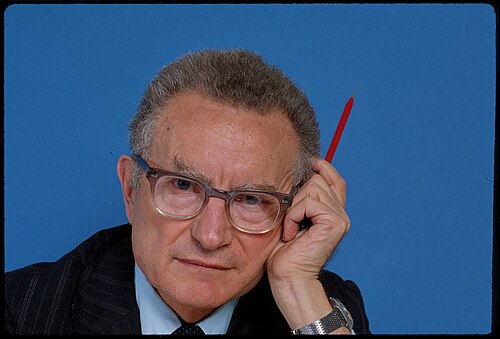
1915–2009 · American
Paul Samuelson
Rewrote economics in equations - then taught it to the world in the best-selling textbook of all time.
The idea in one paragraph
If your parents took an economics course anywhere on Earth after 1948, there's a decent chance Paul Samuelson taught them. His textbook Economics sold millions of copies through nineteen editions and dozens of languages. But the textbook was the sideshow. Samuelson's real project was to stop economists arguing in words and make them argue in equations: his Foundations of Economic Analysis (1947) showed that one piece of mathematics - people maximizing something, subject to limits - underlies consumers, firms, and trade alike. Then he bolted Keynes onto the classical machine: government manages the slumps, markets run the rest. He called it the neoclassical synthesis. For thirty years, it simply was economics.
The world they lived in
Samuelson was born in Gary, Indiana, in 1915, and liked to say he was "born as an economist" on the morning in 1932 he first walked into a University of Chicago lecture hall, aged sixteen. The timing mattered: inside, professors taught that markets self-correct; outside, a quarter of America's workers had no job. Something in the doctrine didn't add up, and the young Samuelson went to Harvard for graduate school just as Keynes's ideas were crossing the Atlantic. He was, by common consent, the most dazzling student the department had seen - and in 1940 Harvard let him go anyway, a decision widely attributed, then and since, to the antisemitism of the era's faculty. He walked three miles down the road to MIT, then a mere engineering school, and spent the next seven decades turning its economics department into the most influential on the planet.
The postwar decades were built for a man with his toolkit. Governments had accepted responsibility for managing their economies; what they lacked was an instruction manual. Samuelson wrote it - literally, in the textbook, and technically, in a torrent of papers that colleagues joked would have earned five separate Nobels. The actual Nobel came in 1970, the second year the economics prize existed and the first time an American won it. He kept writing - including a long-running Newsweek column dueling with Milton Friedman's - until his death in 2009.
What they argued
Samuelson's manifesto hides in the epigraph of Foundations, a line borrowed from the physicist J. Willard Gibbs: "Mathematics is a language." Before him, economics ran on elegant paragraphs - Marshall had even advised burning the mathematics once the words were done. Samuelson reversed the advice. Verbal debates that had smoldered for decades, he showed, could be restated as equations and simply settled. A theory earns its keep by making "operationally meaningful" predictions - statements the data could in principle prove wrong. As Robert Lucas later put it, Samuelson would take some interminable verbal controversy and just end it. The whole discipline, from the consumer choosing groceries to nations choosing trade patterns, became variations on one theme: somebody maximizing something under constraints, and the equilibrium that results.
He applied the method with almost unfair range. Revealed preference (1938): you can't peer inside a shopper's head to measure "utility," so don't - watch what they choose, and let choices reveal the preferences. The theory of public goods (1954, in three pages): some things, like national defense or a lighthouse beam, can't be sold by the slice, because my consumption doesn't reduce yours and non-payers can't be excluded - so everyone waits for someone else to pay, and markets undersupply them. That free-rider logic is the rigorous case for why some jobs belong to government. His overlapping-generations model (1958) captured something ancient in equations: each working generation supports the old and is supported in turn, which illuminates everything from why money holds value to how pension systems hang together.
The synthesis was his answer to the biggest question of his lifetime: was Keynes a revolution or a heresy? Samuelson's verdict - Keynes for the short run, the classics for the long run. Left alone, an economy can sink into a slump and stay there; fiscal policy and monetary policy should manage aggregate demand to hold the economy near full employment. But once it's there, the old classical logic of scarcity, prices, and markets takes over. Depression economics for depressions, market economics for normal times. Later editions added the Phillips curve - a suggested menu of trade-offs between inflation and unemployment - as the policy dial.
And he understood, better than anyone, where the real power lay. "I don't care who writes a nation's laws - or crafts its advanced treaties - if I can write its economics textbooks," he said. Economics (1948) carried the synthesis to generations of students on every continent: bright diagrams, plain sentences, and underneath them, quietly, the equations.
Where it breaks down
The 1970s broke the synthesis on live television. Inflation and unemployment rose together - stagflation - which the Phillips-curve menu said shouldn't happen. Friedman had predicted exactly that, and the deeper wound came from Samuelson's own intellectual grandchild: Robert Lucas argued that people learn and anticipate policy, so models built on past statistical patterns fall apart the moment governments lean on them. The Keynesian toolkit Samuelson had codified spent a generation in the repair shop.
The mathematics itself drew fire from opposite directions. Joan Robinson and the Cambridge (England) school attacked the aggregate models' treatment of capital; Samuelson conceded the logical point in print in 1966 - and critics note that mainstream practice changed remarkably little afterward. From the other flank, Hayek and the Austrians argued that equation-first economics mistakes formal precision for understanding, stripping out institutions, uncertainty, and everything that doesn't fit a maximization problem - a charge later echoed within the mainstream by economists like Deirdre McCloskey.
And one famous embarrassment: for decades, successive editions of Economics carried projections showing the Soviet economy plausibly overtaking America's - the date discreetly receding edition by edition until the USSR itself expired. Scholars David Levy and Sandra Peart documented the sequence. It was a lesson in his own dictum: models are only as good as what they assume.
Lasting influence
Modern economics is written in Samuelson's language. Open any journal: the maximization, the equilibrium conditions, the comparative statics - that's Foundations, running two generations later. The vocabulary of policy debates is his too: public goods, revealed preference, the factor-price theorems that underpin arguments about trade and wages. Financial economics grew in his greenhouse at MIT - he helped revive the forgotten mathematics of market prices and mentored the generation that priced modern finance.
His textbook's DNA persists in every introductory course that teaches micro and macro as one subject, markets and the government's role in one breath. The synthesis itself, battered in the 1970s, was rebuilt with new foundations and quietly reigns again in central banks under the name "New Keynesian." Samuelson claimed he was economics' last generalist. In the equations-versus-words war he started and won, the ledger shows one perfect irony: the man who mathematized economics is remembered by millions for a book of plain, patient words.