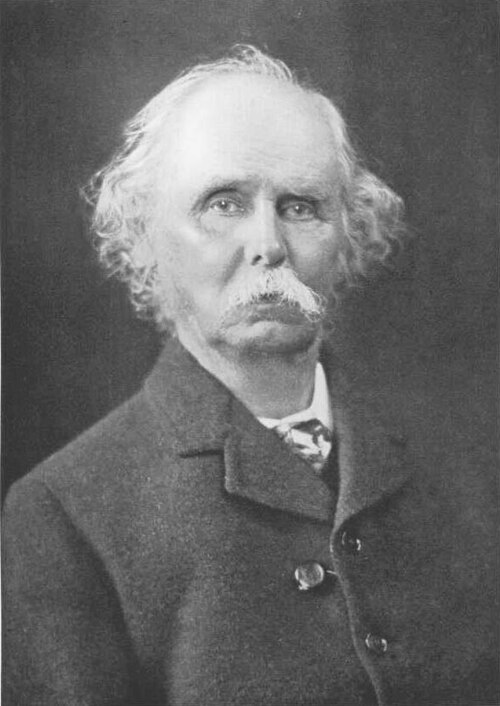
1842–1924 · British
Alfred Marshall
Supply and demand as two blades of a pair of scissors - plus the everyday toolkit of Econ 101: elasticity, consumer surplus, the short run and the long.
The idea in one paragraph
For a century, economists fought over what sets a price. The classical school said cost: things sell for what they cost to make. The rebels of the 1870s said desire: things sell for what buyers want at the margin. Alfred Marshall told both sides to stop. Asking whether value is governed by cost or by usefulness, he wrote, is like asking "whether it is the upper or the under blade of a pair of scissors that cuts a piece of paper." Supply and demand cut together. He drew the crossing curves that now open every economics course, and stocked the toolbox - elasticity, consumer surplus, the short run and the long - that economists still reach for daily.
The world they lived in
Marshall was born in London in 1842, the son of a stern, evangelical bank clerk who wanted him ordained. He escaped into mathematics instead, finishing second in Cambridge's brutal mathematics exams of 1865. Then the safe career swerved: walking the slums of England's industrial cities, Marshall looked into "the faces of the poorest people" and decided the great question of the age was whether poverty was necessary. He resolved to make economics the engine for fixing that, telling his students the discipline needed "cool heads but warm hearts."
Economics itself was in an awkward adolescence. The classical system of David Ricardo and John Stuart Mill was creaking, and in the 1870s William Stanley Jevons, Carl Menger, and Léon Walras declared that value came from marginal utility, not cost - the marginal revolution. Marshall, professor at Cambridge from 1885 to 1908, spent two patient decades building the truce. His Principles of Economics (1890) ran through eight editions and ruled English-speaking economics for a generation. He founded the Cambridge school, married the economist Mary Paley - his former student and co-author, though he later, less admirably, opposed Cambridge degrees for women - and defined economics as "a study of mankind in the ordinary business of life."
What they argued
Start at a farmers' market, at the strawberry stall. How much would you pay for a punnet? A lot for the first; less for a second; by the fourth you're done - each extra punnet is worth less to you. Chart that falling willingness to pay across all buyers and you get a demand curve, sloping down. Now the growers: coaxing more strawberries out of the fields costs progressively more, so the supply curve slopes up. Where the curves cross, the market clears - buyers want exactly what growers will sell. That crossing point is equilibrium, and the diagram is Marshall's famous cross: the two blades of his scissors. Neither blade alone cuts. (Use the Try It link below to drag Marshall's own curves around and watch the price move.)
Marshall then coined a word for a question every business and tax office asks daily: elasticity - when a price rises, how much does buying shrink? Petrol is inelastic: double the price and commuters grumble but still fill up, because there's no easy substitute. Restaurant meals are elastic: raise prices ten percent and the tables empty. That's why governments love taxing fuel and tobacco - the revenue doesn't run away - and it turned vague talk about "sensitive" markets into a number you can estimate.
Third tool: consumer surplus. You'd happily have paid five pounds for that first punnet, but the price was two - you walked away with three pounds of pure, unpriced gain. Add those gaps up across every buyer and you can measure what a market quietly hands its customers for free - and how much a tax or a monopoly destroys. Marshall built the tool so policy arguments could be weighed rather than shouted.
Fourth, and closest to his heart: time. His own example: a fish market. On any single day the catch is landed and fixed, so demand alone sets the price - the demand blade does the cutting. Over months, fishermen hire more crews and sail more often. Over years, new boats are built and newcomers enter the trade, so cost of production drags the price toward itself - the supply blade takes over. The short run belongs to demand, the long run to supply. That settled the old war: Jevons and the marginalists were describing the market day, Ricardo and the classicals the long horizon. Each side was holding one blade.
Underneath it all sat a method. Rather than solving the whole economy at once, as Walras attempted with general equilibrium, Marshall examined one market at a time while everything else was held still - locked, as he put it, in the "pound" of ceteris paribus, "other things equal." This is partial equilibrium: less majestic than Walras's grand system, but usable by a tax inspector before lunch. A trained mathematician, Marshall buried his equations in appendices; his rule was to translate the maths into English, illustrate from real life, then "burn the mathematics."
Where it breaks down
The sharpest critique came from his favourite student. John Maynard Keynes revered Marshall - his 1924 memoir is a love letter - but rebelled affectionately against the method. Partial equilibrium is superb for strawberries, Keynes argued, but what is true of one market can be false of all markets together. One firm cutting wages hires more workers; every firm cutting wages shrinks the nation's spending power, and jobs vanish instead. In the Great Depression, Keynes concluded, the one-market-at-a-time lens hid the big picture, and his General Theory (1936) was written as a jailbreak from Marshallian habits - using tools Marshall had taught him. Even his most famous line, "in the long run we are all dead," is a jab at Marshall's serene long run.
A quieter blow landed in 1926 from the young Italian economist Piero Sraffa. Marshall's upward-sloping supply blade assumes that producing more costs more per unit. But across much of modern industry the opposite holds: bigger factories produce cheaper - increasing returns to scale. Follow that logic and the tidy competitive equilibrium unravels, because the biggest firm should undercut everyone and swallow the market. Sraffa's paper pushed economists - Joan Robinson at Cambridge among them - toward theories of imperfect competition that Marshall's scissors couldn't hold.
Lasting influence
Open any introductory economics course and you are looking at Marshall: the crossing curves, elasticity, consumer surplus, the short run versus the long. No economist's tools are used more often by people who have never heard his name - pricing teams estimating whether a fare rise will drive passengers away, treasury analysts costing a sugar tax. He professionalized the discipline too, founding Cambridge's economics degree in 1903 and helping launch the Royal Economic Society; before Marshall, economics was a hobby of bankers and philosophers, and after him it was a career.
Then there are the students. A. C. Pigou extended Marshall's notion of "external economies" into the theory of externalities - every carbon tax on the planet descends from that Cambridge lineage. And Keynes, whose rebellion remade macroeconomics, never stopped measuring economists against his teacher: the master economist, he wrote in his memoir of Marshall, "must be mathematician, historian, statesman, philosopher - in some degree." Marshall's fish and strawberries have faded; the scissors have not. Try them yourself below - drag the blades and watch what they cut.