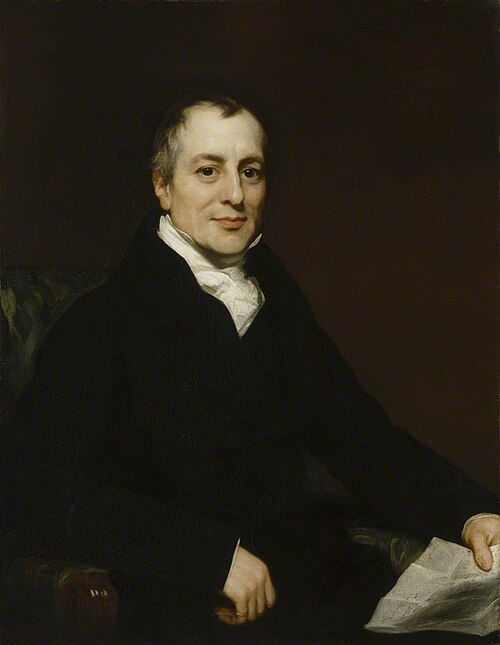
1772–1823 · British
David Ricardo
Comparative advantage - both countries gain from trade even when one of them is better at making everything.
The idea in one paragraph
Suppose Portugal makes both wine and cloth more cheaply than England. Common sense says Portugal should make everything and England should despair. Ricardo showed common sense is wrong: what matters isn't who's best at something, but what each country gives up to make it. If Portugal is brilliant at wine and merely good at cloth, every yard of cloth it weaves costs it magnificent wine - so it should make wine, buy cloth, and let England do what England does least badly. Both end up with more. This is comparative advantage, the most quietly subversive idea in economics: trade isn't a contest with winners and losers, and even the hopeless have something to sell.
The world they lived in
Ricardo learned markets before he learned theory. Born in London in 1772 to a Dutch-Jewish family, he joined his father on the stock exchange at fourteen and was disowned at twenty-one for marrying a Quaker. Starting nearly from scratch, he became one of the richest men in England - famously as a contractor for the government loan floated just before Waterloo, a bet on British victory that paid spectacularly. He met economics by accident: bored on holiday in Bath in 1799, he picked up Adam Smith's Wealth of Nations and never really put it down. By his early forties he had retired to a country estate to think, and later bought his way into Parliament, where the practical men found him strange: a millionaire arguing from first principles.
The England he was theorizing about was a pressure cooker. Twenty years of war with Napoleon had brought paper money and inflation - the subject of Ricardo's first pamphlets. Factories and mill towns were rising in the north, but political power still sat with the landowners, and in 1815 they used it: the Corn Laws slapped a steep tariff on imported grain, keeping bread expensive. The great question of the day was who gets what: landlord, capitalist, or worker. Ricardo's On the Principles of Political Economy and Taxation (1817) made that question the center of economics, and it stayed there for a century.
What they argued
Take the famous example from Chapter 7 of the Principles. In Portugal, a year's wine takes 80 men and a year's cloth takes 90. In England, wine takes 120 men and cloth 100. Portugal beats England at both. Yet look at the trade: if Portugal moves 90 men from cloth into wine, and England moves 120 men from wine into cloth, the same workers produce more wine and more cloth between them than before. Portugal's cloth was never expensive in men - it was expensive in wine forgone. The opportunity cost, not the headcount, is the real price. The everyday version: the best surgeon in town may also be the town's fastest typist, but she still hires a receptionist, because every hour she types costs an hour of surgery. Countries, Ricardo showed, work the same way.
His theory of rent explained the landlords. Land varies in quality, and the best acres get farmed first. As population grows, farmers push onto stonier, drier ground - and the price of corn must rise to cover costs on that worst land in use. But the owner of good land pays the same costs as ever while selling at the new higher price, and pockets the difference. That windfall is rent, and it comes from scarcity, not effort: rent is high because corn is dear, not the other way round. The implication was politically radioactive. Anything that forces cultivation onto worse land - population growth, or a Corn Law shutting out cheap foreign wheat - enriches landlords while squeezing everyone else. In his 1815 Essay on Profits Ricardo put it bluntly: the interest of the landlord is "always opposed" to that of every other class. His case for repealing the Corn Laws and embracing free trade followed directly, and he made it in Parliament to the landlords' faces.
Underneath both theories sat a refined labor theory of value: Smith had gestured at it; Ricardo made it a system. goods tend to exchange in proportion to the labor embodied in them, with careful (and nagging) exceptions for capital and time. On top of it he built a machine of distribution - wages held near subsistence by his friend Malthus's population mechanism, rent absorbing the gains of scarcity, and profit as the residual that funds all future growth. If rents rise, profits fall, and the economy's engine slows. It was the first fully worked-out model in economics: strip reality to a few moving parts, crank the logic, accept the conclusions however uncomfortable.
He could be wrong with the same rigor. Against Malthus, Ricardo insisted a "general glut" was impossible - production creates the income that buys production - a position that ruled economics until the 1930s proved gluts could sit on every doorstep at once. Their disagreement was handsome, though: a decade of letters without a trace of malice, and a bequest to Malthus in Ricardo's will.
Where it breaks down
The labor theory of value frayed first, and Ricardo knew it. Wine that ages in a cellar gains value while nobody labors; machines complicate every calculation. He fiddled with the exceptions to the end (the economist George Stigler wryly called the result a "93% labor theory of value"). The marginal revolution of the 1870s replaced the whole apparatus: value comes from what buyers want at the margin, not the toil embodied in things. And the strand of Ricardo that Marx extended - if labor creates all value, what exactly is the capitalist paid for? - became the century's most explosive question, one most economists now answer very differently.
Comparative advantage has fared far better, but honesty requires the fine print. The clean result assumes full employment and capital that stays home; the Portuguese winemaker who loses his job is assumed into a new one. Twentieth-century trade theorists - Paul Samuelson above all - showed that while nations gain overall, particular groups can lose lastingly (the Stolper–Samuelson theorem), and Samuelson was still publishing qualifications in 2004. None of this overturns Ricardo: the gains are real, but so are the losers, and they don't compensate themselves. Joseph Schumpeter also left a warning label - the "Ricardian vice," his name for stripping a model so bare that its conclusions feel more certain than the world allows.
Lasting influence
Ricardo died suddenly in 1823, at fifty-one. When Richard Cobden's Anti-Corn Law League won repeal of the Corn Laws in 1846, it was armed with his arguments, and the free-trade order Britain built - down through today's trade agreements and the WTO - rests on his Chapter 7. Asked once for a single proposition in social science that is both true and non-trivial, Samuelson answered: comparative advantage.
His method may matter even more. John Stuart Mill systematized Ricardo into the century's standard textbook; Marx radicalized him; and every economist since who has reasoned from a deliberately simplified model - which is to say, every economist - is working in the style Ricardo invented. Not bad for a stockbroker who took up theory because he was bored on holiday.