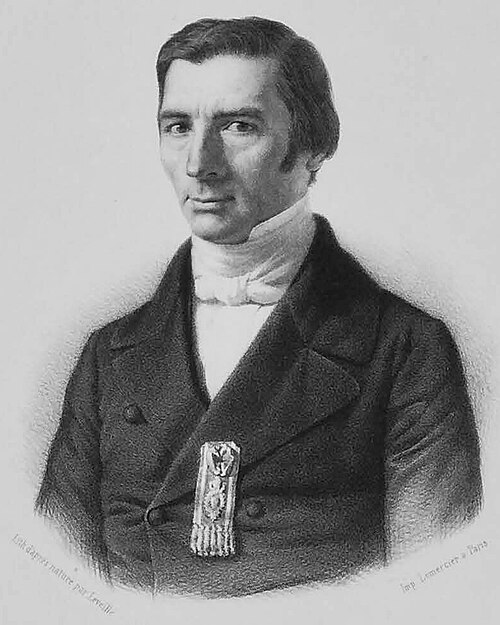
1801–1850 · French
Frédéric Bastiat
The broken window - judging every policy by what is seen AND what is not seen, and doing it with the best jokes in economics.
The idea in one paragraph
A boy puts a rock through the baker's window. The crowd tuts - and then someone offers comfort: look, the glazier gets six francs of work, and he'll spend them at the tailor's, and so on round the town. Silver linings! Bastiat's reply made him immortal: those six francs were already headed somewhere. The baker was about to buy shoes. Now the town gets a repaired window instead of a window plus a new pair of shoes. It is poorer by exactly one pair of shoes - you just can't see shoes that were never made. Good economics, Bastiat argued, is the discipline of tracking what is not seen. He taught it with jokes, which is why people are still reading him.
The world they lived in
Frédéric Bastiat was born in 1801 in Bayonne, a port town in southwest France where a boy could watch ships unload - and watch the tariff wall built to keep their cargo out. Orphaned at nine, he drifted through commerce and farming, inherited his grandfather's estate in 1825, and settled into twenty quiet years of reading: Adam Smith, Jean-Baptiste Say, and everything else he could get. Around him, France's iron masters and landowners had wrapped the economy in protective duties and called it patriotism. Across the Channel, Richard Cobden's Anti-Corn Law League was dismantling Britain's food tariffs, and Bastiat, electrified, resolved to become the French Cobden. An article attacking protectionism made the unknown provincial suddenly famous in Paris; by 1846 he had founded a national free-trade association and his own weekly paper.
Then history hit fast-forward. The revolution of 1848 toppled the monarchy, and Bastiat - now a member of France's political assemblies - found himself fighting a two-front war: against protectionists on his right and socialists on his left. He was also dying of a throat disease and seems to have known it. In roughly six years he produced the Sophisms, The Law, the unfinished Economic Harmonies, and finally, in 1850, the seen-and-unseen essay. He died that year, aged 49.
What they argued
Start with that window, because Bastiat generalizes it beautifully. The glazier's six francs are the seen. The shoemaker's lost sale is the unseen: nothing happens at the shoemaker's shop, and nothing is very hard to notice. Yet the town's true position - one window, no new shoes, versus one window and new shoes - depends entirely on the nothing. Every claim that destruction stimulates the economy, from hurricane silver linings to "war is good for business," is the broken window with a bigger rock. Bastiat said the entire difference between a bad economist and a good one is that the bad economist stops at the seen. He was doing opportunity cost reasoning - asking "compared to what?" - half a century before economics had a name for it.
His other favorite weapon was the straight face. In Economic Sophisms (1845) he published a petition to the Chamber of Deputies from the candlemakers of France complaining of a rival "who works in conditions so far superior to ours" that he floods the market with light at literally zero price: the sun. The remedy is obvious - a law requiring the closing of all windows, shutters, curtains, and skylights. Think of the boom in candles! In tallow, whale oil, and all the industries that supply them! The petition's logic is flawless, which is the point: if cheap goods from outside are a menace, free daylight is the greatest menace of all. Anyone who won't board up their windows has already conceded the case for free trade.
The Sophisms run this method again and again: accept the protectionist's premise, extend it honestly, and watch it explode. If breaking a railway at Bordeaux enriches the porters and hotels there, why not break it in every town - a "negative railroad" of pure prosperity? Underneath the comedy is one serious principle: an economy exists for consumers - that is, for everyone - while protection serves particular producers who are visible, organized, and loud. What we'd now call rent-seeking, Bastiat simply called plunder with paperwork.
The Law (1850) is the argument's dark finale, written while socialist experiments were being debated in the streets. Law exists to protect person, liberty, and property, Bastiat argued - but capture the law, and you can use it to do the taking instead: "legal plunder." His test is disarmingly simple. Does the law take from some people what belongs to them and hand it to others to whom it does not belong? Then it's plunder, no matter who benefits - and the fix is not to redirect the plunder but to end it. The state, he wrote in a companion essay, is the great fiction by which everyone tries to live at everyone else's expense.
Where it breaks down
The strongest objection arrives eighty years later, and it's about timing. Bastiat's shoemaker argument quietly assumes the six francs would have been spent anyway - that resources are employed and the only question is where. Followers of John Maynard Keynes reply: suppose it's a depression. The glazier is idle, the shoemaker is idle, and the frightened baker is sitting on his six francs. Now the rock forces hoarded money into motion, idle hands into work, and total output can genuinely rise - Keynes himself noted in the General Theory that even wasteful projects can raise employment in a deep unemployment slump. On this view the broken-window logic is airtight at full employment and incomplete in a bust. Bastiat's heirs, most famously Henry Hazlitt, answer that the destroyed window is still destroyed - if idle money is the problem, spend it on something without smashing anything first. How much slack changes the arithmetic remains contested.
There's also a professional's complaint. Joseph Schumpeter rated Bastiat a brilliant journalist but no theorist: the Sophisms demolish bad arguments without building much, and Economic Harmonies, his attempt at a grand system, is widely judged his weakest work. Modern trade economists would add a gentler version: free trade's gains are real, but its losers are real too - concentrated in particular towns and trades - and they are also part of the unseen. Bastiat's cheerful ledger tends to glide past them.
Lasting influence
Opportunity cost is now the first idea taught in nearly every economics course, and while the term came later from the Austrian school, the reflex - compared to what? at the expense of which unseen alternative? - is Bastiat's bequest. Henry Hazlitt's Economics in One Lesson (1946), one of the best-selling economics books ever written, is one long expansion of the seen-and-unseen essay. Friedrich Hayek wrote the admiring introduction to the standard English edition of Bastiat's essays, and Milton Friedman liked to quote his line about the state as the fiction by which everyone lives at everyone else's expense. Paul Samuelson's famous textbook reprinted the candlemakers' petition.
And he invented a genre. The short, funny, ruthlessly concrete takedown of a popular economic fallacy - the stock-in-trade of every economics columnist and blogger since - is Bastiat's format, rarely executed as well. Every time a pundit explains after a hurricane that rebuilding isn't a stimulus package, somewhere a French farmer with six years to live and a rock-solid punchline is collecting his royalty: unseen, of course.