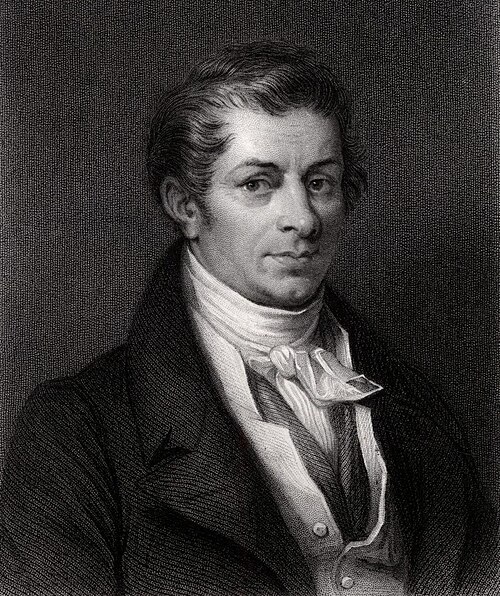
1767–1832 · French
Jean-Baptiste Say
Say's Law - you buy things with things: producing something people want is what gives you the power to demand.
The idea in one paragraph
How do you afford anything? By making something first. A baker demands shoes with bread; a farmer demands hats with wheat; money just carries value from one sale to the next. That was Say's point: products are bought with products, so supply and demand aren't opponents - every act of production creates purchasing power somewhere. It follows, he argued, that an economy can't suffer a lasting glut of everything: too many hats really means too little of whatever hatters want to buy. A century later Keynes compressed all this into "supply creates its own demand," made it his villain, and built modern macroeconomics against it. Whether Keynes buried Say or misquoted him is still a live fight.
The world they lived in
Jean-Baptiste Say was born in Lyon in 1767 to a Protestant merchant family, apprenticed in business, and worked briefly in England while its cotton mills were roaring to life. Back in Paris he read The Wealth of Nations and it hit him like a conversion. When the French Revolution came, Say was the commercial republican in the room - editing a leading reform journal and preaching that France's future lay in workshops and trade, not courts and conquest.
Napoleon disagreed. Appointed to the Tribunate, Say published his Traité d'économie politique in 1803 - clear, organized, and firmly free-trade. Napoleon, who wanted an economist to bless his tariffs and war finance, summoned him and demanded revisions. Say refused, lost his post, and the Traité was blocked from reprinting. So he did something almost no economist has done before or since: he went off and ran a cotton-spinning mill, quite successfully, for a decade. Theory tested against payroll. After Napoleon fell, Say returned to Paris, held France's first professorship of political economy, and watched Britain's postwar slump of 1815–19 ignite the "general glut" debate - with himself on one side and Thomas Malthus on the other.
What they argued
Start where Say started: a village market. The farmer wants the hatter's hat; the hatter wants the farmer's wheat. Money passes between them, but money is "only the medium" - a cart that carries value from one exchange to the next. What actually pays for the hat is the wheat. Scale that up and you get Say's famous "law of markets": a product, once created, opens a market for other products to the full extent of its own value. Good harvests make farmers into good customers; a booming town buys more than a ruined one. If you want more demand in an economy, don't wish for it - produce more things people actually want.
From this he drew a bold conclusion: there can be no general glut, no lasting situation where everything goes unsold at once. Partial gluts, absolutely - warehouses in 1815 were stuffed with goods Europe couldn't buy. But a glut here always pairs with a shortage there: too much of one thing means too little of something else, and falling prices in the glutted trade plus profits in the starved one steer producers across. The fix for a slump is adjustment, not more spending. One caution: the slogan "supply creates its own demand" appears nowhere in Say. The phrasing is closer to James Mill, and it was Keynes who pinned it on Say - a paraphrase sharp enough to argue with and simple enough to lose the qualifications.
Say's second great contribution was a person, not a proposition: the entrepreneur. The word existed in French, but Say gave it its modern job description - the one who combines land, labor, and capital, buying inputs at known prices and selling output at unknown ones, pocketing profit or eating loss. English classical economics, oddly, had no such character; Ricardo's world runs on landlords, workers, and capitalists, with nobody actually steering. Say put judgment and risk-bearing at the center of production.
He also quietly loosened one of classical economics' worst screws. Where Smith and Ricardo tied value to the labor a good contained, Say tied it to utility - a thing is worth what it's worth because people find it useful, and costs chase value rather than creating it. It was a step away from the labor theory of value and toward the subjective-value revolution of the 1870s. And through it all he was the great popularizer: the Traité was translated across Europe and became the standard economics textbook in the United States for decades. Much of the world learned its Adam Smith from Jean-Baptiste Say - reorganized, clarified, and considerably better written.
Where it breaks down
The Great Depression looked like the thing Say said couldn't persist: a decade of unsold goods, idle factories, and idle workers, everywhere at once. John Maynard Keynes made Say the villain of The General Theory (1936), arguing that the law fails because money isn't just a cart. In frightening times, people and firms want to hold money rather than spend or invest it - and a desire to hoard is demand for nothing that employs anyone. Production then no longer guarantees purchasing: aggregate demand can fall short across the whole economy, and a recession can feed on itself instead of self-correcting. On Keynes's reading, classical economics had assumed away the very possibility of the 1930s.
Say's defenders answer that Keynes demolished the slogan, not the argument. A "general glut of goods," they say, is really an excess demand for money - the shortage Say's logic predicts has simply moved into the money market - so the cure is monetary repair, not permanent deficit spending. Economists in this tradition - W. H. Hutt, Robert Clower, Axel Leijonhufvud, and more combatively Steven Kates - note that Say acknowledged crises, wrestling honestly with the post-1815 slump in his Letters to Mr. Malthus. How badly Keynes misread Say - and whether the repair job rescues the law or retires it - remains genuinely contested among economists and historians of thought.
What's less contested is that Say was too serene about the short run. Adjustment takes time, wages and prices are sticky, and "a partial glut plus a shortage elsewhere" is cold comfort to the town whose mill just closed. The law describes where economies head, not how painlessly they get there.
Lasting influence
Say's clarity became a French tradition. Frédéric Bastiat inherited his free-trade convictions and his gift for the killer example, and Say's textbook style - definitions, principles, everyday illustrations - set the template for how economics would be taught for a century.
His entrepreneur had the longest afterlife of all. Schumpeter crowned the figure as capitalism's engine of innovation, Ludwig von Mises and the Austrians made entrepreneurial judgment the heart of how markets work, and every startup pitch deck is, in spirit, a footnote to Say. His utility-based theory of value ripened into the marginal revolution. And Say's Law never left the arena: it stands behind every "supply-side" argument that growth comes from producing more, while Keynes's attack on it stands behind every stimulus package. Politicians arguing over red tape versus relief checks are re-running a debate between a French mill owner and an English don - one of whom had been dead a hundred years when the fight officially started.