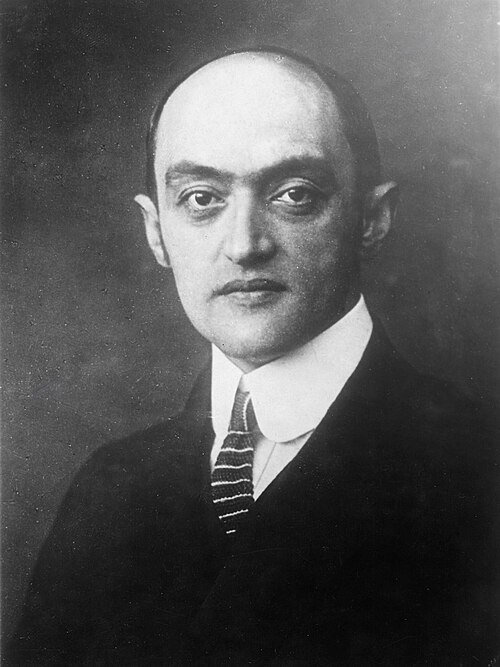
1883–1950 · Austrian-American
Joseph Schumpeter
Creative destruction - capitalism grows by ripping out the old to build the new.
The idea in one paragraph
Think about what the car did to the village blacksmith, or what streaming did to the video store. Nobody beat them at their own game - the game itself was scrapped. Schumpeter called this creative destruction: capitalism grows not mainly through firms politely undercutting each other's prices, but through entrepreneurs launching new products and methods that make whole industries obsolete. That gale is where rising living standards come from - and it's also why capitalism never feels safe, settled, or fair. His darkest twist: capitalism's very success, he predicted, would mass-produce the comfortable critics who talk it to death.
The world they lived in
Joseph Schumpeter was born in 1883 in Moravia, then part of the Austro-Hungarian Empire - the year Marx died, and the year Keynes was born, a coincidence he never quite forgave history for arranging. He studied law and economics in Vienna in the famous seminar of Eugen von Böhm-Bawerk, alongside Ludwig von Mises, and was a prodigy with a prodigy's vanity: he liked to tell people he had set out to become the greatest economist, horseman, and lover in Vienna, and admitted things had not gone well with the horses. Real life was rougher than the joke. He served briefly and disastrously as Austria's finance minister in 1919 amid postwar chaos, then ran a Viennese bank that collapsed in 1924, leaving him years of debts to pay off.
He rebuilt his career as a scholar - Bonn from 1925, then Harvard from 1932 - just as the Great Depression handed the spotlight to his exact contemporary, John Maynard Keynes. Schumpeter watched the profession swoon for the General Theory with barely concealed exasperation; he thought Keynes had turned a temporary emergency into a permanent theory. His own masterwork, Capitalism, Socialism and Democracy (1942), asked bigger and darker questions. Though trained by Austrians, he outgrew every label - he revered Léon Walras, took Karl Marx more seriously than most of Marx's enemies did, and belonged, by his own reckoning, to no school at all. He died in Connecticut in 1950.
What they argued
Start with an economy running on autopilot: every year the same goods, made the same way, sold at the same prices. Schumpeter called this the "circular flow," and he pointed out something odd - in that world of perfect routine and equilibrium, there is no real profit. Everything earns just enough to keep going. Profit only appears when somebody breaks the routine. That somebody is the entrepreneur, and Schumpeter defined the job precisely: not the inventor, not the investor, but the person who carries a "new combination" into practice - a new product, a new production method, a new market, a new source of supply, or a new way of organizing an industry. Invention is an idea; innovation is an idea made to pay. The entrepreneur, funded by bank credit, is the character who does it.
Innovation is where his most famous idea comes in. The competition that matters, Schumpeter argued, is not five bakeries shaving pennies off the price of bread. It's the competition from the thing that makes your product irrelevant - the car that ruins the blacksmith, the streaming service that empties the video store, the refrigerator that kills the ice-delivery man. This "perennial gale of creative destruction" is, in his words, the essential fact about capitalism. It also flipped the standard verdict on big firms and monopoly profits. A temporary moat - a patent, a brand, a dominant position - is often the prize that makes the expensive leap worth attempting, and the profits it throws off fund the next leap.
If innovation drives growth, it also drives the business cycle. Innovations don't arrive in a smooth drizzle; they cluster. Railways, electricity, the automobile - each triggered a swarm of imitators, a wave of investment, and a boom. Then the wave is absorbed: the new capacity comes online, weaker firms are shaken out, and the economy digests its progress in a recession. For Schumpeter, downturns weren't malfunctions to be engineered away - they were the sometimes brutal accounting that follows a burst of creation. This is where he and Keynes genuinely collided: where Keynes saw deficient demand needing government rescue, Schumpeter saw an organism metabolizing change, and worried that rescue would keep the deadwood standing.
His strangest argument came last. Capitalism, Socialism and Democracy opens with the question "Can capitalism survive?" and answers: "No. I do not think it can." Not because it fails - because it succeeds. Giant corporations would routinize innovation, turning the swashbuckling entrepreneur into a committee. Capitalism's rational, calculating spirit would dissolve the older loyalties - family, faith, deference - that had quietly held the system up. And above all, prosperity would fund an ever-growing class of intellectuals: educated, articulate, underemployed, and rewarded for eloquent hostility toward the very system that feeds them. Step by democratic step, he predicted, capitalism would vote itself into socialism. He insisted he wasn't cheering: "If a doctor predicts that his patient will die presently," he wrote, "this does not mean that he desires it."
Where it breaks down
His grand theory of cycles fared worst. Business Cycles (1939) stacked three overlapping waves - including a 50-year "Kondratieff" long wave - into one scheme, and the statistician Simon Kuznets, reviewing it, argued the data simply didn't support the machinery. Few economists have defended the three-cycle apparatus since.
His Depression-era policy stance drew fire too. Schumpeter held that recovery is "sound only if it come of itself," which Keynesians - and most macroeconomists since - regard as a counsel of despair that would have prolonged mass unemployment through the 1930s. Even admirers concede Keynes won that argument, at least for deep slumps.
The great prophecy hasn't come true - so far. Capitalism outlived the Soviet Union, and the entrepreneur, far from being routinized out of existence, came roaring back in garages and startups. Defenders reply that Schumpeter's mechanism (cultural self-undermining, the anti-capitalist intellectual) still looks uncomfortably sharp; the timing, not the diagnosis, was off. That remains an open argument. Finally, his suggestion that big, dominant firms are the best innovators - the "Schumpeterian hypothesis" - is contested: economists like Kenneth Arrow argued competition spurs innovation better than monopoly, and decades of empirical work have split the difference.
Lasting influence
Schumpeter lost the 1930s to Keynes and won the century's second half. When growth economists finally built rigorous models of innovation, they built them on him: Philippe Aghion and Peter Howitt's 1992 model of growth through creative destruction earned them the 2025 Nobel Prize, with the committee citing the very phrase Schumpeter coined. Every antitrust debate about whether breaking up a tech giant would help or harm innovation is a Schumpeterian debate. Every business-page use of "disruption" is his idea wearing a lanyard.
He also left a method: taking rivals seriously. His posthumous History of Economic Analysis remains the greatest tour of the discipline ever written by one person. The man who predicted capitalism would be talked to death spent his life proving how much good talking about it could do.