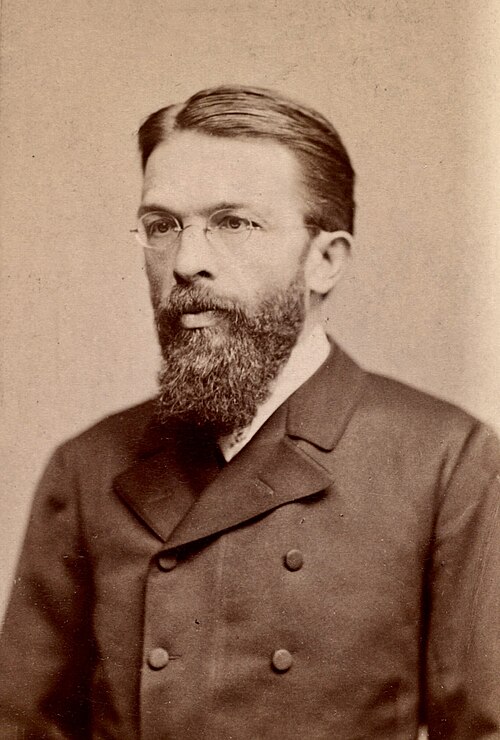
1840–1921 · Austrian
Carl Menger
Subjective value - things are valuable because people want them, not because of the labor in them - and the Austrian school built on it.
The idea in one paragraph
Value isn't a property of things, like weight. It's a judgment made by people. A sack of grain has value because someone believes it will satisfy a need - and how much value depends on which need it actually serves, starting from the least urgent one covered. From that single flip - value lives in the valuer, not the object - Menger rebuilt economics: prices, wages, and even money itself become the unplanned outcomes of millions of personal judgments. He published this in 1871, the same year Jevons reached similar conclusions in England, with Walras close behind in Lausanne - and unlike them, he did it entirely without mathematics. The Austrian school starts here.
The world they lived in
Menger was born in 1840 in Galicia, on the eastern edge of the Austrian Empire, studied law in Vienna and Prague, and drifted into journalism. His beat included market reports - daily write-ups of what was selling in Vienna and at what price. The traders he interviewed explained prices by what buyers wanted, feared, and expected; the classical textbooks explained them by adding up labor and production costs. The stories didn't match, and Menger decided the traders were right. He spent years working out why; in 1871 he published his Grundsätze der Volkswirtschaftslehre - the Principles of Economics.
He was writing into a hostile climate. German-language economics was ruled by the Historical School, which held that universal economic laws were an English fantasy: real scholarship meant accumulating historical and statistical detail, country by country. Menger dedicated the Grundsätze to Wilhelm Roscher, the school's revered elder - a peace offering that failed spectacularly. The book did win him a professorship at Vienna in 1873, and even a stint tutoring Crown Prince Rudolf, heir to the Habsburg throne. Vienna argued about everything in those decades; Menger gave it something new to argue about.
What they argued
Picture yourself on a desert hike with five bottles of water. The first keeps you alive. The second cooks dinner. The third washes your face; the fourth waters the dog; the fifth you're saving to rinse your feet. Now you lose one bottle. Which use do you give up? Not survival - foot-rinsing. So what is one bottle worth to you? Exactly that: the least important need it actually serves. This is marginal utility, reasoned out in plain prose - Menger never used a line of calculus - and it resolves the old puzzle of why life-giving water is cheap while useless diamonds are dear. Value is subjective: it exists "within us," as Menger put it, not inside objects.
From there he rebuilt production. Why is flour valuable? Only because bread is. Why the mill, the millstone, the wheat, the farmland? Same answer, passed backward down the chain. Menger sorted the world into goods of "first order" (bread, things that directly satisfy wants) and goods of "higher order" (flour, mills, land - things valuable only as means to first-order goods). Value flows backward from consumers to factories and farms, not forward from costs to prices. This quietly inverts both Ricardo and Marx: labor doesn't give value to its products - the labor theory of value has it backwards - rather, products people want give value to the labor, land, and capital that make them. A skill is well paid because its output is wanted, not the reverse.
His most celebrated set piece is the origin of money. Barter has a famous flaw: the baker who wants shoes must find a cobbler who wants bread, at the same moment. Menger showed how traders escape the trap without anyone designing an escape: you accept, in exchange, not what you want but what everyone else will accept - the most saleable good around, whether cattle, salt, or silver. Each trader copying the shrewdest neighbors makes that good more saleable still, until one or two commodities snowball into money. "Money," he wrote, "has not been generated by law. In its origin it is a social, and not a state institution." No king required - and, he argued, the same logic explains other institutions nobody invented, from language to law to markets themselves.
Then came the brawl. In 1883 Menger published his Investigations into the Method of the Social Sciences, defending exact economic theory against the Historical School; its leader, Gustav Schmoller, answered with a contemptuous review, and the Methodenstreit - the "battle over method" - was on. Menger's core point: history without theory is blind, because you cannot even decide which facts matter without a framework. Schmoller's faction sneered at the "Austrian school" - the label began as an insult - and the name stuck to one of the most influential movements in modern economics. Menger won on points (Schmoller eventually stopped replying) but lost the institutions: for decades, Historical School men controlled German university appointments and kept Austrians out.
Where it breaks down
Steelman Schmoller for a moment, because he had a point. Economies really are soaked in history, law, and culture, and a theory of universal choice can glide over the institutions that make markets possible at all. Critics from the Historical School onward - including institutionalists like Thorstein Veblen - argued that Menger's timeless, need-ranking individual is itself a historical oddity. Modern economics has partly conceded this: institutional and behavioral research now does some of what Schmoller demanded.
Second, Menger's proud refusal of mathematics cut both ways. The mainstream absorbed his subjectivism but built it in the mathematical style of Jevons and Walras; the Austrian insistence that formal models and statistical testing miss the point has left the school outside the professional mainstream ever since. Whether that is Austrian stubbornness or mainstream physics-envy remains a live, contested dispute - but the cost in influence was real.
Finally, the money story is contested on the evidence. Anthropologists and historians - David Graeber most prominently - argue that early money often emerged from temples, debt records, and state tax demands rather than from barter, which is strikingly rare in the historical record. Menger's account may explain how money can arise, and how commodity monies like cigarettes in POW camps do arise, without being the way most money actually did.
Lasting influence
Menger's direct output was small - he resigned his chair in 1903 to perfect a grand revision of the Grundsätze and, in the way of perfectionists, died in 1921 without publishing it. His school did the rest. Böhm-Bawerk and Wieser turned his ideas into a system; a generation later Ludwig von Mises used Mengerian logic to argue that central planning couldn't calculate, and Friedrich Hayek generalized the origin-of-money story into a whole theory of spontaneous order - institutions that are, in words Hayek loved, the result of human action but not of human design.
The quieter legacy is bigger. Every introductory textbook now teaches value the way Menger did - wants first, costs derived - usually without mentioning him. And whenever you hear that some order in society emerged rather than being decreed - a currency, a customary law, a language - you are hearing the market reporter from Galicia who noticed that the traders understood prices better than the textbooks did.