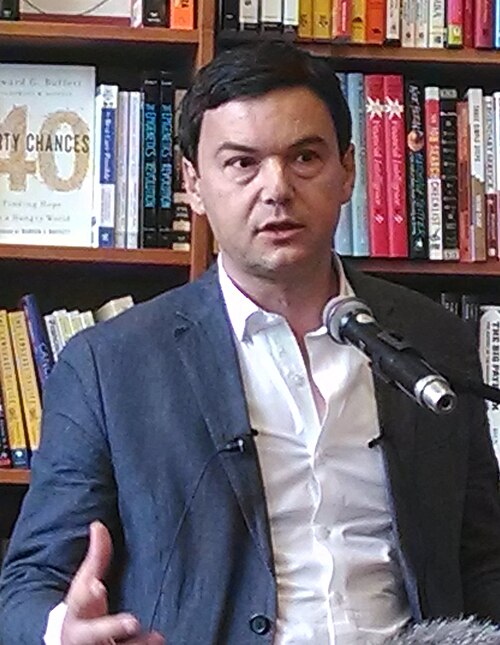
1971–present · French
Thomas Piketty
r > g - when returns on wealth outpace economic growth, inherited fortunes compound faster than anything you can earn.
The idea in one paragraph
In 2014, a 700-page economics book stuffed with tax tables became a global number-one bestseller. Thomas Piketty's Capital in the Twenty-First Century had one deceptively simple formula at its heart: r > g. When the return on wealth (r) - rents, dividends, capital gains - outruns the economy's growth (g), old fortunes compound faster than wages rise: left alone, wealth concentrates, and the past devours the future. Piketty backed this with two centuries of tax records from twenty countries, showing inequality falling through the mid-1900s and climbing again since 1980. His conclusion: extreme inequality isn't a law of nature - it's a policy choice.
The world they lived in
Piketty was born in 1971 in the Paris suburbs, to parents who had manned the barricades of May 1968 and later raised goats. A mathematical prodigy - doctorate at 22, snapped up by MIT - he lasted barely two years in America before going home, unimpressed. Economists, he complained, were proving elegant theorems about inequality without measuring it - a "childish passion for mathematics" crowding out the historian's dirty work of counting. A trip to the crumbling Soviet bloc in 1990 had vaccinated him against the communist answer. Starting with French estate records back to the Revolution, then mining tax filings worldwide with Anthony Atkinson and Emmanuel Saez, he built the longest inequality series ever assembled - work that grew into the World Inequality Database.
The timing did the rest. Since around 1980, top income shares in the English-speaking world had been climbing steeply, but the profession's center of gravity said don't look: Robert Lucas had written in 2004 that of all tendencies harmful to sound economics, "the most poisonous" was to focus on questions of distribution. Then came the 2008 crash, bailouts alongside foreclosures, and Occupy Wall Street's "we are the 99%" - a slogan in search of a dataset. When Piketty's book appeared (French 2013, English 2014), it sold some 2.5 million copies and made a shy archive-digger the unlikeliest celebrity economics had produced since John Maynard Keynes.
What they argued
Start with the shape of the data. Plot the share of wealth held by the top 10% in Europe or America over two centuries and you get a giant U. On the left, the Belle Époque before 1914, when the richest tenth owned around 90% of the wealth - a world where, as Piketty shows through Balzac and Jane Austen, marrying an heiress paid several times better than any career. Then the U plunges: two world wars, the Depression, and the policies that followed destroyed or taxed away great fortunes, leaving the rich world of the 1950s–70s more equal than it had ever been. Since 1980, the curve turns up again - steeply in the US, more gently in Europe.
Why? Here is r > g in plain clothes. Suppose the economy - everyone's wages, roughly - grows at 1–2% a year, while wealth, parked in property and shares, quietly returns 4–5% after inflation. A family that already has a fortune, saving even part of those returns, sees its wealth grow faster than the salaries of everyone beneath it - mechanically, with nobody doing anything wrong - and inheritance compounds it across generations. Piketty's claim is that r has exceeded g through most of history - the mid-century compression was the freak, born of war and policy, not a new normal. Absent such shocks, we drift back toward what he calls patrimonial capitalism, where your standing depends on what you inherit, not what you earn.
His prescription follows from the diagnosis: if wealth compounds itself, tax the compounding. Piketty's signature proposal is a global annual progressive tax on net wealth, rising with fortune size - global because capital hops borders faster than tax collectors. He admits the idea is "utopian" and offers it as a direction, along with steeper inheritance taxes and top income rates; he likes reminding Americans that they invented near-90% top rates in the 1940s–60s, decades of excellent growth. (You can see where today's countries actually sit in our tax explorer.)
About that title: the nod to Karl Marx is deliberate mischief, but Piketty insists the debt is loose - he has said he "never managed really to read" Das Kapital, and his book, he says, is built on data rather than prophecy. He predicts no inevitable collapse and wants no abolition of markets, which he calls efficient at producing wealth. He resists school labels; the fairest is the oldest - political economist, asking with spreadsheets the question of who gets what that David Ricardo asked about landlords two centuries ago.
Where it breaks down
The mechanics of r > g drew immediate fire. Matthew Rognlie, then an MIT graduate student, reworked Piketty's own numbers and found that the modern rise in capital's share of income is almost entirely housing - scarce urban land inflated by zoning, not machines and factories accumulating. If so, the remedy looks less like a global wealth tax and more like building more homes. Lawrence Summers adds that returns to capital diminish faster than the doom loop requires. Contested on both sides.
Daron Acemoglu and James Robinson aimed at the method: history, they argue, shows no "general laws of capitalism." Sweden and South Africa both had r > g, yet produced radically different inequality - because institutions and politics, not arithmetic, decide who gets what. Piketty half-agrees (his later Capital and Ideology is a thousand-page concession that politics drives everything), which critics read as quietly retiring the formula.
The U-curve's right side is under audit too. Gerald Auten and David Splinter, reworking the same tax data, find the top 1%'s after-tax income share has barely risen since the 1960s once you account for changing tax rules and government transfers - versus the sharp rise Piketty, Saez, and Gabriel Zucman report. The camps have traded rebuttals for years; the honest summary: the size of the US increase - though not the direction of pre-tax trends - is genuinely contested. This site leans market-friendly on much of this evidence; even so, Piketty's critics are, almost without exception, arguing inside a data landscape he built.
Lasting influence
Whatever happens to r > g, Piketty moved the question. Before him, inequality was a footnote in mainstream economics; after him, it is a field - with the World Inequality Database as its shared infrastructure, feeding statistics the OECD, IMF, and newsrooms now cite routinely. "The 1%" went from protest chant to measurable object.
Policy felt it quickly. The wealth-tax proposals in the 2020 US presidential campaign were drafted with his collaborators Saez and Zucman; inheritance and top-rate debates worldwide cite his numbers; even the global minimum corporate tax echoes his insistence that capital taxation must cross borders to work. He helped rehabilitate economic history as a core tool and licensed a generation of economists to write plainly for the public. His critics measure against his data, his supporters march with his charts - habits the economics of 1990, which considered distribution a poisonous distraction, would have found very strange. Few economists get to change what their field argues about. Piketty did it with tax returns.