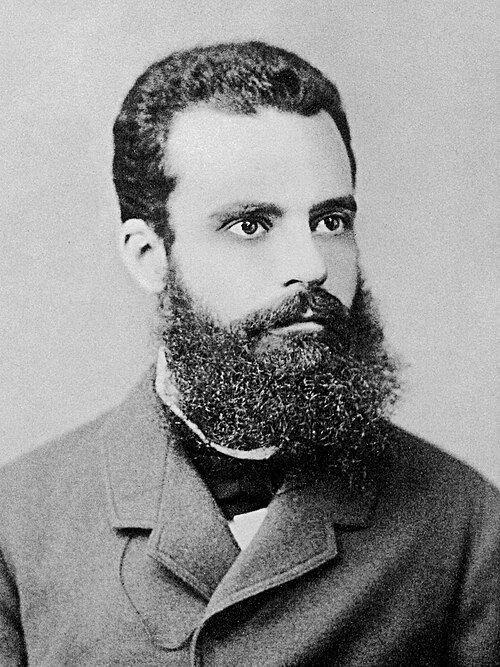
1848–1923 · Italian
Vilfredo Pareto
Pareto efficiency - an arrangement you can't improve for anyone without hurting someone else - and the lopsided 80/20 shape of wealth.
The idea in one paragraph
You've packed two sandwiches and no drink; your friend has two drinks and no sandwich. Swap, and both of you are better off - nobody worse. Keep trading until no swap can help one of you without hurting the other, and you've reached Pareto efficiency: the point where all the free wins are used up. It's the quiet standard behind most judgments economists make about markets and policy. Pareto also noticed that wealth everywhere piles up in the same lopsided way - a small slice of people holding most of it - and, late in life, abandoned economics for a darker question: why the people at the top always seem to stay there.
The world they lived in
Pareto's whole life had a whiff of the barricades. He was born in Paris in 1848 - the year revolutions swept Europe - to a French mother and an exiled Italian marquis. The family returned to Italy, where Vilfredo trained as an engineer in Turin, writing his thesis on equilibrium in solid bodies; he would spend the rest of his career hunting for equilibrium in societies instead. For two decades he managed railways and ironworks while fighting a furious losing battle in the press for free trade against Italy's protectionist, patronage-soaked governments. He ran for parliament; the machine beat him. The experience left a lifelong suspicion that fine political principles usually decorate someone's private interest.
At forty-one he discovered the mathematical economics of Léon Walras, and in 1893 he succeeded Walras in the chair at Lausanne - the engineer completing the system the visionary had sketched. It was the high noon of the marginal revolution, and also of rising socialism: Pareto wrote a two-volume critique of socialist systems, arguing against Karl Marx that collectivism would merely install a new ruling class. As liberal Italy lurched from scandal to scandal, his hopes for reform curdled. He withdrew to a villa on Lake Geneva with a celebrated crowd of Angora cats, and turned from prices to power.
What they argued
Scale the sandwich swap up: a school cafeteria where everyone's lunchbox is slightly wrong for them, trading until every mutually agreeable swap is done. At that point you cannot rearrange things to make one student better off without making another worse off. That is Pareto efficiency. Notice what it does not say: nothing about fairness. If one student arrived with ten lunchboxes and another with none, trading to efficiency won't fix that. Pareto built the standard deliberately narrow - a judgment you could make without comparing one person's happiness to another's, which he considered scientifically impossible. Modesty was the point.
That modesty came from his second great move. Economists since Jevons had talked as if pleasure came in measurable units - as if pizza gives you 8 "utils" and soup 5. Pareto showed the units were unnecessary. All economics needs is rankings: you'd pick pizza over soup, and that's that. From rankings he drew indifference curves - maps of the combinations of goods (some coffee and three croissants, more coffee and two) that leave you equally content - and rebuilt the theory of demand on them. Ordinal utility, this is called, and it freed economics from pretending to measure happiness. It remains the foundation of consumer theory today.
Then there was the pattern in the data. Plotting income distributions - England, Prussia, Saxony, Italian cities, even Peru - Pareto found the same steep, skewed curve again and again: a small fraction of households holding the great bulk of income, in the neighborhood of the "80/20" split later named after him. He concluded he had found something close to a social law: inequality was a stubborn regularity, not an accident of policy, and growth would do more for the poor than redistribution. The universal claim was contested then and still is - though the fat-tailed shape of the curve itself has proved remarkably durable.
Why do the few always sit on top? His answer became sociology. In The Mind and Society (1916), Pareto argued that people mostly act on sentiment and instinct - "residues" - and then invent respectable reasons, "derivations," afterwards. Politics, in this view, is rival elites dressing up their interests: cunning "foxes" ruling by manoeuvre, forceful "lions" ruling by strength, endlessly replacing one another in a circulation of elites. History, he wrote, is "a graveyard of aristocracies." Democracy, the aging Pareto argued with deepening pessimism, was not rule by the people but rule by a political class with better slogans.
Where it breaks down
Start with the standard critique, put best by Amartya Sen: Pareto efficiency is silent about distribution. A society where one person owns everything and everyone else is starving can be Pareto efficient - feeding the starving would make the owner worse off, so no free win exists. As Sen wrote, a society "can be Pareto optimal and still be perfectly disgusting." That's not a gotcha; Pareto designed the tool to be narrow. The trouble comes when economists treat the floor as the whole house, reading "efficient" as "good" and smuggling a value judgment inside a technical word. Efficiency says no crumbs are left on the table. It says nothing about who got pie.
The 80/20 "law" also overreached. Income distributions share a family resemblance, but they are not fixed by nature: the twentieth century's wars, taxes, and welfare states compressed inequality dramatically for decades - which a true iron law shouldn't permit. Economists today treat Pareto's curve as a striking regularity, not a constant of physics.
Then the awkward part. Pareto died in August 1923, ten months after Mussolini marched on Rome - and the Fascists loudly claimed him, citing his elite theory and honoring him with a Senate nomination (never completed; by some accounts he declined it). Some of his last writings welcomed the restoration of order; he also publicly urged the new regime to preserve press freedom and academic liberty. How far the old cynic would have followed Mussolini into full dictatorship - consolidated only after his death - is disputed among historians, and honest accounts leave it disputed. What is certain is that a theory holding all regimes to be masked oligarchies made unusually comfortable reading for people busy building one.
Lasting influence
Modern welfare economics is built on Pareto's floor. The field's crown-jewel result - the First Welfare Theorem, showing that competitive markets produce Pareto-efficient outcomes - is Adam Smith's invisible hand restated with Pareto's rigor, and every cost-benefit analysis in every ministry quietly asks his question: can anyone be made better off without hurting someone? His indifference curves fill every intermediate microeconomics course, sitting beside Alfred Marshall's scissors in the standard toolkit.
His name escaped economics entirely. The management writer Joseph Juran rebranded the 80/20 pattern as the "Pareto principle," now a staple of everything from software bug triage to sales strategy; quality engineers still draw "Pareto charts." Inequality researchers describe the rich end of wealth distributions with "Pareto tails." And his circulation of elites flowed into political sociology and every argument, left or right, that the game is run by insiders for insiders. Not bad for a retired engineer who concluded, surrounded by his cats, that humans are rationalizing animals rather than rational ones - and built the coldest, cleanest tools in economics anyway.